France and Greece have used President Emmanuel Macron’s visit to Athens to place European mutual defence, defence-industrial cooperation and NATO burden-sharing at the centre of a renewed bilateral partnership.
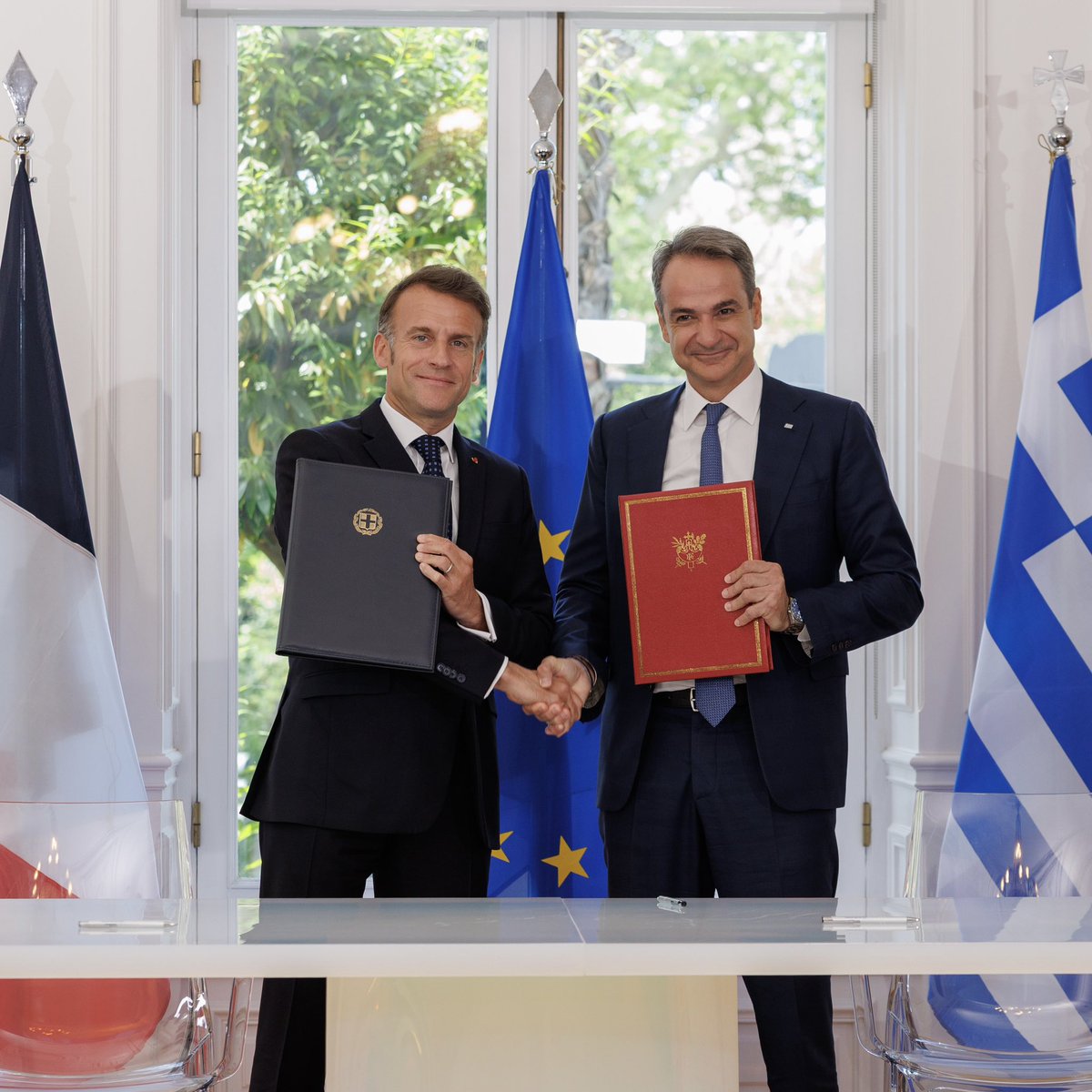
Macron met Greek Prime Minister Kyriakos Mitsotakis at the Maximos Mansion on 25 April, with both leaders presenting the Franco-Greek relationship as a model for wider European defence cooperation. The visit came as Paris and Athens moved to renew their 2021 strategic partnership on defence and security, an agreement that already includes a mutual assistance clause and has been tied to major Greek purchases of French-built Rafale fighter aircraft and frigates.
The political message from Athens was that European defence should become more practical, better funded and more coordinated, while remaining compatible with NATO. Mitsotakis said France and Greece had been “at the forefront” of the debate on strategic autonomy and described the 2021 defence agreement as an early example of what European cooperation “at scale” could mean. He also said the agreement would be renewed, placing the bilateral relationship within a wider discussion about Europe’s ability to respond to strategic pressure.
Macron framed the partnership as comprehensive rather than narrowly military. In his remarks at the start of the meeting, he said the relationship covered defence and security, but also energy, the economy, culture and innovation. That broader framing matters because both governments are linking security policy to Europe’s industrial base, competitiveness and energy costs.
The most significant element was the renewed focus on Article 42.7 of the Treaty on European Union, the bloc’s mutual assistance clause. Mitsotakis argued during a public discussion in Athens that Europe should take the clause more seriously, including by considering exercises and practical planning for cases in which support may be offered to an EU member state under threat.
His remarks pointed to a gap in European defence policy. NATO’s Article 5 is supported by an established military command structure, standing planning mechanisms and decades of collective-defence practice. Article 42.7 has a different legal and institutional character. It is a treaty obligation between EU member states, but it has not developed the same operational machinery. The question raised in Athens was whether Europe now needs to give that clause more practical meaning.
Macron also placed the clause at the centre of his message. During the Athens visit, he said the EU mutual assistance provision was unambiguous and that European efforts to strengthen defence were not intended to replace NATO. That distinction is important for both France and Greece. Paris has long argued for a stronger European defence capacity, while Athens remains closely tied to NATO planning and to the United States through its wider security relationships.
The debate is no longer abstract. Russia’s war against Ukraine, instability in the Middle East, maritime-security pressures in the Red Sea and Eastern Mediterranean, and uncertainty over long-term US strategic priorities have all increased pressure on European governments to spend more and coordinate better. For Greece, the issue is also shaped by its position in the Eastern Mediterranean and by its role as a maritime state with direct interest in freedom of navigation.
Mitsotakis connected defence policy to industrial policy. He said Europe needed to spend more, spend more intelligently, achieve scale, and encourage defence start-ups. He also referred to the need for European countries to streamline procurement and standards, using fighter aircraft and shipbuilding as examples. Greece has made large defence purchases from France in recent years, including Rafale jets and Belharra-type frigates, but Athens is also seeking greater participation by Greek industry.
That point is central to the wider European debate. Higher defence spending alone does not automatically produce stronger capability if procurement remains fragmented across national systems. Europe continues to face duplication, long production timelines and limited interoperability in several capability areas. The Athens discussion therefore fits into a broader push for more common purchasing, stronger industrial capacity and greater emphasis on European-made systems.
The Franco-Greek partnership is not a substitute for EU-wide policy. It is a bilateral framework between two states with overlapping but not identical security priorities. However, it gives both governments a practical example to cite when arguing for a more active European defence pillar. It also shows how procurement, mutual assistance and political signalling can be combined in a single strategic relationship.
For NATO, the implications are mixed but not necessarily contradictory. A more capable European defence sector could strengthen the European pillar of the alliance, particularly if it delivers usable military capacity. At the same time, the EU’s own mutual assistance clause raises questions about planning, command arrangements, and how European responses would be organised in a crisis affecting an EU member state that is not covered in the same way by NATO structures.
The Athens visit therefore gave renewed visibility to an issue that has often remained at the level of treaty language. France and Greece are now presenting mutual defence not only as a political commitment, but as an area requiring planning, exercises and industrial backing. Whether other EU capitals adopt the same approach will determine whether Article 42.7 remains a declaratory clause or becomes part of Europe’s practical security architecture.
EU Leaders Seek Practical Blueprint for Mutual Defence Clause