EU leaders have opened a more practical discussion on how the European Union’s mutual defence clause would be used in a real crisis, moving a rarely invoked treaty provision into the centre of current security planning.
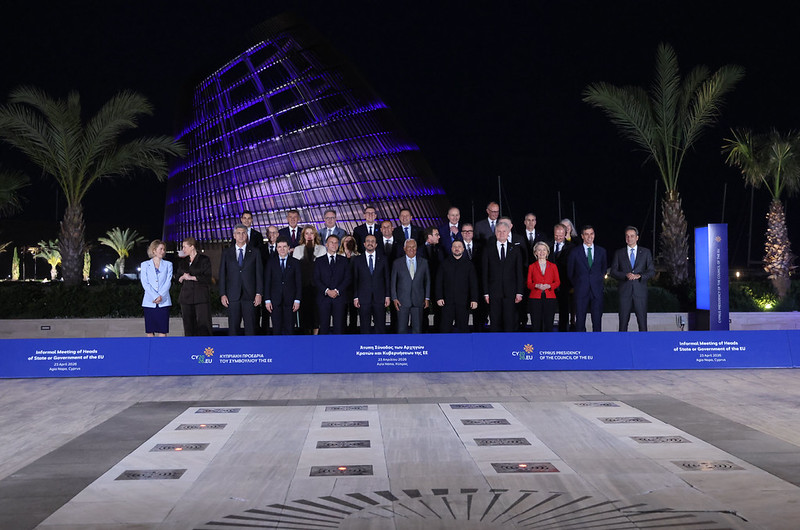
At the informal meeting of heads of state or government in Cyprus on 23 and 24 April, leaders discussed Article 42(7) of the Treaty on European Union, which requires member states to provide aid and assistance if another member state is the victim of armed aggression on its territory. The discussion was not framed as a substitute for NATO. It was instead presented as part of a wider effort to clarify what Europe can do, through its own institutions and national capabilities, if a member state is attacked.
The European Council’s summary of the Cyprus meeting said leaders focused on how the clause “can be used in practice”, while the EU High Representative updated them on ongoing work. That formulation is significant. Article 42(7) has existed since the Lisbon Treaty entered into force, but it has never developed the same operational clarity as NATO’s Article 5.
The question now being addressed is practical rather than theoretical. If a member state invoked the clause, what would other capitals be expected to provide? How would military, diplomatic, cyber, intelligence, logistics and civil-protection assistance be coordinated? Which EU bodies would be involved? How would the EU avoid duplication with NATO structures where both organisations are relevant?
In his remarks after the summit, European Council President António Costa said the Union had discussed its readiness to respond to the current geopolitical and security environment. He said that included defining more precisely how the mutual assistance clause could be used in practice. The meeting took place against a wider agenda covering Ukraine, the Middle East, energy security and the next long-term EU budget.
The choice of Cyprus as host gave the discussion additional relevance. Cyprus is an EU member state but not a member of NATO. For countries outside the Alliance, Article 42(7) is not a secondary legal clause but the EU’s principal mutual-assistance guarantee. For NATO members, it raises a different question: how EU obligations would sit alongside Article 5 commitments in a crisis involving conventional attack, hybrid operations, cyber incidents or attacks on critical infrastructure.
The clause itself is broad. It obliges member states to provide aid and assistance “by all the means in their power”, while also stating that this does not prejudice the specific character of the security and defence policy of certain member states. It further says commitments under the clause must be consistent with NATO obligations for those states that are members of the Alliance. That wording preserves national differences, including neutrality or non-alignment traditions, but it also leaves operational questions open.
France remains the only EU member state to have invoked Article 42(7), following the terrorist attacks in Paris in November 2015. That precedent showed that the clause could be activated politically, but it did not create a standing EU command mechanism for collective defence. Assistance was handled largely through bilateral support rather than through a fully developed EU procedure.
The current discussion suggests that EU capitals now want greater predictability. That does not necessarily mean creating a European equivalent of NATO’s military command structure. It could instead mean agreed scenarios, contact points, planning assumptions, exercises and decision-making channels so that the clause can be applied quickly if needed.
For defence planners, this matters because modern attacks may fall below the threshold of a traditional invasion while still producing serious security consequences. Drone incursions, cyber attacks, sabotage of energy infrastructure, disruption of ports and strikes on military logistics could all force governments to decide whether an incident is primarily national, NATO-related, EU-related or a combination of all three.
The EU has tools that NATO does not possess in the same form. These include sanctions, regulatory powers, civil-protection mechanisms, financial instruments, border measures, energy-market coordination and internal-security cooperation. NATO retains the central role in collective military defence for its members. The practical issue is how these instruments would be sequenced and coordinated during a crisis.
The timing also reflects a wider shift in European defence policy. Russia’s war against Ukraine has pushed EU states to increase defence spending, expand ammunition production, invest in air defence and reassess the vulnerability of critical infrastructure. Instability in the Middle East has added further pressure through energy security, maritime risk and the protection of European citizens and assets abroad.
The Cyprus summit did not produce a public operational plan. Nor did it define which types of attack would automatically trigger Article 42(7). The importance of the meeting lies in the fact that EU leaders are now treating the clause as something that requires advance planning, rather than a dormant treaty safeguard.