

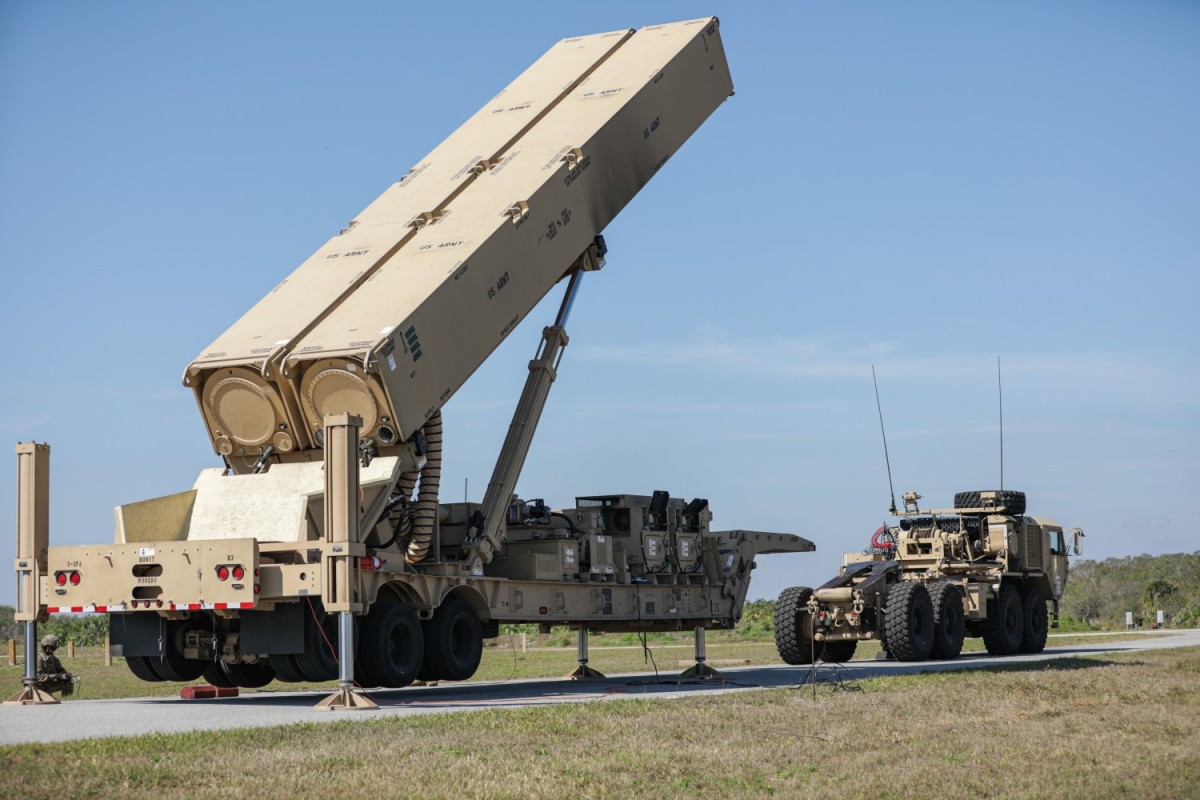
US Central Command has requested the deployment of the Army’s Dark Eagle hypersonic missile system to the Middle East for possible use against Iran, according to Bloomberg. The request, if approved by the Pentagon, would mark the first operational deployment of the weapon, which has been developed as one of the United States’ principal long-range conventional strike systems.
The reported request reflects concern within the US military that Iran has moved some ballistic missile launchers beyond the reach of existing American strike assets in the region. Bloomberg reported that CENTCOM is seeking a system capable of hitting launchers deep inside Iranian territory, beyond the range of the Precision Strike Missile currently available to US forces.
Dark Eagle, formally known as the Long-Range Hypersonic Weapon, or LRHW, is a ground-launched missile system developed for the US Army. According to a Congressional Research Service report reproduced by the US Naval Institute, the system consists of a missile equipped with a hypersonic glide body, supported by transport, launch, fire control and associated equipment.
The missile has a reported range of about 1,725 miles, or roughly 2,775 kilometres. It is designed to travel at hypersonic speed, usually defined as above Mach 5, and to manoeuvre during flight, making interception more difficult than with many conventional ballistic or cruise missiles.
Such a capability would allow the United States to hold at risk targets that are mobile, time-sensitive or located inside defended territory. In the Iranian context, the focus would appear to be ballistic missile launchers that Tehran has moved farther inland in response to earlier US strike options.
The possible deployment comes despite a ceasefire between the United States and Iran that has been in place since early April. The move does not mean that renewed strikes are imminent, but it indicates that US military planners are preparing options should President Donald Trump authorise further military action. Bloomberg reported that CENTCOM’s request has not yet been approved.
The Dark Eagle programme has had a difficult development history. The weapon was originally expected to enter service earlier, but testing delays and technical setbacks pushed the programme behind schedule. The Pentagon announced in December 2024 that the Army and Navy had successfully tested a conventional hypersonic missile from Cape Canaveral, describing the event as an important step for the jointly developed capability.
The system remains scarce. Bloomberg reported that the United States has no more than eight Dark Eagle missiles available and that each missile costs about $15 million. The same report said the overall cost of a battery is estimated at about $2.7 billion.
That limited inventory gives the decision strategic weight. Deploying Dark Eagle to the Middle East would involve moving a high-value and still maturing capability into an active theatre. It would also expose the system to the operational demands of a regional conflict before it has been widely fielded across the US Army.
The request also has broader implications for Washington’s competition with Russia and China. Both countries have already fielded hypersonic weapons, while the United States has been under pressure to demonstrate progress in its own programmes. A first deployment against Iran would therefore be watched not only in Tehran, but also in Moscow and Beijing.
For Iran, the reported US request points to a continuing vulnerability in its missile posture. Tehran’s ballistic missile force is central to its deterrence strategy and to its capacity to threaten US bases, Gulf states and Israel. If the United States can strike launchers positioned deeper inside Iran, it could weaken one of Tehran’s principal means of retaliation.
For Washington, however, the risks are considerable. The use of a hypersonic missile against Iranian targets would represent a significant escalation in the type of conventional weaponry used in the conflict. It could also raise questions in Congress over cost, readiness and the use of a system that has not yet been declared fully operational.
The reported request should therefore be read as contingency planning rather than a confirmed decision to strike. Even so, it shows that the United States is considering the use of weapons designed for high-intensity conflict against a regional adversary. That shift underlines the scale of concern over Iran’s ballistic missile capability and the extent to which the conflict has drawn in systems previously associated with major-power deterrence.


Britain’s Consistent Message on Ukraine Carries Growing Weight at the OSCE