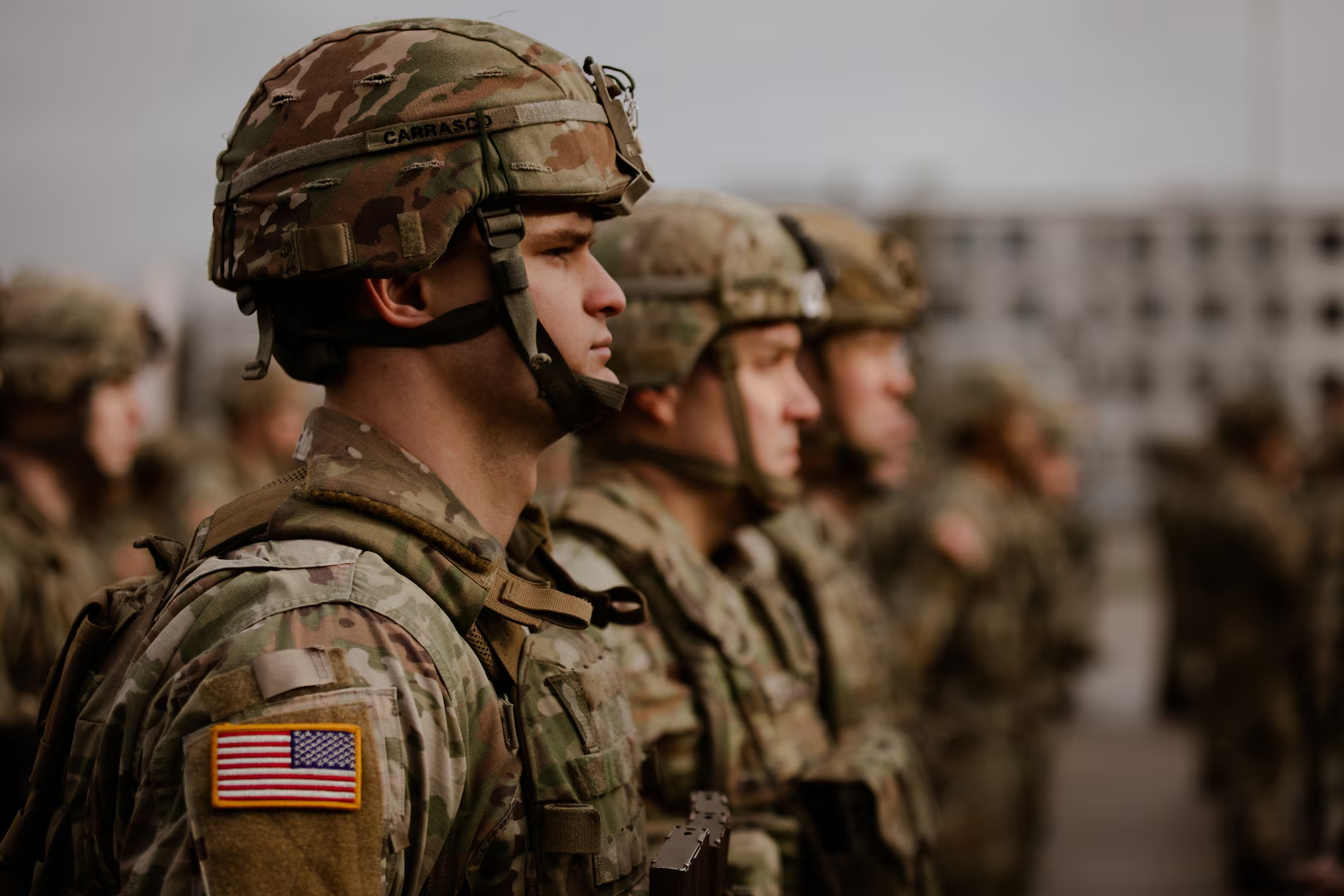
The Pentagon’s confirmation that the United States will withdraw around 5,000 troops from Germany marks more than a bilateral dispute between Washington and Berlin. It is a political signal with strategic consequences. The drawdown is expected to take place over six to twelve months and follows public criticism by German Chancellor Friedrich Merz of President Donald Trump’s handling of the war with Iran. Germany currently hosts roughly 35,000 to 36,000 US troops, making it the principal American military hub in Europe.
The immediate explanation is a clash of personalities and policy. Merz questioned the effectiveness of Washington’s approach to Iran; Trump responded by moving against one of the most visible symbols of American commitment to European security. Yet to read the decision only as retaliation would understate its importance. The withdrawal fits a wider pattern in Trump’s second term: a transactional view of alliances, scepticism towards NATO’s European members, and a willingness to use American force posture as a tool of political pressure.
For Europe, the question is not simply whether 5,000 troops can be replaced. In numerical terms, the withdrawal is limited. One brigade does not determine the entire balance of power on the continent. However, the concern is that this may be only the first step rather than the final one, with further reductions in the American military presence in Europe still possible. European states are already increasing defence spending, rebuilding ammunition production, and debating larger armed forces. Germany itself has shifted its defence debate since Russia’s full-scale invasion of Ukraine in February 2022. Poland, the Baltic states, Finland and Sweden have moved further and faster.
The deeper issue is deterrence. The American presence in Europe has never been only about troop numbers. It represents the forward deployment of US strategic power, the credibility of NATO’s Article 5 guarantee, and the link between European security and America’s nuclear, intelligence, logistical and command capabilities. Germany is not just a host country; it is a military platform for operations across Europe, the Mediterranean, Africa and the Middle East. A reduction there has implications beyond German territory.
This is why the Kremlin will study the decision carefully. Moscow has long argued that American forces in Europe are destabilising and has sought to weaken the US role in the European security order. If Washington now reduces its presence while Russia continues its war against Ukraine, the message is unlikely to be missed. Even if the White House presents the move as punishment for Berlin or as part of a burden-sharing dispute, Russia may interpret it as evidence that US commitment to Europe is negotiable.
That perception matters. Deterrence depends not only on capability, but also on belief. If Russia concludes that the United States is less willing to spend money, deploy troops, and risk escalation for Europe, then the Kremlin’s calculations may change. The same applies to European voters. A visible reduction in American protection could strengthen political forces arguing for accommodation with Moscow, particularly in states where defence spending is unpopular and energy or economic pressures remain acute.
Trump’s defenders will argue that Europe has relied too heavily on the United States for too long. That argument is not without foundation. Many European NATO members failed for years to meet even the alliance’s two per cent defence-spending benchmark. The war in Ukraine exposed shortages in air defence, artillery, ammunition and industrial capacity. A serious European defence effort is overdue.
But a stronger Europe and a reduced America are not the same thing. European rearmament will take years. Industrial expansion is slow, recruitment is difficult, and command integration remains politically sensitive. Above all, Europe does not possess a unified nuclear deterrent comparable to that of the United States. Britain and France have nuclear forces, but they are national assets, not a continent-wide substitute for the American strategic umbrella. Russia remains one of the world’s two largest nuclear powers, alongside the United States. That reality cannot be offset quickly by higher defence budgets or procurement announcements.
The decision also damages American interests. US bases in Europe give Washington reach, influence and operational flexibility. They allow the United States to shape events in regions far beyond NATO’s eastern flank. Reducing that footprint may satisfy a domestic political narrative about allies paying their way, but it also risks ceding initiative to Russia and China. Great-power influence is not maintained by withdrawal.
There is also a trust problem. Once allies begin to believe that US deployments can be altered in response to political criticism, the alliance becomes less predictable. Future European leaders will ask whether disagreement with Washington on Iran, China, trade or Ukraine could result in security penalties. That uncertainty will not automatically produce European unity. It may instead encourage hedging, national defence strategies, and competing approaches to Russia.
For Ukraine, the signal is particularly serious. The reduction in Germany comes amid wider uncertainty over US support for Kyiv. If Washington is seen to be stepping back from Europe while Russia continues its war, Moscow may calculate that time is on its side. The Kremlin has repeatedly sought to outlast Western unity. A visible American drawdown helps that narrative, whether or not it changes the battlefield immediately.
Trump may see the decision as leverage over allies. He may also believe that reducing America’s European commitments improves his negotiating position with Putin. But the strategic effect is different. It suggests that American guarantees are conditional, that criticism from allies carries security costs, and that Washington is prepared to lower its profile in Europe at a moment when Russia is testing the limits of Western resolve.
Europe should not respond with panic. It should respond with speed. That means accelerating air defence, ammunition production, long-range strike capability, military mobility, and command structures able to function with less American support. It also means recognising that defence autonomy cannot be built by rhetoric alone. The United States may remain indispensable for some time; but under Trump, it is no longer safe for Europe to assume that indispensability means reliability.
The withdrawal of 5,000 troops from Germany is therefore not a logistical adjustment. It is a warning. Whether intended as a signal to Merz, to NATO, or to Putin, it tells Europe that the post-1945 security compact is being revised in real time. The risk is that Moscow reads the revision before Europe is ready to answer it.