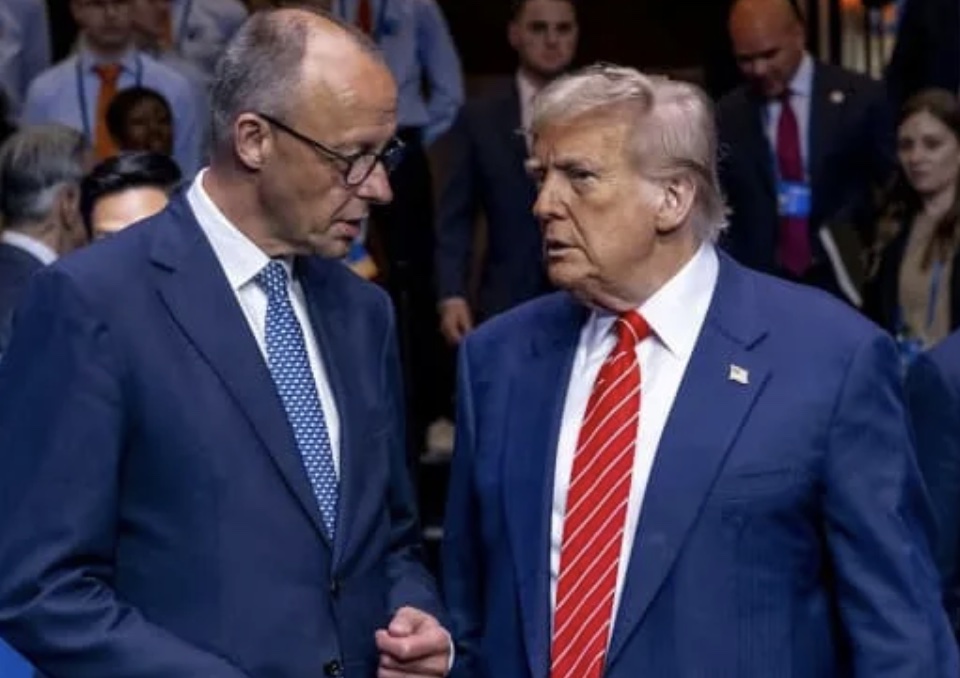
The move, announced amid a worsening personal and political spat between Donald Trump and German Chancellor Friedrich Merz, signals a recalibration that may have consequences far beyond the immediate numbers. At its core lies a dispute over defence spending, strategic autonomy, and the enduring question of who ultimately underwrites European security.
For decades, Germany has served as a cornerstone of the American military footprint in Europe. Tens of thousands of US troops stationed on its soil have formed not only a deterrent against external threats but also a symbol of post-war alliance. To scale back that presence—even modestly—carries political weight. Officials suggest the reduction is part of a broader reassessment of global deployments, yet the timing has raised eyebrows on both sides of the Atlantic.
The tensions between Mr Trump and Mr Merz have been simmering for months. Washington has grown increasingly frustrated with Berlin’s reluctance to meet NATO’s defence spending targets, a longstanding grievance revived with renewed vigour. For Mr Trump, whose transactional approach to alliances is well documented, the logic is blunt: security guarantees, he argues, should not come cheaply. Germany, however, has resisted what it views as pressure bordering on coercion, insisting that its contributions to European stability extend beyond headline defence budgets.
The result is a diplomatic standoff in which troop numbers have become a bargaining chip. While American officials have been keen to emphasise that the reduction does not represent a withdrawal from NATO commitments, the optics suggest otherwise. In Berlin, there is concern that the decision could embolden adversaries or, at the very least, signal a weakening of the alliance’s cohesion.
Yet the implications stretch further still. Across Europe, the move is being read as part of a broader shift in American strategic thinking—one that places greater emphasis on the Indo-Pacific and demands more from regional partners closer to home. If the United States is indeed recalibrating its priorities, Europe may find itself compelled to accelerate its own defence integration, a prospect that has long been discussed but rarely realised.
There is, too, a domestic dimension in the United States. Mr Trump has repeatedly framed overseas troop deployments in terms of cost and return, appealing to a political base wary of prolonged international commitments. In that context, reducing the American footprint in Germany can be presented not as retreat, but as prudence—an effort to align military expenditure with national interest.
For Germany, however, the stakes are different. The presence of US forces has been both a security guarantee and a political reassurance, anchoring the country firmly within the Western alliance. Any diminution of that presence inevitably raises questions about Europe’s strategic future and Germany’s role within it.
The coming weeks are likely to see intense diplomatic engagement aimed at containing the fallout. Both sides have an interest in preventing a temporary dispute from hardening into a lasting rupture. NATO, after all, remains the bedrock of collective defence, and neither Washington nor Berlin can afford to see it weakened at a time of mounting global uncertainty.
Still, the episode serves as a reminder that alliances are not static constructs but living arrangements, subject to the pressures of politics, personality, and shifting priorities. The reduction of 5,000 troops may, in isolation, appear a modest adjustment. In context, it is something more—a signal, perhaps, of a relationship entering a more transactional and less predictable phase.
Germany publishes first military strategy as Berlin sets out force-growth and reserve plans