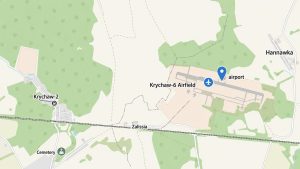
The claims focus on the Krychaw-6 airbase in the Mogilev region, a site close to the Russian border and already identified by open-source researchers as a possible deployment location for the Russian intermediate-range missile system. Reuters reported in December that US researchers had assessed the former airbase as the likely Belarusian site for Oreshnik, following analysis of satellite imagery and construction activity.
The latest information, circulated by the Belarusian Railway Workers’ Community and reported by Reform.news and Militarnyi, concerns a large Russian military train that allegedly arrived in the Krychaw-6 area between 20 and 29 December 2025. According to the activists, the train included dozens of railway cars carrying military equipment, supplies, ammunition and personnel. The cargo was reportedly registered under generic transport codes, a practice commonly used to obscure the nature of sensitive military movements.
The precise contents of the shipment have not been independently verified. Nor has there been confirmation that the train carried Oreshnik launchers themselves. However, the reported logistics pattern is consistent with broader indications that Russia has been preparing Belarusian infrastructure for the deployment of the system.
Krychaw-6 was a Soviet-era military airfield used by combat aviation. After the withdrawal of military units in the early 1990s, the facility fell into disuse and later appears to have had limited civilian aviation activity. Its renewed significance dates from 2025, when satellite imagery and public reporting began to indicate construction, rail-related work and military movement in the area. The site is located near the Krychaw-2 railway station, giving it direct logistical value for the movement of heavy equipment.
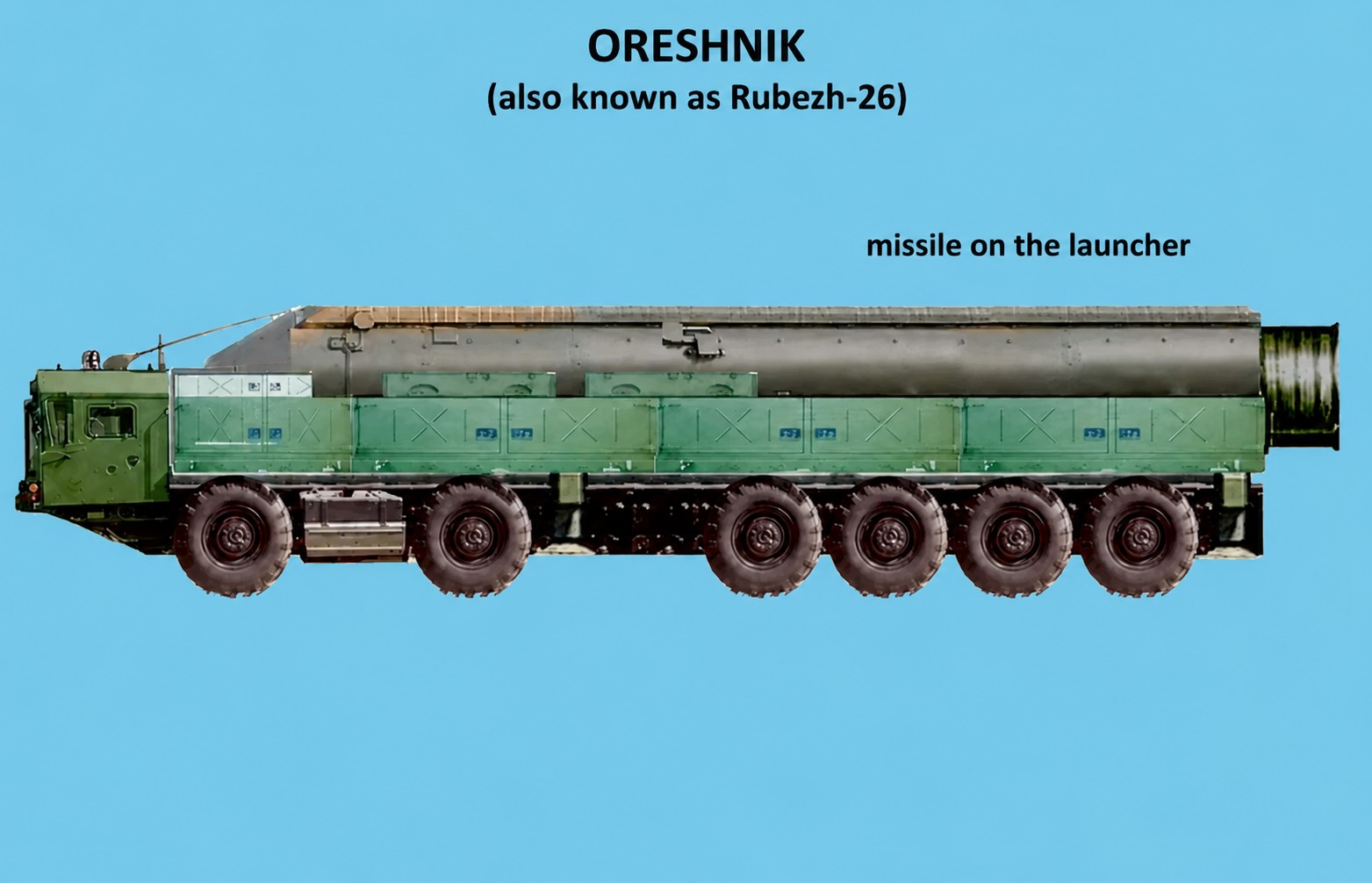
Belarusian President Alexander Lukashenko said in December that Russia’s Oreshnik missile system had been deployed in Belarus, though he did not disclose the location. Reuters later reported that Lukashenko had confirmed the deployment, and Belarusian state-linked footage subsequently showed what officials described as Russian nuclear-capable Oreshnik systems on Belarusian territory. The video did not identify the site.
The Oreshnik has been described by Moscow as a hypersonic intermediate-range ballistic missile capable of carrying conventional or nuclear payloads. Russia first used the system in a strike on Ukraine in November 2024, according to Moscow’s own statements. The CSIS Missile Threat project notes that range estimates vary, but even lower assessments would allow the missile to reach much of Europe from Russian territory. Its deployment in Belarus therefore appears to be less about basic reach than about political signalling, operational flexibility and the forward positioning of strategic assets.
The choice of Krychaw-6, if confirmed, would be significant. The site lies only a short distance from Russia, making it easier for Moscow to move equipment, personnel or sensitive components back across the border in a crisis. This may explain why a location in eastern Belarus was selected rather than a deeper deployment further west. It would allow Russia to station the system on allied territory while retaining relatively rapid access to its own rear areas.
At the same time, the base would place high-value Russian military assets within Belarus, further integrating the country into Moscow’s military infrastructure. Belarus was used as a staging ground for Russia’s full-scale invasion of Ukraine in February 2022 and has since hosted Russian forces, aircraft, training activity and nuclear-related deployments. The reported Oreshnik presence would deepen that role.
There are also operational risks. Krychaw lies roughly 250 kilometres from Chernihiv in northern Ukraine, placing it within range of some Ukrainian long-range strike capabilities developed since 2022. A site of this kind could reasonably be expected to feature among potential Ukrainian targets, including for drones or longer-range missiles. That does not mean any strike is planned or imminent, but it does highlight the vulnerability of fixed or semi-fixed infrastructure associated with strategic systems.
Caution is still required in assessing the available evidence. Some images circulating in connection with the alleged deployment reportedly show vehicles with four axles, whereas open-source analysts have noted that the Oreshnik launcher itself is expected to use a larger six-axle transporter. This suggests that some visible equipment may be support vehicles, unrelated assets or elements of a wider military logistics package rather than launchers.
The railway data nevertheless adds a further layer to the public picture. Taken together with satellite imagery, Belarusian confirmation of deployment, Russian statements and the timing of military shipments, the claims point to Krychaw-6 as one of the most important locations to watch in Belarus.
For NATO and Ukraine, the issue is not only whether the Oreshnik launcher itself is already present at the former airfield. The larger point is that Belarusian territory is continuing to serve as a forward platform for Russian military pressure. The reported activity around Krychaw-6 suggests that this role now extends beyond conventional support and into the infrastructure of strategic missile deployment.