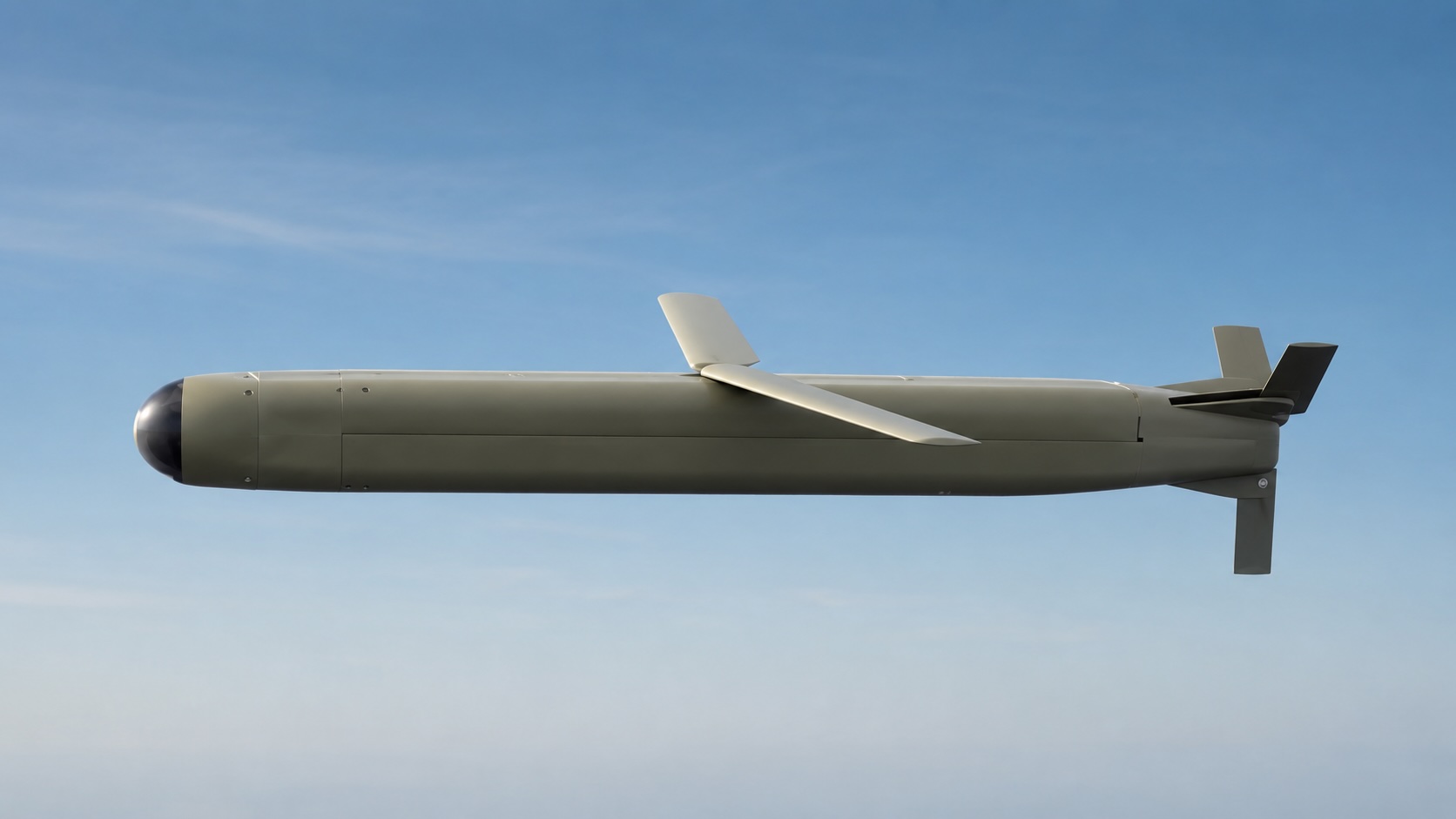
The American defence company said Jackal is a turbojet-powered precision strike missile designed for launch from air, land and maritime platforms. During the latest test, the missile demonstrated rapid response through automated turbojet engine start-up, controlled flight under autopilot and high-speed manoeuvring. According to Northrop Grumman’s announcement, the trial validated the technical maturity of the missile’s airframe, propulsion, navigation and autopilot systems.
Jackal is being developed as a smaller and more flexible alternative to larger precision-strike systems. It is intended to provide a standoff capability against targets in areas protected by modern air defences, where aircraft, drones and conventional munitions may face a high risk of interception. Northrop Grumman says the missile’s flight profile is designed to reduce the probability of detection and increase the effectiveness of strikes against defended targets.
The missile’s performance places it between loitering munitions, tactical cruise missiles and short-range precision-strike weapons. According to the company’s Jackal datasheet, the system has a range of more than 100 kilometres when launched from a surface platform. Defence reporting has indicated that the missile can reach more than 300 miles per hour, or roughly 480 kilometres per hour, and that its range may extend to around 125 kilometres when launched from an aircraft.
One of Jackal’s most notable features is its autonomous guidance package. Northrop Grumman says the missile includes GPS-denied navigation and automatic target recognition. This means it is designed to continue operating if satellite navigation is unavailable, jammed or degraded, a capability that has become increasingly important in conflicts where electronic warfare is used extensively to disrupt drones and guided weapons.
The company describes Jackal as a “fire and forget” missile, capable of sprinting directly to a target or flying along pre-set waypoints. Its modular design is intended to support different payloads, including lethal and non-lethal effects, depending on mission requirements. Northrop Grumman also says the missile can be integrated with light tactical vehicles, giving small ground units a mobile precision-strike option without requiring heavier launcher systems.
The latest test does not mean that Jackal is ready for immediate operational deployment. Northrop Grumman has said the programme will continue through further testing and evaluation before the missile reaches operational readiness. However, the flight test marks an important stage in the development of a weapon designed around autonomy, mobility and resilience against electronic disruption.
The development comes as Western militaries reassess the balance between cost, range, survivability and production scale in precision weapons. The war in Ukraine has highlighted the importance of systems that can be produced in larger numbers, survive electronic warfare and strike targets at tactical and operational depth. It has also shown that expensive, low-volume weapons cannot meet every battlefield requirement when large numbers of targets must be engaged across extended front lines.
Jackal appears to reflect this shift. Rather than relying on large aircraft-launched missiles or strategic strike assets, the system is designed to give manoeuvre forces their own precision-strike capability. If successfully fielded, it could be used against air-defence systems, command posts, radars, logistics hubs, launchers and other time-sensitive targets.
The programme is also part of a wider trend in the United States and Europe towards longer-range, more autonomous and more survivable strike systems. In France, Thales and ArianeGroup have carried out the first successful firing of the FLP-t 150 long-range rocket, which is intended to reach beyond 150 kilometres and operate in jammed environments. Reuters reported that the test was part of France’s effort to strengthen its sovereign long-range strike capability.
Elsewhere in Europe, Dutch company Destinus has announced the accelerated development of RUTA Block 3, a 2,000-kilometre-class precision-strike system developed with Rheinmetall. Destinus describes the system as a long-range strike platform for high-value targets in contested environments, with a planned flight-test campaign beginning in 2027.
These programmes point to a broader change in defence planning. Precision strike is no longer limited to large strategic missiles or aircraft-delivered weapons. Increasingly, the focus is on mobile, dispersed systems that can operate despite electronic attack, be launched from different platforms and provide commanders with faster strike options.
For the United States, Jackal is one example of that direction. Its combination of compact size, autonomous guidance, GPS-denied navigation and multi-platform launch options is intended to address several of the operational problems exposed by recent conflicts. Further trials will determine whether the missile can meet those requirements in practice, but the latest test suggests that Northrop Grumman is moving the programme closer to a deployable capability.