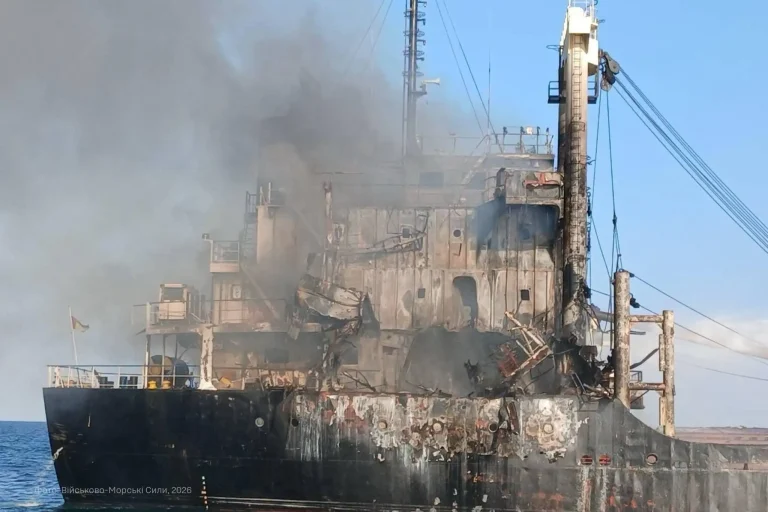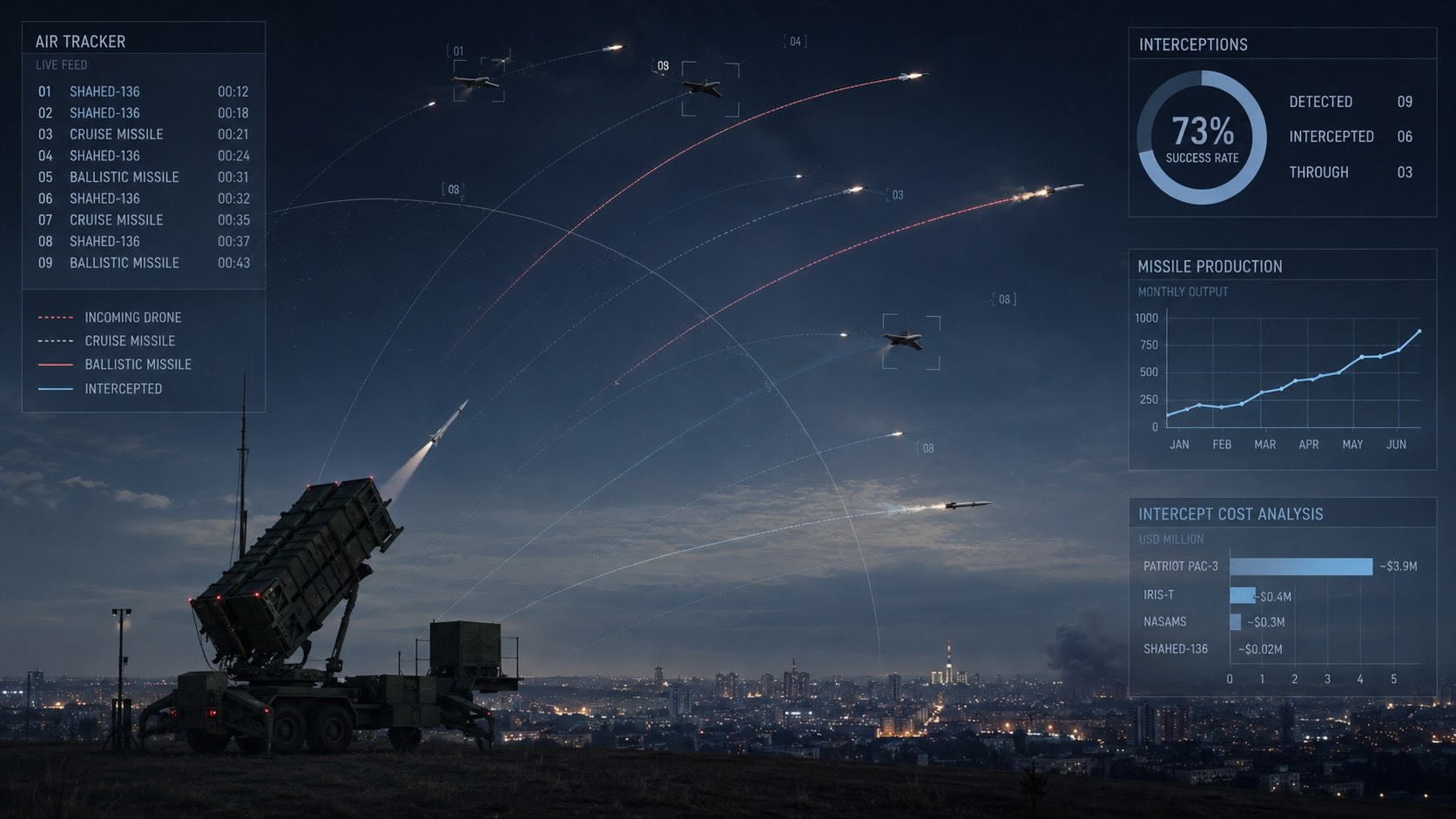
According to Ukraine’s Air Force, Russia launched 729 aerial targets during the attack, including 73 missiles and 656 drones. Ukrainian defences neutralised 642 of them, including 602 drones and 40 missiles. At first glance, this appears to show a high interception rate. Yet the more important figure lies below the headline number: ballistic missiles remain far harder to defeat than drones or cruise missiles.
The attack followed an established Russian pattern. Large numbers of unmanned aerial vehicles were used to saturate Ukrainian air defences, while more complex and more expensive missiles were directed at priority targets. The logic is not new, but the scale and composition are changing. If a defender must track hundreds of incoming objects at once, the attacker does not need every object to get through. It needs enough of them to force difficult choices, consume interceptors, overload command systems and create opportunities for ballistic weapons.
This is where the mathematics becomes strategic. Shahed-type drones and decoys can be produced and launched in large numbers. Cruise missiles are more expensive and more complex, but remain more vulnerable to layered air defence. Ballistic missiles such as the 9M723 Iskander-M and the Kh-47M2 Kinzhal sit in a different category. Their speed, flight profile, manoeuvring capability and possible use of decoys make them demanding targets. For Ukraine, the principal Western system capable of intercepting such threats remains Patriot, particularly when equipped with PAC-3 MSE interceptors.
The imbalance is clear. If Russia can produce and launch several hundred ballistic missiles a year, then Ukraine and its partners must be able either to intercept them, destroy them before launch, or degrade the industrial chain that produces them. Relying only on interception is the most expensive answer. It requires a steady supply of advanced interceptors, trained crews, launchers, radars, spare parts and protected deployment sites. It also assumes that the defender can always place the right system in the right location at the right time.
Recent missile-production analysis has focused on precisely this problem: the relationship between Russian ballistic missile output and employment rates. The exact figures remain contested, but the trend is not. Russia has sustained, and in some areas increased, the use of ballistic missiles against Ukraine. Even if its production capacity is constrained by electronics, specialist materials and manufacturing bottlenecks, it has not been exhausted.
That has direct implications for Europe. The war is no longer only a question of how many systems can be donated from existing stocks. It is a question of whether European and American industry can produce interceptors at a rate that matches or exceeds the threat. The United States has already moved to expand production, with Lockheed Martin saying it delivered more than 600 PAC-3 MSE interceptors in 2025 and is working with the Pentagon to accelerate output. But lead times remain long, orders are global, and demand is no longer confined to Ukraine.
Europe is moving in the same direction, but from a lower industrial base. Efforts to expand the European PAC-3 supply chain show that missile defence is becoming an industrial-policy issue as much as a military requirement. Production lines, supplier networks, rocket motors, seekers, guidance components and testing capacity now matter as much as political declarations of support.
The same arithmetic applies to Russia’s side. Ballistic missiles are not limitless. They require precision manufacturing, specialist propellants, guidance systems, microelectronics and supply chains that remain vulnerable to sanctions, interdiction and long-range strikes. Ukrainian and Western investigations have repeatedly found foreign-made components in Russian missiles and drones. This does not mean sanctions have failed entirely. It means enforcement, export control and third-country trans-shipment routes have become part of the battlefield.
The policy conclusion is uncomfortable but straightforward. Air defence alone cannot solve the ballistic missile problem. It can reduce losses, protect major cities and preserve critical infrastructure, but it is structurally defensive and expensive. A sustainable strategy must combine four lines of effort: more interceptors, more launchers, tighter technology controls, and the ability to strike launchers, storage sites and production nodes before missiles are fired.
That final point is politically sensitive, but militarily central. If a ballistic missile can be intercepted only by scarce and costly systems, then preventing its launch may be more efficient than waiting for it in flight. This is the logic behind Ukraine’s long-range attacks on Russian military infrastructure and defence-industrial facilities. It is also why European debates over range restrictions, industrial co-production and air-defence procurement cannot be separated from one another.
The 1–2 June attack should therefore be read less as an isolated barrage than as a data point in a larger contest. Russia is testing whether mass drones and a growing ballistic component can outpace Ukraine’s defences and Western production. Ukraine is testing whether adaptation, electronic warfare, Patriot coverage and long-range strikes can offset that pressure. Europe is testing whether its defence-industrial base can move from peacetime procurement cycles to wartime consumption rates.
Modern war still depends on will, training and command. But it also depends on ratios. If the attacker can produce more missiles than the defender can intercept, protection erodes. If the defender can strike production and launch infrastructure faster than the attacker can replace it, deterrence improves. The mathematics of war is not abstract. In Ukraine, it is measured nightly in missiles launched, interceptors fired, factories repaired, and cities left standing.