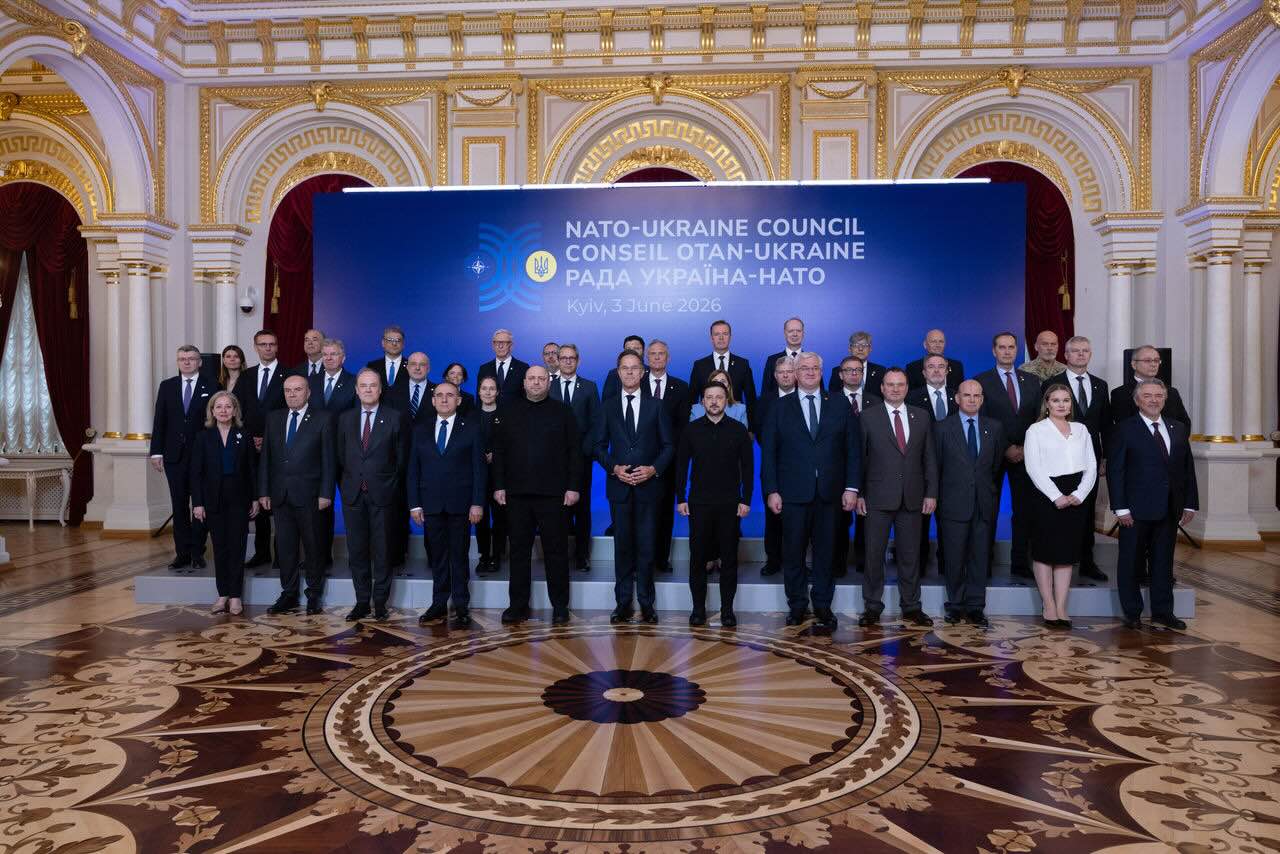
NATO Secretary General Mark Rutte and the North Atlantic Council visited Kyiv on Wednesday for the first meeting of the Council held in the Ukrainian capital. The visit was described by the Alliance as a sign of continued support for Ukraine. Rutte also met President Volodymyr Zelenskyy, Foreign Minister Andrii Sybiha and Defence Minister Mykhailo Fedorov, according to the official media advisory.
The location matters. The Council was created in 2023 to replace the earlier NATO-Ukraine Commission, placing Ukraine and the Allies in a format where they sit together as equal participants in political consultation. Holding the meeting in Kyiv brings that format into the country at war, rather than keeping it as a Brussels-based mechanism.
That symbolism should not be dismissed. Russia’s war has made Ukraine one of Europe’s central security questions, and NATO has tried to deepen political engagement without extending full membership guarantees while the war continues. A meeting of the North Atlantic Council in Kyiv therefore signals that Ukraine’s defence is not being treated as a distant partner issue.
Yet symbolism is not the same as capability. Ukraine’s battlefield requirements remain practical: interceptors, artillery ammunition, drones, electronic warfare systems, armoured vehicles, repair capacity, air-defence integration and predictable financing. The question for Kyiv is not whether NATO supports Ukraine in political terms. It is whether that support can be converted quickly enough into usable military capacity.
That distinction has become more important as the war has entered a phase of attrition and long-range strikes. Zelenskyy has argued that Ukrainian strikes inside Russia have helped place Kyiv in a stronger negotiating position. Rutte, speaking in Kyiv, directed comments at Russian recruits and their families, warning them about the consequences of joining Russia’s war in Ukraine. Both messages point to a conflict in which morale, manpower and industrial endurance are central.
For NATO, the issue is also broader than Ukraine alone. The Alliance is reassessing how much of the burden Europe and Canada must carry as the United States reduces or reallocates some capabilities. Washington has urged European NATO members and Canada to provide more aircraft, drones and naval assets as the US steps back in some areas of alliance planning. That pressure makes the Kyiv meeting part of a larger debate over whether European Allies can support Ukraine and strengthen NATO’s own deterrence at the same time.
Ukraine’s military has become one of Europe’s most experienced forces, particularly in drones, counter-drone warfare, dispersed command, battlefield innovation and adaptation under fire. NATO has recognised this through co-operation programmes, including defence innovation initiatives with Ukraine. The UNITE – Brave NATO programme is one example of an effort to link NATO structures with Ukrainian battlefield innovation, although translating those lessons into procurement and doctrine remains slower than the battlefield cycle that produced them.
This is where the Kyiv meeting could matter, if it becomes a mechanism for delivery rather than consultation alone. NATO has taken on a greater co-ordinating role in security assistance and training. It has also supported programmes linked to innovation and defence-industrial co-operation. The test is whether these structures can reduce fragmentation among Allies, avoid duplicated initiatives and provide Ukraine with equipment at scale.
Air defence remains the clearest example. Russian missile and drone attacks continue to force Ukraine to allocate scarce interceptors across cities, energy infrastructure, military sites and logistics hubs. Each promise of additional systems or ammunition has to be measured against the pace of Russian attacks and the time needed to manufacture, transfer and integrate new equipment. Political meetings can help align priorities, but they cannot replace production capacity.
The same applies to ammunition and drones. Ukraine’s war effort depends on continuous supply, while European defence industry is still expanding from a low post-Cold War base. Procurement cycles, national budget rules and competing industrial interests have slowed the conversion of political commitments into output. The more NATO treats Ukraine as a partner in capability planning, the more pressure there will be to match consultations with contracts.
There is also a strategic message to Moscow. A NATO-Ukraine Council meeting in Kyiv shows that the Alliance is willing to engage visibly with Ukraine on Ukrainian territory despite Russian pressure. It does not change Ukraine’s membership status, nor does it create an Article 5 guarantee. But it reinforces the fact that Russia has failed to isolate Ukraine politically from the Euro-Atlantic security system.
For Kyiv, the immediate value of the meeting will be judged less by the communiqué than by what follows: additional air-defence supplies, clearer procurement decisions, greater defence-industrial co-operation and a more reliable pipeline of support. Ukraine needs political backing, but it needs military output more.
The first NATO-Ukraine Council in Kyiv is therefore best understood as a signal with conditions attached. It is a signal of political proximity and institutional integration. Its importance will be measured by whether it helps turn NATO’s support from repeated declarations into faster, larger and more predictable capability delivery.