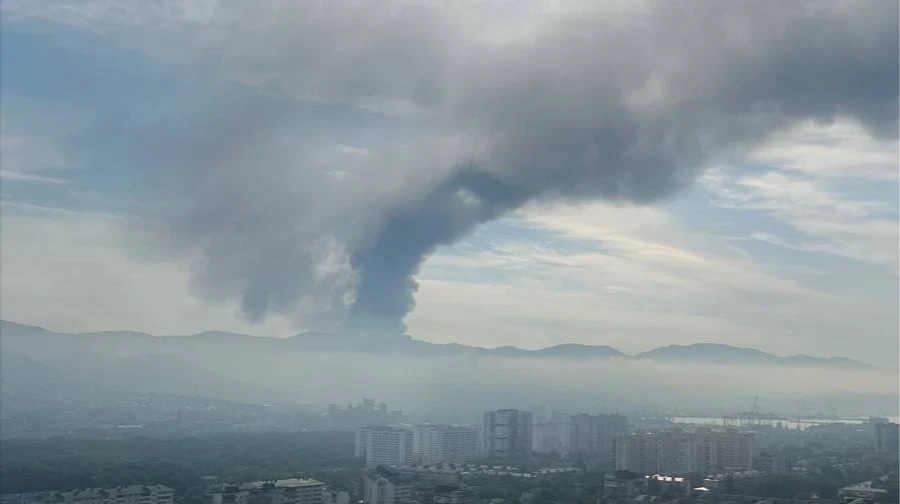
Ukraine’s Defence Forces have struck one of Russia’s largest oil storage facilities in the Caucasus, hitting the Grushovaya oil transshipment base in Novorossiysk, Krasnodar Krai, overnight on 8 June.
According to a Ukrainian military statement, operators of the 1st Separate Centre of the Unmanned Systems Forces carried out the operation in co-ordination with Ukraine’s Special Operations Forces and other elements of the Defence Forces.
The target was identified as the Grushovaya tank farm, part of the Sheskharis transshipment complex and operated by Chernomortransneft, a subsidiary of Russia’s state pipeline monopoly Transneft. Ukrainian officials said a fire had been recorded on the site after the strike, while the full extent of the damage was still being assessed.
The Grushovaya site is important because it forms part of the oil export system feeding the Black Sea port of Novorossiysk, one of Russia’s principal energy outlets. The facility is used for the receipt, storage and transfer of crude oil and petroleum products arriving by trunk pipelines before onward shipment by sea.
The broader Sheskharis complex includes two main industrial sites, Sheskharis and Grushovaya, located around 12 kilometres apart and connected by pipeline infrastructure. Russian industry material has described the complex as a terminal point for Transneft’s main pipelines in Krasnodar Krai and as a facility used for export loading through Novorossiysk.
Ukrainian officials said the Grushovaya base has a total storage capacity of about 1.2 to 1.4 million tonnes and functions as a key accumulation point for the Novorossiysk oil port. Its operation, Kyiv argues, supports revenues for the Russian state budget, which Ukraine says are used to finance Moscow’s war.
The strike forms part of a wider Ukrainian campaign against Russian oil, fuel and logistics infrastructure. On the same day, Ukrainian forces also reported strikes on other energy-related sites in Russia and occupied Crimea, as part of an effort to impose economic and operational costs on Moscow’s war effort. The latest attacks were reported alongside Russian claims that it had intercepted large numbers of Ukrainian drones over several regions, including Krasnodar Krai.
The Novorossiysk area has been struck repeatedly during the war, reflecting its strategic importance for Russia’s Black Sea energy exports and military logistics. In May, an earlier drone attack caused a fire at an oil terminal in the same port area. Russian regional authorities at the time said falling drone debris had hit oil storage facilities and nearby buildings.
The pressure on Novorossiysk is particularly relevant because Russia has already had to adjust crude oil flows in response to Ukrainian attacks on refineries and export infrastructure. Recent analysis of Russian exports showed that western port shipments rose as refinery outages pushed more crude towards export channels, while repeated drone strikes complicated operations at key terminals and pipelines. Those shifts have increased the importance of functioning export routes through ports such as Novorossiysk.
Previous disruptions at the port have also had measurable effects. In April, traders said Rosneft had diverted crude to the Tuapse refinery after damage at the Sheskharis terminal affected export berths at Novorossiysk. Earlier, delays at the port were linked to damage affecting infrastructure used for large tankers.
No independently verified assessment of the damage from the 8 June strike was immediately available. Ukrainian military statements said only that a fire had been observed and that the scale of the damage was being clarified.
The attack illustrates the continued expansion of Ukraine’s long-range unmanned operations against Russian energy infrastructure. Kyiv has increasingly targeted depots, refineries, pipeline facilities and export terminals that it says contribute either directly to military supply or indirectly to the state revenues sustaining Russia’s invasion.
For Russia, sites such as Grushovaya are difficult to protect fully. Oil depots and transshipment terminals cover large areas, contain combustible material and are connected to wider pipeline, port and storage networks. Even limited fires can interrupt operations, require substantial emergency response and force temporary changes to loading or storage schedules.
For Ukraine, the reported involvement of the Unmanned Systems Forces, Special Operations Forces and other Defence Forces components indicates a co-ordinated operation against a high-value economic target. The longer-term impact will depend on whether tanks, pumping systems, pipeline connections or control infrastructure were damaged.
If disruption is limited, the strike may have a primarily financial and psychological effect. If key transfer systems were affected, however, the consequences could extend to export scheduling through Novorossiysk and the wider southern Russian oil logistics network.