Ukraine has developed a drone-interceptor technology capable of autonomously engaging Russian Shahed-type attack UAVs, according to Defence Minister Mykhailo Fedorov, in what Kyiv presents as a further step towards a cheaper and more distributed model of air defence.
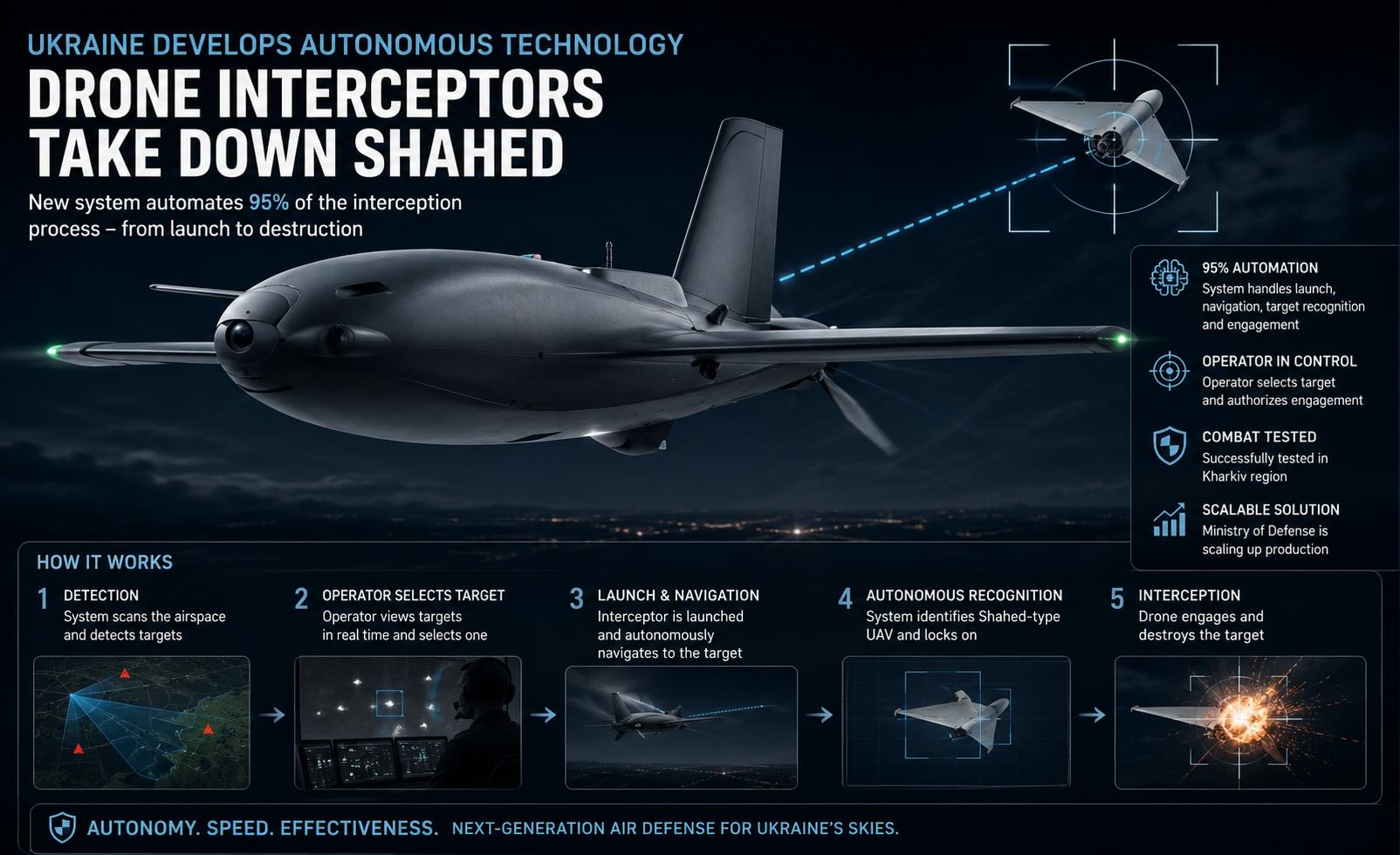
Fedorov said a company participating in Ukraine’s Brave1 defence technology platform had created a system that automates 95 per cent of the interception process, from the launch of the interceptor drone to the destruction of the target. The technology has already undergone a successful combat test in Kharkiv region, according to the minister’s statement, which was also carried in Ukrainian-language defence reporting.
The system retains a human operator in the decision-making loop. The operator monitors aerial targets in real time, selects one and gives the command to engage. After that, the software guides the interceptor towards the target, identifies it autonomously and directs the drone onto the Shahed-type UAV.
Fedorov said the developer had moved from prototype to combat use in less than a year with support from Brave1. He described autonomy as one of the main directions for modern air defence, arguing that such systems allow faster responses to mass attacks and more effective protection of Ukrainian cities.
The announcement comes as Ukraine continues to adapt its defences against large-scale Russian drone strikes. Shahed-type loitering munitions, originally of Iranian design and now also produced by Russia under the Geran designation, have been used extensively against Ukrainian energy infrastructure, military targets and urban areas. Their relatively low cost has forced Ukraine to look for interception methods cheaper than conventional surface-to-air missiles.
Interceptor drones have become one of the most visible answers to that problem. Instead of using high-cost missiles against single one-way attack drones, Ukraine has been developing small, fast unmanned systems designed specifically to catch and destroy incoming UAVs. Recent battlefield reporting has described how Ukrainian manufacturers are working on low-cost drone interceptors intended to reduce the financial pressure on more expensive air-defence systems.
The latest reported advance is not only the interceptor itself, but the level of automation around the engagement. In a mass-raid scenario, the limiting factor is often not only the number of defensive assets available, but also the speed at which operators can detect, assign and intercept multiple targets. Semi-autonomous or highly automated guidance systems are intended to reduce that burden while keeping the final decision to engage under human control.
Ukraine has also been working on other elements of what officials have described as “small” air defence. Fedorov previously said that Kyiv was testing cheaper interceptor missiles against Shahed-type UAVs, including as a response to faster jet-powered versions. Separately, Ukrainian developers have introduced remote-control solutions allowing interceptor drones to be operated from much greater distances, reducing the exposure of drone crews near likely Russian strike zones.
That shift is already changing the organisation of Ukraine’s counter-drone effort. Recent reporting on remote operation of interceptor drones described systems allowing pilots to engage Russian one-way attack drones from far beyond the previous line-of-sight limits, using communications links that can place operators hundreds or even thousands of kilometres from the battlefield.
The broader trend points to a layered and increasingly distributed model of air defence. Ukraine still relies on Western-supplied systems such as Patriot, NASAMS and IRIS-T to counter missiles and higher-value aerial threats. However, Shahed-type drones present a different cost equation. They can be launched in large numbers, often at night, and may be routed across wide areas to stretch defensive coverage. A cheaper interceptor layer can therefore preserve more expensive air-defence missiles for targets that require them.
The development also reflects the rapid feedback loop between Ukraine’s front line and its defence technology sector. Brave1 has been used to connect developers, military units and state procurement channels, allowing new systems to be tested under combat conditions and modified quickly. The official platform describes itself as a mechanism for state support of defence-tech innovation, including grants, testing and assistance for projects intended for Ukraine’s defence forces.
There are still operational questions. Autonomous target recognition must work in poor weather, at night, under electronic warfare pressure and against changing Russian drone designs. Russia has modified its Shahed-type systems during the war, including changes to engines, materials, routes and electronic protection. Any Ukrainian interceptor system will therefore have to evolve continuously rather than rely on a single technical solution.
Nevertheless, the reported Kharkiv test suggests that Ukraine is moving from manually piloted interceptor drones towards systems in which operators supervise, assign targets and authorise engagement while software handles most of the flight and terminal guidance process. If scalable, that could increase the number of simultaneous engagements during mass attacks and reduce the training burden on individual operators.
For European defence planners, the development is relevant beyond Ukraine. The war has shown that long-range one-way attack drones can impose heavy pressure on traditional air-defence networks. A low-cost, autonomous or semi-autonomous interceptor layer may become a standard component of future protection for cities, military bases, logistics hubs and critical infrastructure.
Fedorov said Ukraine is now scaling solutions that have already proved effective in combat conditions. The full technical details have not been disclosed, and the claim remains based on Ukrainian official reporting. Even so, the announcement underlines a clear direction in Ukraine’s air-defence development: more automation, lower-cost interceptors and faster integration between battlefield requirements and domestic production.