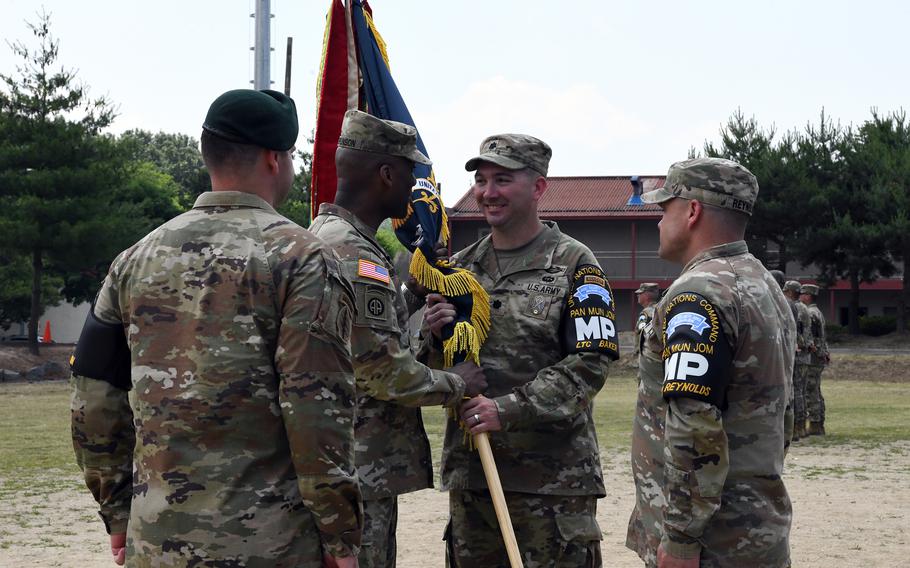
Last week, that responsibility passed to a new commander. Lieutenant Colonel Michael Baker assumed leadership of the battalion during a ceremony at Camp Bonifas, just south of the border separating North and South Korea. On the surface, such military transitions are routine affairs. Yet in this case, the change of command highlights the enduring significance of a mission that has quietly helped preserve stability in north-east Asia for more than seven decades.
The Korean War ended not with a peace treaty but with an armistice in 1953. Technically, the conflict remains unresolved. The heavily fortified frontier dividing the peninsula remains one of the world’s most sensitive flashpoints. Against that backdrop, the Security Battalion’s role is both practical and symbolic.
Its responsibilities extend well beyond standing watch at a border crossing. The battalion supports enforcement of the Korean Armistice Agreement, safeguards Daeseong-dong — the only South Korean village located entirely within the Demilitarised Zone — and oversees the Joint Security Area, where representatives from opposing sides have historically met face-to-face. It is also the only fully integrated United Nations Command and South Korean military unit operating in the area.
That integrated structure deserves greater recognition. At a time when alliances are being tested across the globe, the battalion offers a compelling example of multinational cooperation functioning effectively over decades. American and South Korean personnel operate within a shared command framework designed around common objectives: deterrence, stability and readiness.
General Xavier Brunson, commander of United States Forces Korea and the United Nations Command, captured the essence of the mission during the ceremony. For more than seventy years, he observed, the battalion has maintained its vigil opposite one of the world’s largest standing armies. The objective has remained constant: preserving peace while ensuring preparedness should deterrence fail.
Critics sometimes view military deployments solely through the prism of confrontation. Yet the Security Battalion demonstrates another reality. Military professionalism, properly directed, can create the conditions necessary for diplomacy to flourish. The Joint Security Area has hosted negotiations, facilitated communication during periods of crisis and provided a structured environment in which miscalculation can be minimised.
Lieutenant Colonel Baker himself appears acutely aware of that balance. Returning to South Korea after previous service in the region, he described the assignment as coming home. His stated ambition — maintaining security while supporting future diplomatic engagement — reflects an understanding that military readiness and political dialogue are not mutually exclusive but often complementary.
The battalion’s record offers grounds for confidence. In 2017, personnel assigned to the unit helped rescue a North Korean defector who had been seriously wounded while crossing the border. The actions of American and South Korean soldiers alike illustrated the human dimension of a mission frequently reduced to strategic abstractions.
As concerns persist regarding Pyongyang’s nuclear ambitions and missile programmes, the temptation is often to focus exclusively on dramatic headlines and escalating rhetoric. Less visible are the institutions that work daily to prevent tensions from spiralling into conflict.
The Security Battalion is one such institution. It represents continuity in uncertain times, international partnership in a fractured world and the often-overlooked truth that peace requires constant stewardship.
Its soldiers occupy a unique position at the frontier between war and diplomacy. Their presence serves as a reminder that stability is rarely self-sustaining. It is maintained through vigilance, cooperation and an unwavering commitment to preserving the possibility of dialogue.
Seventy-three years after the armistice was signed, that remains a mission worth supporting.
Seoul says 10,000 North Korean troops deployed near Russia–Ukraine border
Main Image: Lt. Col. Michael Baker, second from right, assumes command of the United Nations Command Security Battalion–Joint Security Area at Camp Bonifas, South Korea, June 12, 2026. (Julie Masson/Stars and Stripes)