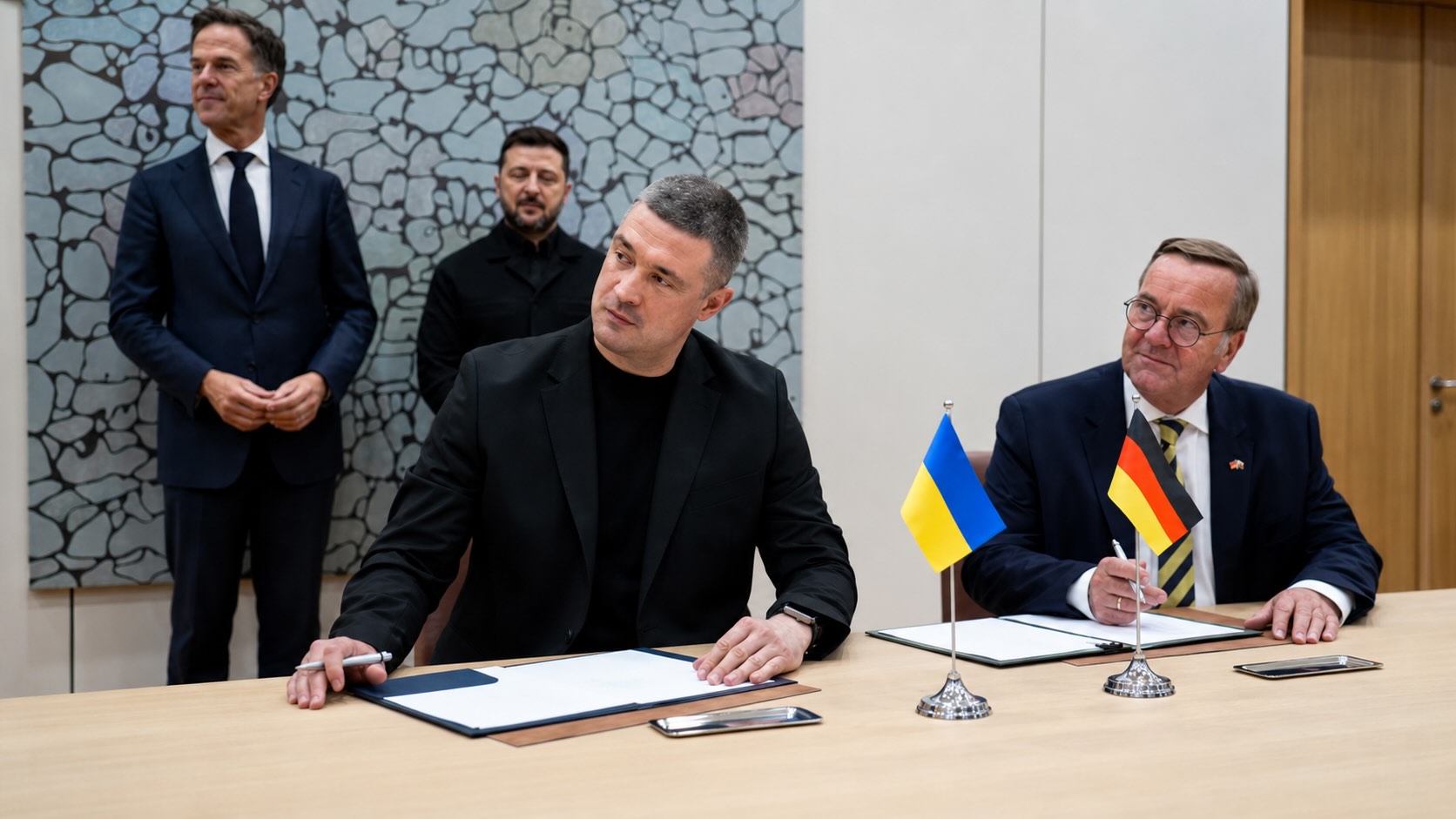
Ukraine and Germany have signed an agreement to develop anti-ballistic capabilities, placing missile defence at the centre of a wider European debate over how to protect Ukraine and NATO’s eastern flank from Russian ballistic strikes.
President Volodymyr Zelenskyy announced the agreement during a meeting of the Ukraine Defence Contact Group in Brussels on 18 June, saying that Russian ballistic missiles remained one of the central problems for Ukraine’s air defence. According to details reported after the meeting, the agreement also includes the joint production in Germany of TerMIT unmanned ground vehicles, which are designed to carry ammunition, equipment and water to frontline positions.
The anti-ballistic component is the more strategically important part of the announcement. Ukraine’s air-defence requirement has moved beyond the interception of drones and cruise missiles towards a more difficult problem: how to counter high-speed ballistic missiles, including Russian Iskander-type systems, in sufficient numbers and at a sustainable cost.
That problem has been present throughout the war, but it has become more acute as Ukraine has struggled to obtain enough Patriot interceptors and other advanced air-defence missiles. Patriot remains one of the few proven systems available to Ukraine for ballistic missile defence, but demand is global, production is limited, and US political decisions continue to affect availability.
The German-Ukrainian agreement therefore has a wider implication than another bilateral defence package. It points to an attempt to build European production and integration capacity in a field where the continent has long depended heavily on US systems. For Ukraine, the issue is immediate battlefield survival. For Europe, it is a test of whether repeated commitments to defence-industrial autonomy can be translated into deployable capability.
The timing is notable. At the Eurosatory defence exhibition in Paris, Ukrainian manufacturers have been trying to position themselves not only as recipients of Western aid, but as industrial partners with combat-tested designs. Fire Point, Ukraine’s largest missile and drone manufacturer, is among the companies involved in the latest German-Ukrainian effort. The company has also been promoting Freyja, a proposed ballistic missile defence system built around Ukrainian interceptor technology and European components.
Freyja is not yet a mature equivalent to Patriot or SAMP/T. That distinction matters. The system remains in development, and Fire Point has acknowledged that key elements such as radars, command-and-control architecture and seekers require European partners. The relevant development is not that Ukraine has solved ballistic missile defence. It has not. The development is that Ukrainian industry is trying to assemble an open European architecture around a specific capability gap.
Germany’s Hensoldt has signed a memorandum of understanding with Fire Point to integrate its TRML-4D radar into the Freyja project. Under the arrangement, Hensoldt would be responsible for radar production, testing and delivery, while Fire Point would act as prime contractor and overall system integrator, producing FP-7 missiles and related launch and control elements.
That division of labour reflects the direction of travel in European defence cooperation with Ukraine. Ukrainian companies bring wartime iteration, operational urgency and direct exposure to Russian systems. European firms bring sensors, integration experience, certification procedures and industrial scale. The challenge is whether those different strengths can be combined quickly enough to matter on the battlefield and credibly enough to attract long-term European procurement.
There are reasons for caution. Missile defence is not an area where improvised solutions can easily replace mature systems. Detection, tracking, fire control, seeker performance, command integration, electronic-warfare resilience and interceptor reliability all have to work together. A cheap interceptor is of limited value if the system cannot identify, prioritise and engage fast-moving targets under combat conditions.
There are also political and industrial obstacles. European procurement remains slow, fragmented and often nationally protective. Established manufacturers are unlikely to welcome a Ukrainian-led challenger if it competes for funding or market share. At the same time, European governments face pressure to expand air-defence capacity faster than traditional procurement cycles allow.
This is the space in which the Ukraine-Germany agreement should be understood. It is not simply another wartime pledge. It is part of a broader effort to move from emergency transfers towards joint production and European-based missile defence capacity.
The question is whether Berlin and Kyiv can turn the agreement into measurable results before winter, as Zelenskyy has requested. If they can, it would strengthen Ukraine’s defences and provide a practical model for European defence-industrial cooperation. If they cannot, the announcement risks becoming another example of Europe identifying a capability gap faster than it can close it.
For now, the strategic direction is clear. Ukraine is no longer only asking Europe for air-defence systems from existing stocks. It is asking Europe to help build the next layer of defence with Ukrainian industry inside the production chain. That shift may prove as important as the equipment itself.