The proposed acquisition, which is expected to go before the Bundestag budget committee this week, would place Berlin on an equal footing with Paris in one of Europe’s most important land-systems companies. Under the reported arrangement, Germany would acquire the stake from the German family owners behind Krauss-Maffei Wegmann, while France and Germany would become equal shareholders ahead of a possible public listing in Frankfurt and Paris.
The deal is reported to value KNDS at between €15 billion and €18 billion. It is also expected to prepare the company for an initial public offering, potentially before mid-July. If approved, the transaction would turn KNDS into a partly listed defence group under strong state influence from both Berlin and Paris.
This is more than a financial transaction. It is a test of how European governments intend to manage the defence-industrial base at a time of higher military spending, tighter delivery timelines and increased pressure to replace equipment sent to Ukraine.
KNDS was formed through the 2015 combination of Germany’s Krauss-Maffei Wegmann and France’s Nexter, a merger that had the backing of both governments and was presented at the time as a step towards closer Franco-German co-operation in land defence systems. The company now sits at the centre of Europe’s armoured-vehicle sector.
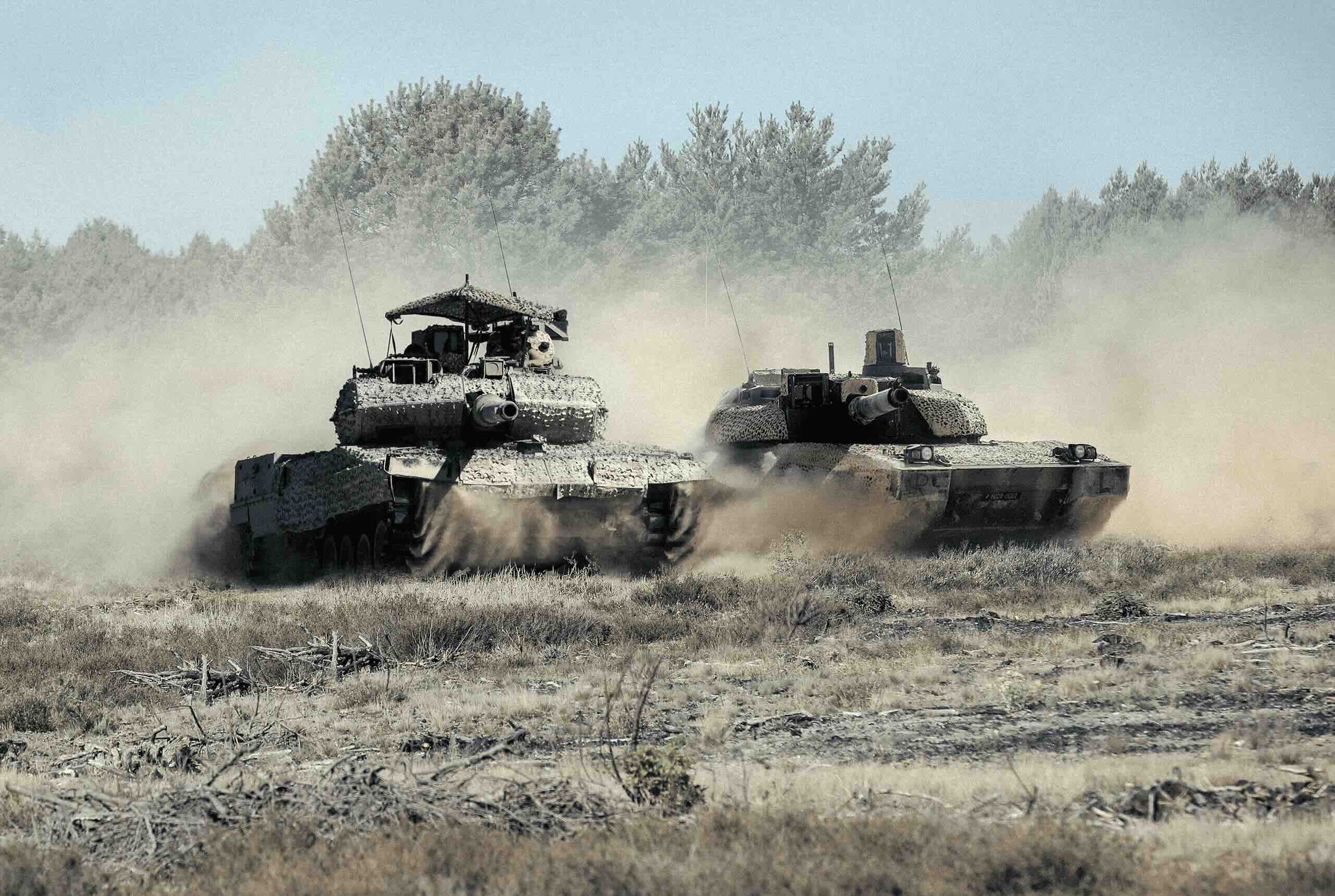
Its product base includes the Leopard 2, one of the most widely used main battle tanks in Europe, and the French Leclerc. KNDS is also involved in the Main Ground Combat System, the Franco-German project intended to replace both platforms with a future land-combat system.
Those programmes now carry greater political weight. The war in Ukraine has made clear that tanks, artillery, ammunition stocks, maintenance capacity and production speed are not abstract planning issues. They determine whether pledges made at political level can be converted into military capability.
Germany’s decision also reflects a wider concern in Berlin: that strategic defence companies cannot be treated as ordinary industrial assets. A listed KNDS may have better access to capital, but public ownership could also expose a core defence manufacturer to market pressure, shareholder demands and future changes in control.
Berlin’s reported pursuit of a “golden share” in the German unit points to that concern. Such a mechanism would give the German state additional influence over strategic decisions, even after a listing. In practice, it would allow Berlin to protect national security interests while still permitting a broader capital-market transaction.
For France, the issue is equally sensitive. Paris has long treated defence industry as a sovereign capability. A Franco-German balance inside KNDS may help stabilise the company ahead of an IPO, but it will also require clear rules on governance, investment priorities, export policy and future workshare.
The timing is important. Franco-German defence co-operation has faced repeated strain, particularly over large future systems. The Future Combat Air System has been affected by disagreements over leadership, industrial roles and technical control. The Main Ground Combat System has also been slowed by industrial and political complexity.
Against that background, the KNDS stake deal can be read as an attempt to put one pillar of land-systems production on a firmer political and financial footing. It may also indicate that governments are no longer willing to rely only on procurement contracts to shape defence industry. Ownership, voting rights and strategic control are becoming part of defence policy.
The move comes as European governments are increasing defence spending but still face practical limits in production. Demand for tanks, artillery, air defence, ammunition and military vehicles has risen sharply since Russia’s full-scale invasion of Ukraine. Yet Europe’s industrial base remains fragmented, with national programmes, different technical requirements and overlapping suppliers.
A stronger KNDS could help consolidate part of that market. But concentration also raises questions. Smaller suppliers may worry about access to future programmes. Governments may seek guarantees over domestic jobs and technology. Customers will want faster delivery, not only new corporate structures.
The public listing, if it proceeds, would therefore not be a conventional market event. It would test whether a major European defence company can combine public capital, state oversight and operational autonomy. Investors will look at revenue growth, margins and order books. Governments will look at sovereignty, production capacity and control over critical technologies. Armed forces will judge the result by delivery times and battlefield relevance.
For NATO, the issue has a practical dimension. European allies have been urged for years to spend more on defence. That pressure has intensified as doubts persist over the long-term direction of US policy. But higher budgets alone do not solve capability gaps if industry cannot scale. KNDS is one of the few companies with the industrial base and product line to affect Europe’s heavy land capability directly.
The German stake would therefore signal a broader policy choice. Berlin appears to be accepting that defence production is now a strategic asset requiring direct state involvement. Paris has operated on that assumption for years. The question is whether the two governments can use joint ownership to improve capacity, or whether the arrangement becomes another layer of political management.
Europe’s rearmament debate is entering a more concrete phase. The early discussion was about whether governments would spend more. The next stage is about who owns the factories, who controls the technology, who sets priorities, and how quickly equipment can be delivered. KNDS now sits at the centre of that question.