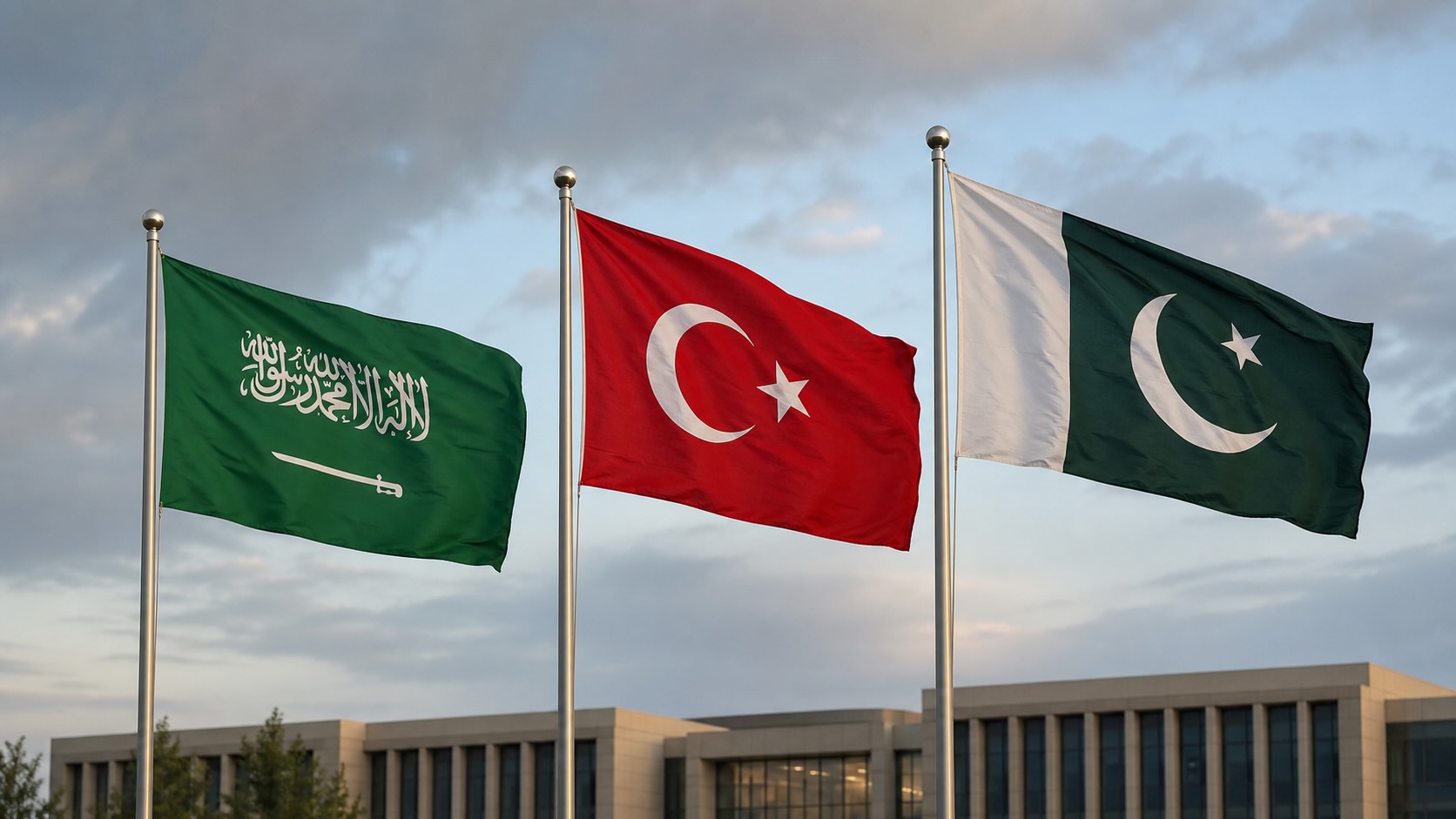
Saudi Arabia, Türkiye and Pakistan are preparing to formalise a trilateral defence agreement that could create a new security framework spanning the Gulf, the eastern Mediterranean and South Asia.
Officials and people familiar with the negotiations told Reuters that the three countries were expected to sign the agreement in Jeddah on 7 August after roughly a year of discussions. At the time of publication, however, none of the three governments had released a signed text or an authoritative account confirming that the ceremony had taken place.
The distinction is important. A prospective agreement can be analysed from the extensive cooperation already under way, but it should not be described as a treaty in force until the parties confirm its signature and explain its status under their domestic laws.
The reported initiative nevertheless merits close attention. It would bring together Saudi financial and political influence, Türkiye’s large armed forces and expanding defence industry, and Pakistan’s experienced military and nuclear status. The arrangement could become substantially more important than another memorandum on training or industrial cooperation if it contains mutual-defence obligations, operational planning or provisions for military deployments.
The proposed framework would not start from nothing. Each side of the triangle already carries significant defence relationships.
Saudi Arabia and Pakistan signed a Strategic Mutual Defence Agreement in September 2025. Their published statement said that aggression against either country would be treated as aggression against both. The Saudi Ministry of Defence subsequently announced the arrival of a Pakistani force, including fighter and support aircraft, at King Abdulaziz Air Base under that agreement. The deployment demonstrated that the pact had an operational dimension rather than being purely declaratory.
Riyadh and Ankara have likewise deepened defence-industrial cooperation. Saudi Arabia agreed to purchase Turkish-made Bayraktar Akıncı unmanned combat aircraft, while their defence ministries adopted an executive plan covering capabilities, joint production, research, technology transfer and localisation. A Saudi–Turkish joint statement described the agreements as part of a broader effort to strengthen military and defence-industry coordination.
Türkiye and Pakistan, meanwhile, maintain long-standing military relations. Their cooperation includes training, exercises, naval construction, aircraft modernisation and defence technology. A joint declaration issued by Pakistan’s foreign ministry established a security, defence and intelligence committee and called for greater joint research, procurement and industrial ventures.
The trilateral proposal would therefore join three mature bilateral relationships under a common structure. Its significance depends on whether it merely co-ordinates those ties or creates new obligations shared by all three states.
The most consequential issue is whether the agreement contains language resembling the Saudi–Pakistani commitment that an attack on one is an attack on both.
If it does, the pact could extend a form of collective deterrence across three very different security theatres. Saudi Arabia faces missile, drone and maritime threats in the Gulf and Red Sea. Türkiye’s concerns include Syria, the eastern Mediterranean, the Black Sea and Kurdish armed groups. Pakistan’s principal strategic focus remains India, alongside instability on its Afghan border.
These threat perceptions overlap only partially. A treaty that treats them as a common security problem would require careful rules on consultation, assistance and the geographic scope of commitments. Governments may support one another politically while remaining unwilling to join every conflict involving a partner.
The unpublished text must therefore answer basic questions. Does an attack trigger automatic military assistance, consultations or merely discretionary support? Does the agreement cover national territory only, or deployed forces and shipping? Does it distinguish defensive action from a conflict initiated by one of the parties? What mechanism decides whether an incident falls within the pact?
Without those answers, claims that the arrangement constitutes a new military alliance are premature.
Pakistan is the only nuclear-armed member of the prospective grouping. That fact will inevitably prompt questions about whether the agreement extends a nuclear guarantee to Saudi Arabia or Türkiye.
The existing Saudi–Pakistani pact did not publicly state that Pakistan’s nuclear weapons formed part of the commitment. Pakistani officials have nevertheless used expansive language about the resources available to defend the kingdom. Such statements encourage interpretations that go beyond the text released by the governments.
A trilateral agreement would intensify that debate, particularly because Türkiye is already protected by NATO’s collective-defence system and participates in the alliance’s nuclear-sharing arrangements. Membership of a separate pact would not automatically extend NATO protection to Saudi Arabia or Pakistan. Article 5 obligations belong to the North Atlantic Treaty and apply between NATO allies; they cannot simply be transferred to third countries through a Turkish agreement.
Ankara would also need to ensure that new commitments remain compatible with NATO planning, export controls and intelligence-security rules. Türkiye has pursued an increasingly autonomous foreign policy, but its position inside NATO still shapes what military information and capabilities it can share.
The responsible conclusion is therefore limited: Pakistan’s participation adds nuclear weight to the proposed grouping, but no public evidence establishes a trilateral nuclear guarantee.
Even without an automatic war-fighting commitment, an organised three-way framework could have substantial industrial consequences.
Türkiye has developed a competitive defence sector producing drones, missiles, armoured vehicles, naval platforms and electronic systems. Pakistan offers lower-cost production, experienced personnel and established aerospace and naval industries. Saudi Arabia supplies capital and a large procurement market while seeking to localise military manufacturing under its economic diversification programme.
The three countries consequently possess complementary strengths. Joint projects could combine Turkish technology, Pakistani manufacturing and Saudi financing. Common procurement could increase production runs and reduce unit costs. Training, maintenance and ammunition agreements could make their forces more interoperable.
There are also constraints. Technology-transfer negotiations are difficult, and each government will want skilled employment and intellectual property at home. Turkish and Pakistani systems often contain foreign components subject to export licences. Saudi procurement still relies heavily on American and European suppliers, creating integration and political complications.
A formal institution could help manage these problems through regular ministerial meetings, technical working groups and longer-term project planning. Whether it succeeds would be measured in contracts and deployable capability rather than ceremonial language.
The initiative also reflects a wider diversification of Gulf defence relationships. Saudi Arabia remains closely tied to the United States and major European suppliers, but it has expanded security and industrial cooperation with a broader set of partners. Pakistan provides personnel and a deeply rooted military relationship; Türkiye offers technology and regional reach.
Pakistan is exploring similar arrangements elsewhere in the Gulf. EU Global recently reported that Pakistan and Kuwait were discussing troops and aircraft in an expanded defence relationship. Kuwait has since ratified a five-year cooperation framework covering training, intelligence, logistics, technology and joint exercises.
These agreements do not necessarily replace Western guarantees. They create additional options in a period when Gulf states are questioning the speed, conditions and reliability of outside support. The result is a more complex security system in which states build overlapping bilateral and minilateral arrangements rather than relying on a single patron.
For Saudi Arabia, the proposed triangle could improve deterrence and accelerate localisation. For Türkiye, it could open markets and reinforce its claim to be an independent security actor across the Muslim world. For Pakistan, it could bring investment, energy support and defence exports while raising the diplomatic value of its armed forces.
India will examine whether the pact affects the strategic balance with Pakistan. New Delhi has developed important commercial and political relations with both Saudi Arabia and Türkiye, although its relationship with Ankara has periodically been strained. Riyadh may seek to reassure India that the arrangement is defensive and not directed at South Asian disputes.
Iran will consider whether the framework is designed partly to contain it. Saudi–Iranian tensions and missile threats make that concern unavoidable, although Pakistan has also tried to maintain relations with Tehran. Türkiye competes and cooperates with Iran across several theatres. Carefully limited language could reduce the risk of the pact becoming an explicitly anti-Iranian bloc.
Israel and the United States will focus on technology, operational access and any suggestion of a Pakistani nuclear umbrella. NATO allies will ask how Ankara intends to reconcile the new mechanism with existing alliance obligations.
These reactions cannot be assessed definitively without knowing the scope of the agreement. A consultation mechanism would be notable but manageable. An automatic collective-defence clause, permanent deployments or nuclear-related understandings would represent a much larger shift.
The reported Jeddah meeting could mark the creation of an important new alignment. It could also produce a broad political document that leaves the hardest security decisions to future negotiations.
The first test is confirmation that the agreement has been signed. The second is publication of enough detail to establish whether it is a treaty, an executive arrangement or a non-binding declaration. The third is implementation: exercises, command structures, deployments, procurement and industrial projects.
Until those facts emerge, the most accurate description is that Saudi Arabia, Türkiye and Pakistan are preparing a trilateral defence framework built on already substantial bilateral ties. Its potential reach is considerable. Its actual obligations remain unproven.