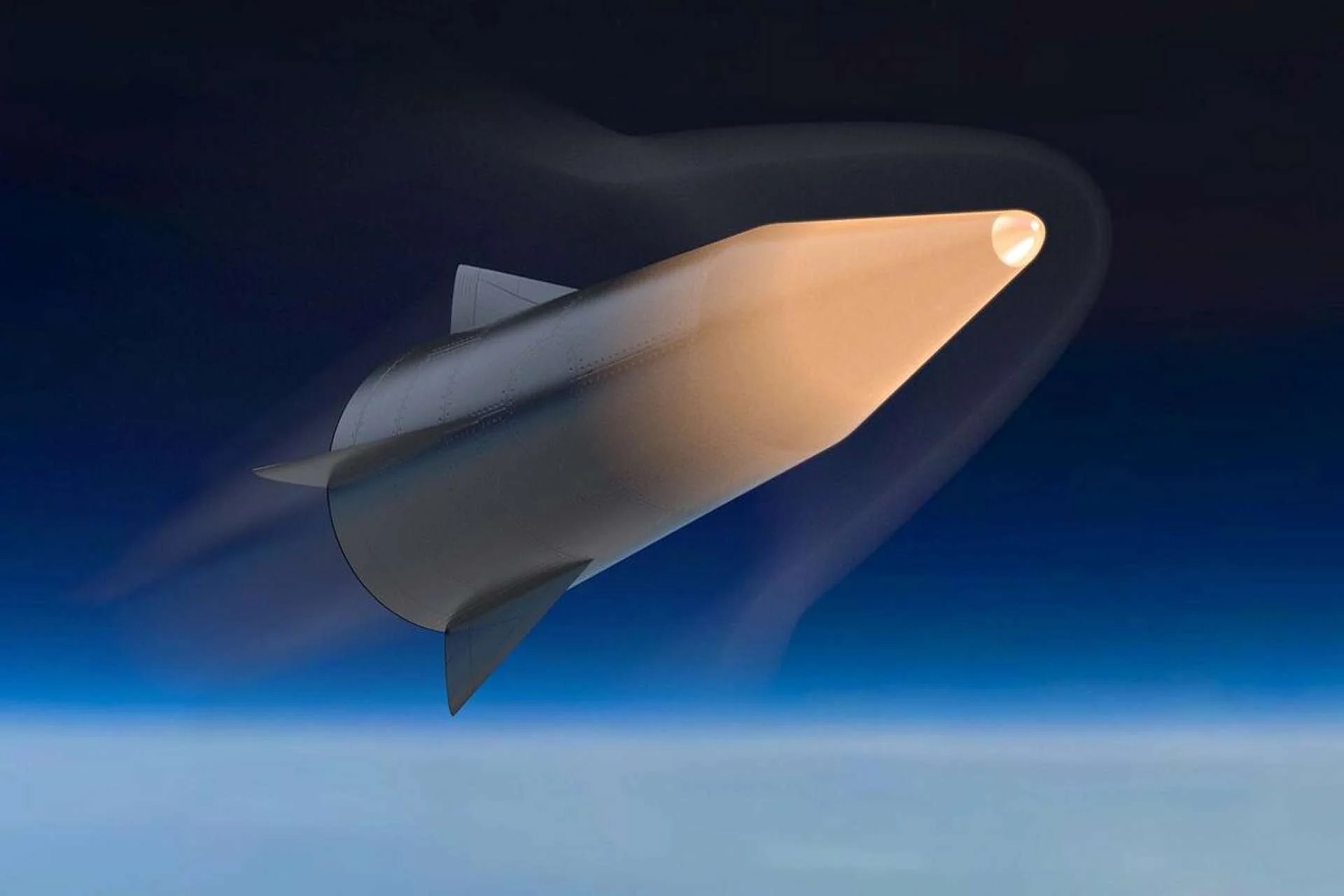
The UK Ministry of Defence has awarded Lockheed Martin UK a GBP20 million contract to develop a hypersonic target for missile-defence testing. The MOD said in a 22 July announcement that Project Bowline will culminate in a live flight demonstration at the Hebrides range in 2027 and will support the development of sensors and interceptors against advanced threats.
The contract value is modest by defence standards, but the capability is not. A hypersonic target is a test article designed to represent a high-speed threat. It is not the same as fielding an interceptor or a weapon. Yet without representative targets, missile-defence programmes cannot prove whether radars, command systems, fire-control loops and interceptors work against manoeuvring threats at relevant speeds.
The MOD says Bowline will support sovereign expertise in modelling, manufacturing and testing, and that the vehicle will represent threats capable of travelling above Mach 5. That speed threshold alone does not define the full challenge. Ballistic missiles can also travel very fast. The hard problem is a target that combines speed, flight profile, manoeuvre, thermal stress, tracking difficulty and compressed decision time. Defenders must detect, classify, track, assign and intercept before the engagement window closes.
Recent analysis of British autonomous air-power development showed how future combat systems require more than platforms. They need testing, networks, doctrine and industrial depth. Hypersonic defence is the same. A country can buy sensors or missiles, but if it lacks representative test infrastructure, it remains dependent on allied ranges and data to validate performance.
Bowline also sits inside the AUKUS Pillar Two agenda. The US Department of Defense announced in 2024 that the United States, Britain and Australia had signed the HyFliTE project arrangement to conduct hypersonic flight-test campaigns, share facilities and accelerate offensive and defensive hypersonic technologies. Australia’s defence department describes HyFliTE as part of AUKUS work on advanced capabilities.
That alliance context matters because no single partner has unlimited test capacity. Hypersonic testing is expensive, instrumented and difficult to schedule. It requires ranges, telemetry, safety arrangements, recovery planning, high-temperature materials, propulsion expertise and data analysis. A live flight at the Hebrides range would strengthen Britain’s contribution to the shared test ecosystem.
The return to target development after more than a decade is also revealing. Western militaries spent years treating hypersonics mainly as an offensive race involving Russia, China and the United States. Defence against hypersonic threats received less public attention because interception is technically difficult and because many existing missile-defence systems were designed around ballistic trajectories or aircraft-like targets. Ukraine’s experience under missile and drone attack has reinforced the importance of layered defence, but hypersonic targets compress those lessons into a harder problem.
Sensors are the first bottleneck. A hypersonic threat may fly lower than a ballistic missile, manoeuvre unpredictably and produce different thermal signatures. Ground radars, airborne sensors and space-based tracking must maintain custody long enough for interceptors to be launched. Losing track for seconds can matter. Bowline can help generate data on how British and allied sensors perform against a more realistic target.
Interceptors are the second bottleneck. It is not enough to fly fast. The interceptor must receive updates, manoeuvre under extreme conditions and arrive at the right point in space at the right time. Testing against scripted or simplified targets can create false confidence. A representative target forces engineers to confront timing, seeker performance and command-chain delays.
Industrial capacity is the third bottleneck. The MOD says the contract will support jobs and supply-chain activity, including small and medium-sized companies. That is politically useful, but also strategically relevant. Hypersonic defence depends on specialised materials, manufacturing tolerances and modelling skills. If those remain fragile, Britain may struggle to expand testing or production during a crisis.
The programme should not be oversold. One target contract will not give Britain a complete hypersonic defence. Nor does a 2027 demonstration guarantee operational readiness. But Bowline fills a necessary gap between theory and procurement. It gives the UK a way to test, learn and contribute data to allied programmes.
The most important output may not be the vehicle itself. It may be the instrumentation, supply chain and engineering habit created around it. Missile defence advances through repeated testing, failure analysis and incremental improvement. In that sense, Project Bowline is a reminder that future air and missile defence is built not only in factories, but on ranges.