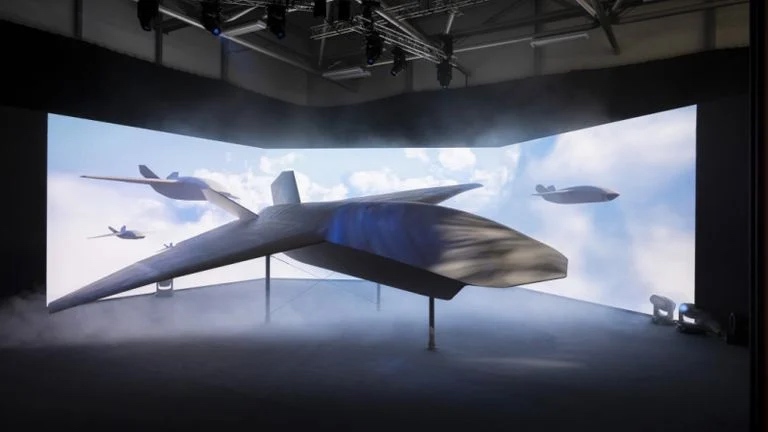
BAE Systems has formally disclosed Brontanax, an uncrewed collaborative combat aircraft designed to fly alongside crewed RAF fighters and add lower-cost combat mass. The company says on its Brontanax product page that the aircraft is similar in scale to the Hawk, built around open architecture and intended to operate as part of a wider force mix rather than as a simple drone replacement for existing jets.
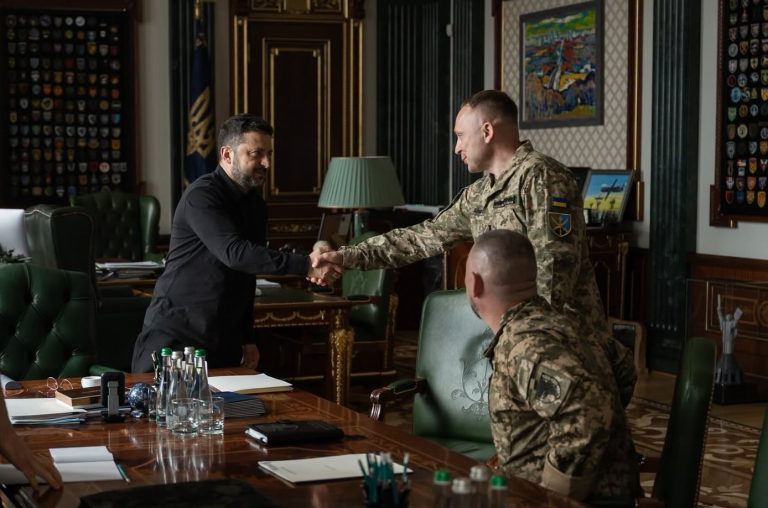
The announcement moves the programme beyond a concept label. BAE says it has developed the project with the Royal Air Force since 2022 and plans flight testing in 2027. Reuters imagery from Farnborough showed the aircraft being presented with senior company and defence figures present, giving the programme a political and industrial profile as well as a technical one. Recent coverage of BAE’s low-cost Brontanax pitch framed the immediate question as affordability. The follow-on question is whether affordability can be achieved without making the platform too limited for contested airspace.
Collaborative combat aircraft occupy an awkward middle ground. They are expected to be cheaper and more numerous than crewed fighters, but they cannot be so basic that they become easy targets. They may carry sensors, electronic-warfare payloads, weapons or decoys. They may fly ahead of crewed aircraft, extend sensor reach, absorb risk or complicate enemy air-defence calculations. Each mission pushes the design in a different direction.
For Britain, Brontanax sits inside a larger force-structure problem. The RAF has high-end combat aircraft, including Typhoon and F-35, and is working toward the Global Combat Air Programme with Italy and Japan. But high-end aircraft are expensive, maintenance-intensive and numerically limited. In a prolonged conflict against an opponent with layered air defences, a small fleet of exquisite platforms can be powerful yet too thin. The logic of Brontanax is that mass must return to air power, but in a form that does not require training and risking a pilot for every aircraft.
The competitive environment is also changing. Boeing’s MQ-28 Ghost Bat, Anduril’s Fury and other autonomous systems show that new entrants and non-traditional defence firms want to define the category. BAE brings integration experience, security clearances, RAF relationships and British industrial depth. Newer companies bring software speed, autonomy-first design cultures and a willingness to iterate quickly. Brontanax will be judged partly on whether BAE can combine the credibility of a prime contractor with the development tempo expected in autonomy.
The open-architecture claim is therefore important. If Brontanax becomes a closed platform with slow upgrade cycles, it risks being outdated before it reaches useful scale. Threat libraries, electronic warfare, autonomy software, payloads and communications links will need constant revision. A collaborative aircraft that cannot accept new mission systems quickly would reproduce the weaknesses of legacy procurement in a cheaper airframe.
Interoperability is another hard problem. A useful uncrewed fighter must communicate with crewed aircraft, command networks, ground stations, satellites and other unmanned systems in degraded conditions. It must also behave predictably around pilots. The more autonomous it becomes, the more important rules of engagement, human control, fail-safe behaviour and cyber resilience become. If it depends too heavily on constant datalinks, it may struggle in electronic warfare. If it operates with too much autonomy, commanders will demand stronger assurance.
The industrial-policy dimension is equally significant. Britain wants sovereign capability, but no European state can afford to duplicate every component of future air combat. Brontanax may support a domestic supply chain while still relying on allied sensors, engines, software tools or weapons integration. That balance will matter because uncrewed combat systems are likely to become export-sensitive. Customers will want capability; governments will worry about autonomy, targeting and proliferation.
There is also a cost trap. The category is often described as affordable or attritable, but aircraft become expensive when requirements accumulate. Stealth shaping, resilient communications, advanced sensors, weapons carriage, autonomy, survivability and certification can push a platform toward the price of a small fighter. BAE’s challenge is to stop Brontanax from becoming too precious to lose. If commanders hesitate to risk it, it will not solve the mass problem.
The 2027 flight-test target is therefore the first real test of credibility. Static display and digital renderings can establish intent. Flight testing reveals integration, handling, maintainability and how quickly a design can be adapted after failure. The RAF will need evidence not only that Brontanax can fly, but that it can be produced, upgraded and fielded in numbers relevant to wartime attrition.
Brontanax shows that Britain understands the direction of air warfare. The question is whether it can move from understanding to inventory. The future fighter race will not be won by the prettiest concept or the most dramatic autonomy claim. It will be won by the system that can deliver trusted combat mass quickly enough to matter.