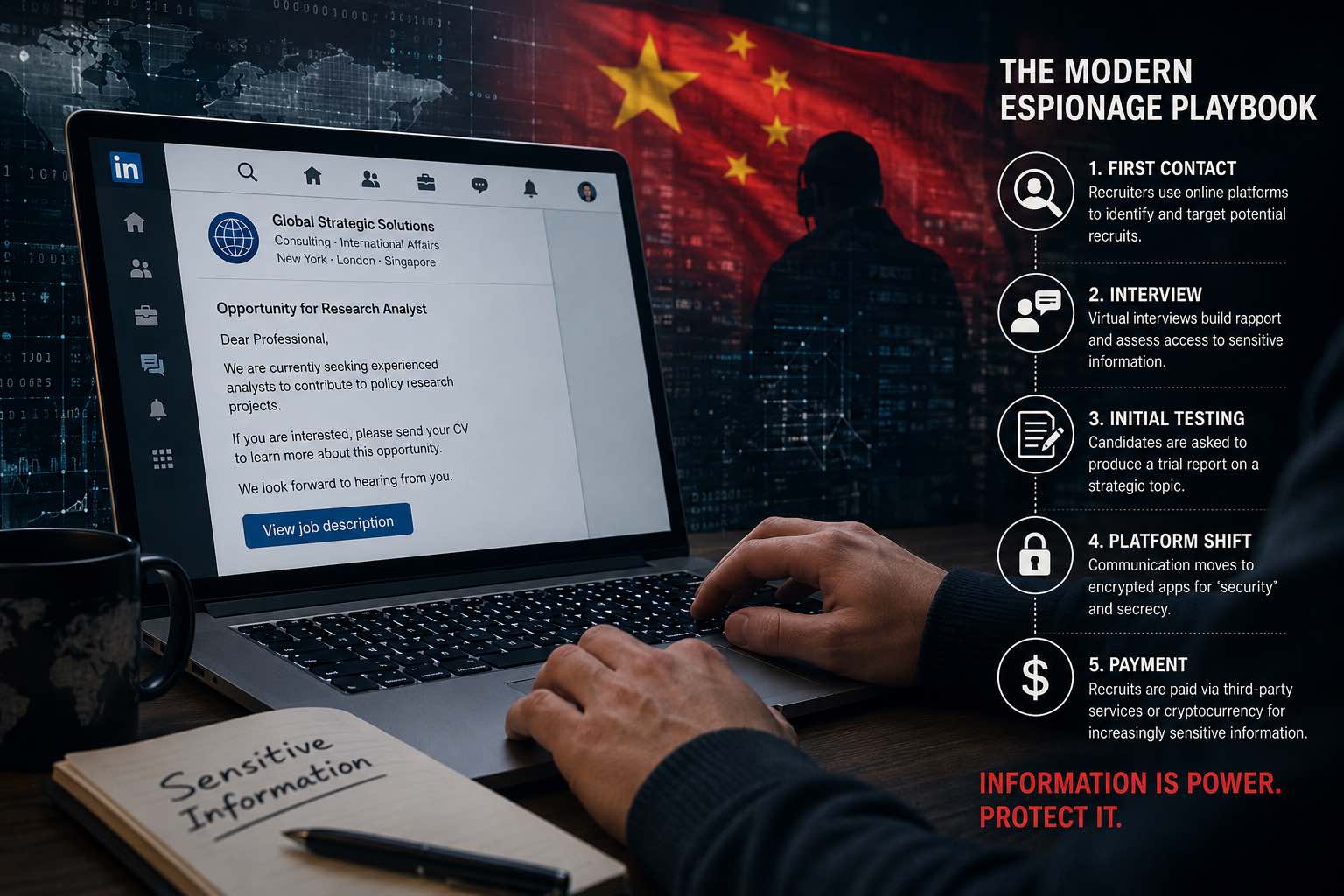
Rather than clandestine meetings in anonymous hotel rooms or the cinematic exchanges of the Cold War, today’s contest increasingly unfolds on LinkedIn, freelance recruitment platforms and encrypted messaging applications. The target is no longer confined to senior officials with access to state secrets. Academics, journalists, researchers, consultants and even freelance analysts have become part of the intelligence landscape.
The document, Safeguarding Our Secrets, represents one of the clearest public acknowledgements yet that China’s military intelligence services have industrialised the use of online recruitment as a means of acquiring strategic information from Western democracies. It also reflects a growing willingness among the intelligence agencies of Australia, Canada, New Zealand, the United Kingdom and the United States to publicly identify the methods employed by Beijing rather than relying solely upon classified counter-intelligence operations.
What distinguishes this warning is its breadth. Chinese intelligence services are not portrayed as searching exclusively for highly classified documents. Instead, they are seeking thousands of individual fragments of information which, when assembled, can provide a remarkably detailed picture of military capabilities, political decision-making and economic vulnerabilities.
This reflects a philosophy of intelligence collection that has long characterised Chinese strategic thinking. Rather than depending upon a handful of spectacular espionage successes, Chinese agencies appear increasingly focused upon accumulating vast quantities of seemingly innocuous information from numerous sources. Modern data analytics then allows those fragments to be correlated into intelligence of considerable operational value.
The Five Eyes advisory identifies a carefully structured recruitment process. It typically begins with what appears to be an entirely legitimate employment opportunity. Intelligence officers, or intermediaries acting on their behalf, create convincing online identities, often posing as employees of consultancy firms, human resources companies or policy research organisations. Vacancies advertised on professional networking platforms invite applications from individuals possessing expertise in defence, international relations or regional security.
At first glance, there is little to distinguish these approaches from ordinary commercial recruitment. That is precisely the point.
Candidates are interviewed remotely, frequently through video conferencing platforms, before being invited to prepare apparently harmless analytical reports concerning issues such as Indo-Pacific security, international trade or bilateral diplomatic relations. Only gradually does the nature of the requests change. Additional payments are offered for reports containing increasingly privileged information, while communications migrate to encrypted applications beyond the visibility of conventional corporate oversight. Compensation may rise from several hundred dollars to several thousand, often arriving through third-party payment services or cryptocurrency.
The sophistication lies not merely in the deception but in the incremental nature of the relationship. By the time recruits recognise that their client may represent a foreign intelligence service, they may already have accepted payment, shared sensitive material and established a pattern of cooperation.
Perhaps the most striking aspect of the advisory is its expanded definition of who may constitute a valuable intelligence target.
The traditional image of espionage centres upon diplomats, intelligence officers and military commanders. The Five Eyes warning paints a far broader picture. Security clearance holders remain prime targets, but so too are academics, journalists, think tank researchers, freelance writers and individuals working around government institutions rather than inside them. Even peripheral access to policy discussions or institutional networks is regarded as potentially valuable by hostile intelligence services.
For journalism, this raises uncomfortable questions.
Investigative reporters routinely cultivate confidential sources, analyse government policy and publish specialist assessments. Most operate entirely within ethical and legal boundaries. Yet journalists also possess exactly the professional profiles that foreign intelligence recruiters may seek to exploit. Freelance contributors, particularly those working independently across multiple publications, can be especially vulnerable to approaches disguised as commercial research contracts.
The same applies to universities. Academic collaboration has become a defining feature of global research over recent decades, particularly in science, engineering and international affairs. Yet universities have also emerged as arenas where strategic competition increasingly intersects with open scholarship. Balancing academic openness with national security will remain one of the defining policy dilemmas of the coming decade.
There is also a broader geopolitical context underpinning the advisory.
Relations between China and the Five Eyes partners have deteriorated steadily over issues ranging from technology transfer and cyber security to Taiwan, the South China Sea and export controls on advanced semiconductors. Intelligence competition has become an increasingly prominent dimension of that rivalry.
Unlike Cold War espionage, however, today’s contest occurs within an environment characterised by unprecedented global connectivity. Professional networking platforms have dramatically reduced the costs of identifying, contacting and assessing potential recruits anywhere in the world. Artificial intelligence further enhances this capability by allowing vast numbers of online profiles to be analysed automatically according to career history, language skills, institutional affiliations and likely access to sensitive information.
In effect, digital recruitment platforms have become intelligence marketplaces.
The Five Eyes document therefore serves not merely as a warning about China but as an illustration of how intelligence work itself has evolved. The distinction between commercial networking and clandestine recruitment has become increasingly blurred.
The advisory is also careful to stress that even information regarded as unclassified can carry significant intelligence value. Military installations, policy discussions, organisational structures, procurement plans or professional relationships may individually appear harmless. Collectively, they may enable adversaries to construct detailed operational assessments capable of influencing military planning or political decision-making.
This principle is often misunderstood outside intelligence communities. Modern espionage rarely depends upon obtaining a single dramatic secret. Instead, competitive advantage frequently emerges through aggregation.
The public nature of this warning is itself strategically significant.
By exposing recruitment techniques openly, the Five Eyes agencies seek to harden societal resilience rather than relying exclusively upon secret counter-intelligence operations. Awareness becomes part of national defence. Individuals who recognise suspicious approaches are less likely to become unwitting participants in foreign intelligence collection.
The advisory concludes with a reminder that some individuals have already faced criminal prosecution, dismissal from employment and revocation of security clearances after participating in such activities. It also directs readers towards protective guidance issued by the United Kingdom’s National Protective Security Authority.
Ultimately, Safeguarding Our Secrets reflects a broader transformation in international security. Strategic competition increasingly depends upon information rather than territory, algorithms rather than armoured divisions, and recruitment messages rather than dead drops.
For governments, businesses, universities and media organisations alike, the lesson is clear. In an interconnected digital economy, professional networking can no longer be viewed solely through the lens of career development. It has also become an arena of geopolitical competition.
The intelligence contest of the twenty-first century is not taking place in the shadows alone. Increasingly, it begins with an unsolicited message offering an attractive consulting opportunity.
France Probes Suspected Russian Sabotage and Espionage Cases