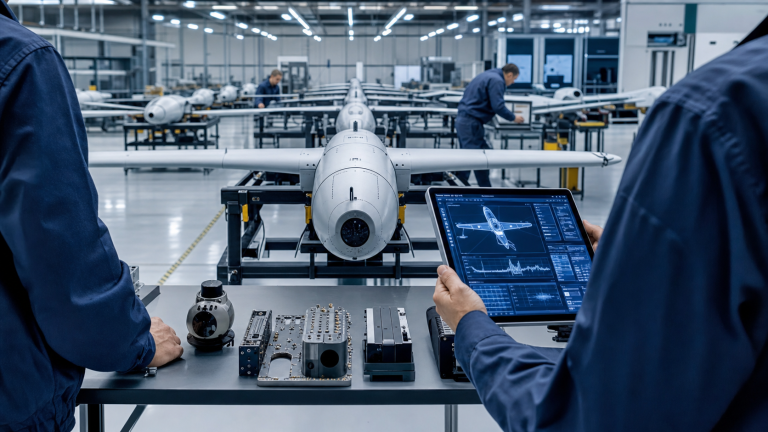
European governments increasingly want maintenance, software access and manufacturing authority alongside US weapons, forcing American suppliers to localise production without surrendering their most sensitive technology.
US defence companies are expanding joint ventures and European production as governments demand more than local assembly from foreign weapons purchases.
The new requirement is control: the ability to maintain systems, replace components, update software and sustain operations without seeking continuing permission from a supplier government.
Lockheed Martin, RTX and Anduril have each pursued European industrial partnerships, although their models differ. Public company announcements and government contracts show a broader trend towards co-production, local maintenance and integration with national suppliers.
That trend reflects higher defence budgets and the experience of Ukraine, where access to software, spare parts and munitions can determine whether a nominal capability remains usable during war.
A system can carry a “made in Europe” label while its critical software, cryptographic keys, source code, components and export permissions remain controlled abroad.
Local assembly creates employment and production familiarity. Sovereign sustainment requires technical data, tools, trained personnel, spares and legal rights. Sovereign modification requires even more sensitive access.
Governments should define which level they need before tendering. Demanding complete design control over every imported system may be unrealistic and expensive. Accepting dependence for a mission-critical capability can be strategically dangerous.
The correct answer varies. A training aircraft presents different risk from national air defence or secure communications.
European Patriot users have invested in local missile and component production through arrangements involving RTX and MBDA. Co-production can expand capacity and distribute maintenance expertise.
Defence Matters has analysed how Ukraine’s proposed Patriot licensing still cannot close its immediate missile gap. The lesson applies more widely: a licence is not a factory, and a factory is not a sovereign supply chain.
Motors, seekers, energetic materials and software may remain constrained. European buyers should map which parts can be produced locally, what requires US approval and how output is allocated in a crisis.
Long-term orders are necessary. Companies cannot invest in tooling and skills based only on political declarations.
Modern systems derive much of their capability from software, threat libraries and network integration. A country may own the hardware but lack authority to change how it behaves.
European buyers increasingly seek open interfaces and national mission-data control. They want to integrate domestic sensors, weapons and command systems without waiting for a foreign update cycle.
American firms have legitimate concerns about cybersecurity and leakage of sensitive technology. Access can be tiered: open interfaces for integration, escrow arrangements for continuity and controlled facilities for highly sensitive code.
Contracts should specify update rights, vulnerability handling, data ownership and what happens if political relations deteriorate.
For US suppliers, localisation is not charity. It can secure access to European budgets, satisfy industrial-return requirements and provide capacity closer to customers.
For European companies, a joint venture can bring technology and export opportunities. It can also relegate them to lower-value manufacturing while design authority stays in the United States.
Governments should measure local value by engineering work, intellectual property and sustainment authority, not only employment numbers.
Competition remains essential. A localisation offer should not become a route to a closed national market. European and US designs should be tested against operational performance, delivery time, cost and sovereignty requirements.
European control is sometimes presented as opposition to NATO or the United States. That is too simplistic. Allies with stronger sustainment and production capacity contribute more to collective defence.
The tension arises when national autonomy fragments standards or excludes the best capability for political reasons. Common NATO interfaces and shared certification can allow European control without sacrificing interoperability.
Defence Matters’ report on NATO allies selecting Saab GlobalEye showed how a European platform can sit within a transatlantic system. Sovereignty and integration are not mutually exclusive when interfaces and responsibilities are defined.
Every major tender should answer:
Answers should be enforceable contract terms. Promises made at air shows are not substitutes for licences, data packages and funded facilities.
Europe’s demand for local control will persist because rearmament involves capabilities expected to serve for decades. Governments no longer assume that global supply chains or political permissions will remain stable in every crisis.
US companies that offer meaningful sustainment and integration rights will remain competitive. Those that preserve a closed architecture may find European alternatives more attractive even when the American system performs better in isolation.
European industry must also earn confidence. Sovereignty claims are weak if domestic suppliers deliver late, charge excessive prices or cannot scale.
The emerging bargain is neither full technological transfer nor continued dependence. It is negotiated control over the functions a state needs to fight, repair and adapt.
Where a weapon is assembled still matters. The decisive question is who can keep it operating when permission, connectivity or supply is contested. European buyers are increasingly writing that question into the procurement itself.