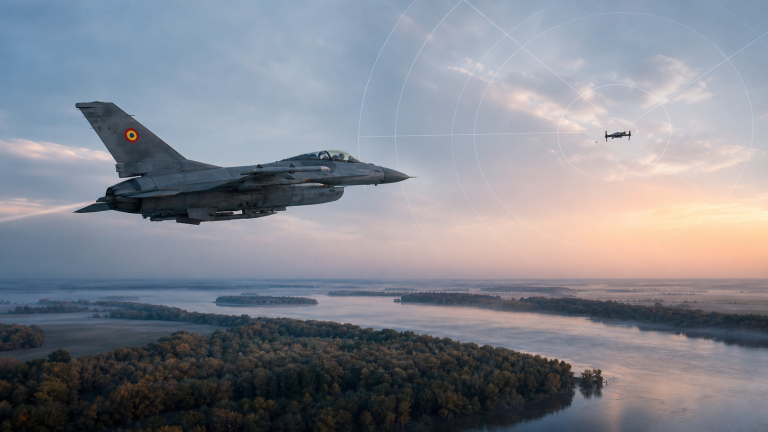
A third Romanian F-16 engagement in three days shows that drone incursions are becoming an operational burden, not an occasional border-security incident.
Romania has shot down a third unauthorised drone in as many days, turning what might once have been treated as an isolated spillover incident into a sustained test of NATO air policing on the Black Sea flank.
The Romanian Ministry of National Defence said an F-16 destroyed the aircraft at 10:13 local time on Sunday, 26 July, after it entered national airspace without authorisation. The ministry said the engagement occurred over Romania’s territorial waters in the Black Sea. It did not immediately identify the drone’s model or operator.
That qualification is important. Attribution should follow the evidence recovered from radar tracks, cockpit recordings and, if possible, wreckage. Nevertheless, the operational pattern is already clear. Romanian fighters have now used force against airborne targets on three consecutive days.
The first shootdown on 24 July took place near Padina in Buzău county. A second incursion was detected the following morning near the Ukrainian border, leading to another F-16 engagement. Defence Matters examined that incident in Romania’s Second Drone Shootdown Marks a New Phase in NATO Airspace Defence. Sunday’s interception moves the issue further: the question is no longer whether Romania has the legal authority or political willingness to act, but whether its current response can be sustained.
F-16s are highly capable interceptors. Their speed, radar and trained crews allow Romania to investigate a contact quickly and engage it well beyond the reach of many point-defence weapons. They are also expensive assets to keep continuously airborne or at high readiness.
A small one-way drone may cost tens of thousands of euros. An F-16 sortie consumes fuel, maintenance hours and crew capacity, while an air-to-air missile can cost many times the value of the target. The comparison does not mean Romania should decline to intercept. The relevant value is the harm prevented, not the purchase price of the intruding aircraft. A relatively cheap drone can kill civilians, damage a refinery or gather intelligence on military positions.
The imbalance does mean that fighters cannot be the only answer. Three consecutive engagements suggest a campaign can impose costs even when every target is destroyed. An adversary can force repeated launches, disrupt training schedules and accelerate the consumption of finite munitions without needing to hit a strategic target.
Romania therefore needs a layered system in which combat aircraft are one component. Passive radio-frequency sensors, low-level radar, electronic warfare, anti-aircraft guns, short-range missiles and mobile counter-drone teams can cover different parts of the threat. No single system will suit the Danube delta, open Black Sea approaches, urban areas and military installations equally well.
Detection is not the same as classification. Small drones can have limited radar signatures, fly close to terrain and change course because of navigation failure or electronic interference. Civilian and military unmanned aircraft can also share components and flight characteristics.
Romanian commanders must determine whether an object is merely unauthorised, whether it is carrying explosives and whether destroying it will create a greater danger to people below. Those judgements must sometimes be made in minutes. Sunday’s engagement over territorial waters reduced the immediate risk from falling debris, but the first interception occurred over land.
The ministry’s caution about attribution is therefore appropriate. Russia’s sustained attacks on Ukrainian infrastructure near Romania make Russian origin a serious possibility, but a credible public account requires more than geographical inference. Technical evidence can identify an engine, flight-control unit, warhead or manufacturing batch. Radar data can reconstruct the route and establish whether the aircraft crossed directly from an area used for Russian attacks.
Where operational security permits, Romania should publish a factual reconstruction after each investigation. Quick, evidence-led disclosure would reduce the space for disinformation and allow NATO allies to compare incidents across the eastern flank.
Traditional NATO air policing is built largely around identifying manned aircraft, escorting them and demonstrating sovereign control of allied skies. Cheap, expendable drones present a different problem. They may not respond to signals, may carry no pilot whose safety must be considered and may be launched in numbers intended to saturate sensors.
Defence Matters previously argued that Eastern Sentry looked reactive as Russian drones tested NATO’s eastern flank. Romania’s three engagements underline the gap between a reassuring allied presence and a sustainable denial system.
National rules of engagement will inevitably differ, but NATO requires compatible definitions and procedures. A drone tracked across borders should not become a new mystery each time it enters another country’s air picture. Shared tracks, common incident formats and rapid technical exploitation would allow allies to distinguish recurring routes from unrelated accidents.
The Alliance must also communicate escalation carefully. Shooting down an unauthorised military drone inside allied airspace is an act of defence. It does not automatically trigger Article 5, which remains a political decision concerning an armed attack and its context. At the same time, describing every incursion as accidental before the evidence is available risks normalising conduct that imposes real costs and danger.
Bucharest should now treat the three incidents as a single operational episode. The review should examine how early each target was detected, how long fighters remained airborne, which sensors produced a reliable track and whether a lower-cost effector could have completed the engagement.
The armed forces must also coordinate closely with civilian authorities. Warnings, temporary airspace restrictions, debris recovery and public communication are part of the defensive system. A successful interception can still cause casualties if wreckage falls into an inhabited area or if residents approach hazardous components.
Procurement decisions should follow the operational evidence rather than the understandable desire for a single rapid solution. Romania’s delayed Watchkeeper X programme, covered by Defence Matters in April, illustrates the broader challenge: frontline states need surveillance and counter-drone capacity that arrives on time and integrates with existing commands.
Three destroyed drones demonstrate that Romania can act. They do not prove that the present model is affordable at a higher tempo. The strategic test is whether Bucharest and NATO can convert a series of successful emergency engagements into a persistent, layered posture that denies hostile access without allowing cheap aircraft to dictate the rhythm of allied operations.