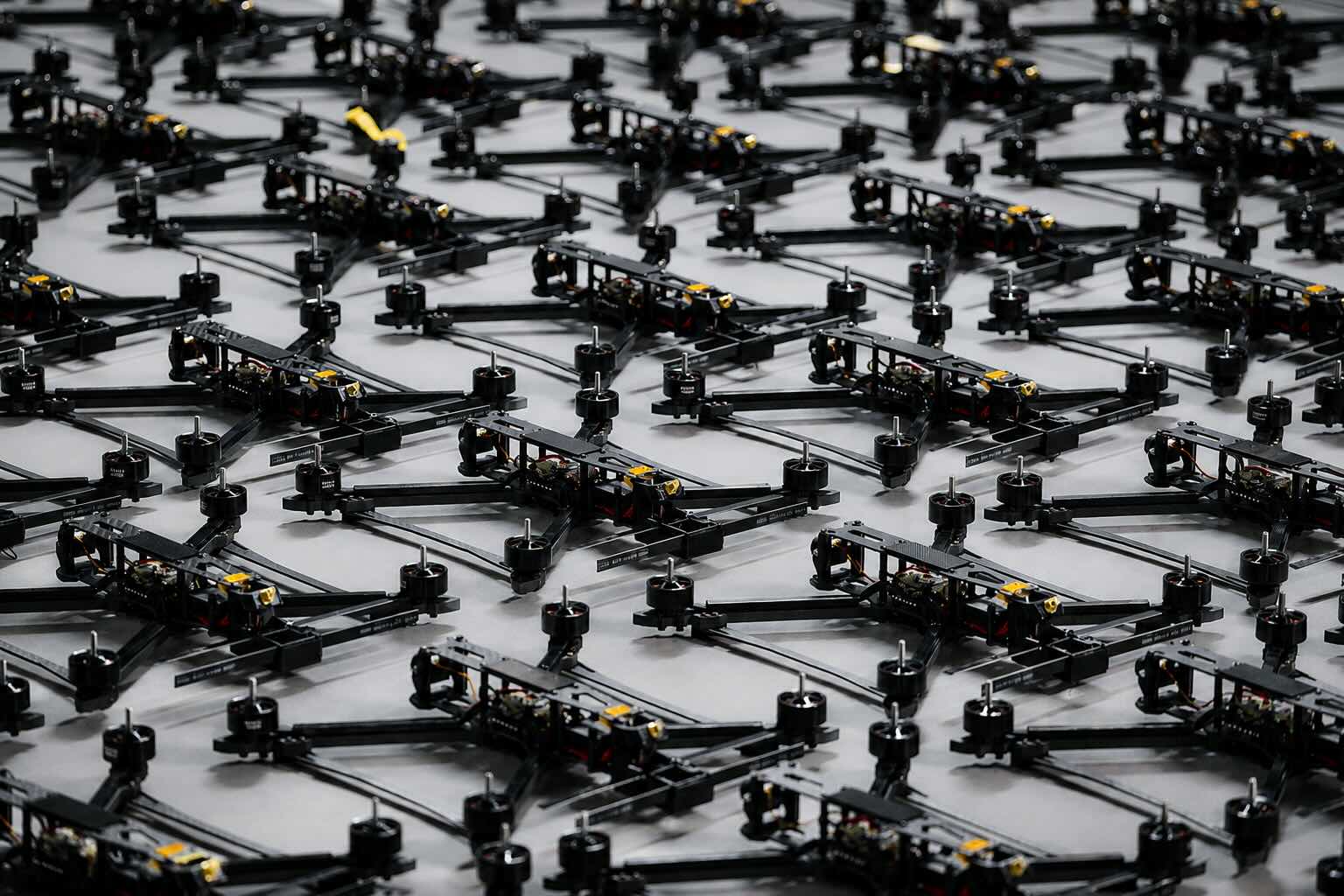
Ukraine expects to produce six to seven million FPV drones this year. The Pentagon is still trying to create a much smaller American market while excluding the Chinese components on which cheap systems depend.
The United States remains several years from matching Ukraine’s wartime production of small drones, according to the Pentagon official responsible for building a domestic manufacturing base, an unusually candid assessment of the industrial gap facing the world’s largest defence spender.
Travis Metz, deputy director and chief operating officer of the Pentagon’s Drone Dominance programme, told Reuters that Ukraine is expected to produce between six million and seven million first-person-view drones this year—roughly 500,000 a month.
The American programme, backed by $1.1 billion, had ordered fewer than 200,000 systems cumulatively by February. Its objective is not simply to buy more aircraft. Washington is trying to create a scalable domestic industry while tightening rules intended to remove Chinese motors, battery packs and other components from the supply chain.
That combination exposes the central difficulty. Ukraine’s output was built under the pressure of national survival, with commercial components, dispersed workshops, direct feedback from combat units and acceptance that designs may become obsolete within weeks. The Pentagon wants similar speed, but also American content, cyber assurance, testing, traceability and procurement discipline.
A million-drone inventory is not merely a larger version of a conventional unmanned-aircraft programme. It requires different assumptions about price, loss and replacement.
Small FPV drones are expendable. Many are destroyed, jammed, crashed or abandoned after a single mission. Their military value comes from the ability to manufacture and modify them faster than the enemy can adapt.
Ukraine’s system connects soldiers to volunteer networks, private companies and government purchasing. Units often test new components directly and send operational findings back to developers. That feedback loop has produced extraordinary speed, although it has also created problems of standardisation, quality and fragmented procurement.
The United States traditionally purchases smaller numbers of more expensive systems through programmes that can take years to mature. That approach works for aircraft expected to remain in service for decades. It is poorly suited to a drone whose radio, software or navigation method may need changing next month.
The Drone Dominance programme is an attempt to create a faster route. The production comparison shows how far it still has to travel.
Cheap drones rely on the vast civilian supply chain developed around consumer electronics, model aircraft and batteries. China is deeply embedded in that market.
Washington has good reasons to reduce the dependence. A high-intensity conflict involving China could interrupt supply precisely when demand was highest. Components may also present security, quality or data risks.
Yet localisation raises cost and can slow delivery. An American motor or battery produced in relatively small volumes will initially struggle to match the price of a mature Chinese product. Manufacturers also need confidence that Pentagon orders will continue long enough to justify investment.
Defence Matters recently examined how EU–Ukraine drone production remains exposed to Chinese components. The US problem is sharper because the Pentagon is imposing domestic-content requirements at the same time as it tries to expand output.
The rules for an August competition reportedly exclude Chinese motors and battery packs. Ukrainian companies wishing to participate are expected to create joint ventures in the United States. That may transfer valuable experience, but it also introduces legal, ownership and production questions that do not exist when Kyiv buys directly from a Ukrainian workshop.
Ukraine’s model cannot simply be imported. Its procurement system grew under emergency conditions and has tolerated risks that a peacetime American department may not accept. Some Ukrainian producers have also faced uncertain orders, late payments and changing technical requirements.
The lesson is not that all oversight should disappear. It is that oversight must match the nature of the product.
The Pentagon can define open interfaces, test against jamming and navigation loss, and require minimum safety standards without freezing a design for years. It can qualify multiple sources for vulnerable components and use short production blocks so that later versions incorporate battlefield lessons.
Orders should reward output and performance rather than elaborate promises. A company that produces thousands of acceptable systems deserves a path to further purchases; one that delivers impressive demonstrations but cannot manufacture at scale should not.
American forces also need realistic training. Large inventories have limited value if units cannot operate them under electronic attack, coordinate airspace or repair systems in the field. Ukraine’s advantage is organisational as well as industrial.
The production gap matters beyond the United States. European allies may assume that American industry can compensate for shortages during a major war. The figures suggest that this cannot be taken for granted in the drone sector.
NATO needs compatible control systems, shared component standards and the ability to exchange designs without forcing every country into an identical platform. Joint procurement can support volume, but a single multinational programme could become too slow for the technology cycle.
Ukrainian partnerships offer a faster route. Defence Matters has reported on proposed US production using Ukrainian drone technology. Such projects must preserve the rapid iteration that made the technology valuable in the first place.
The Pentagon’s admission is useful because it replaces vague ambition with a measurable comparison. The United States does not need to reproduce every feature of Ukraine’s wartime economy. It does need an industry capable of moving from tens of thousands to millions when the threat requires it.
Success should be measured through monthly deliveries, qualified alternative components, unit cost and the time required to incorporate operational changes. Factory announcements and funding totals are insufficient.
There is no contradiction between secure supply and rapid production, but achieving both demands early investment and predictable orders. If Washington waits until a crisis to replace Chinese components, it will discover that industrial sovereignty cannot be improvised.
Ukraine’s six to seven million drones are the product of battlefield necessity. The Pentagon’s challenge is to build comparable depth before necessity becomes an American condition.