A low-flying decoy apparently crossed two NATO airspaces without detection before exploding beside strategic energy infrastructure, presenting a different readiness problem from Romania’s recent successful interceptions.
A drone crossed from Romania into Bulgaria and exploded close to compressor stations on the Trans-Balkan gas pipeline after apparently going undetected by both countries, exposing a surveillance gap on NATO’s Black Sea flank.
Bulgarian Prime Minister Rumen Radev said the aircraft exploded approximately 100 metres inside Bulgarian territory early on 8 August. It came down about 200 metres from a Romanian compressor station and roughly one kilometre from a Bulgarian station. There were no casualties or reported structural damage.
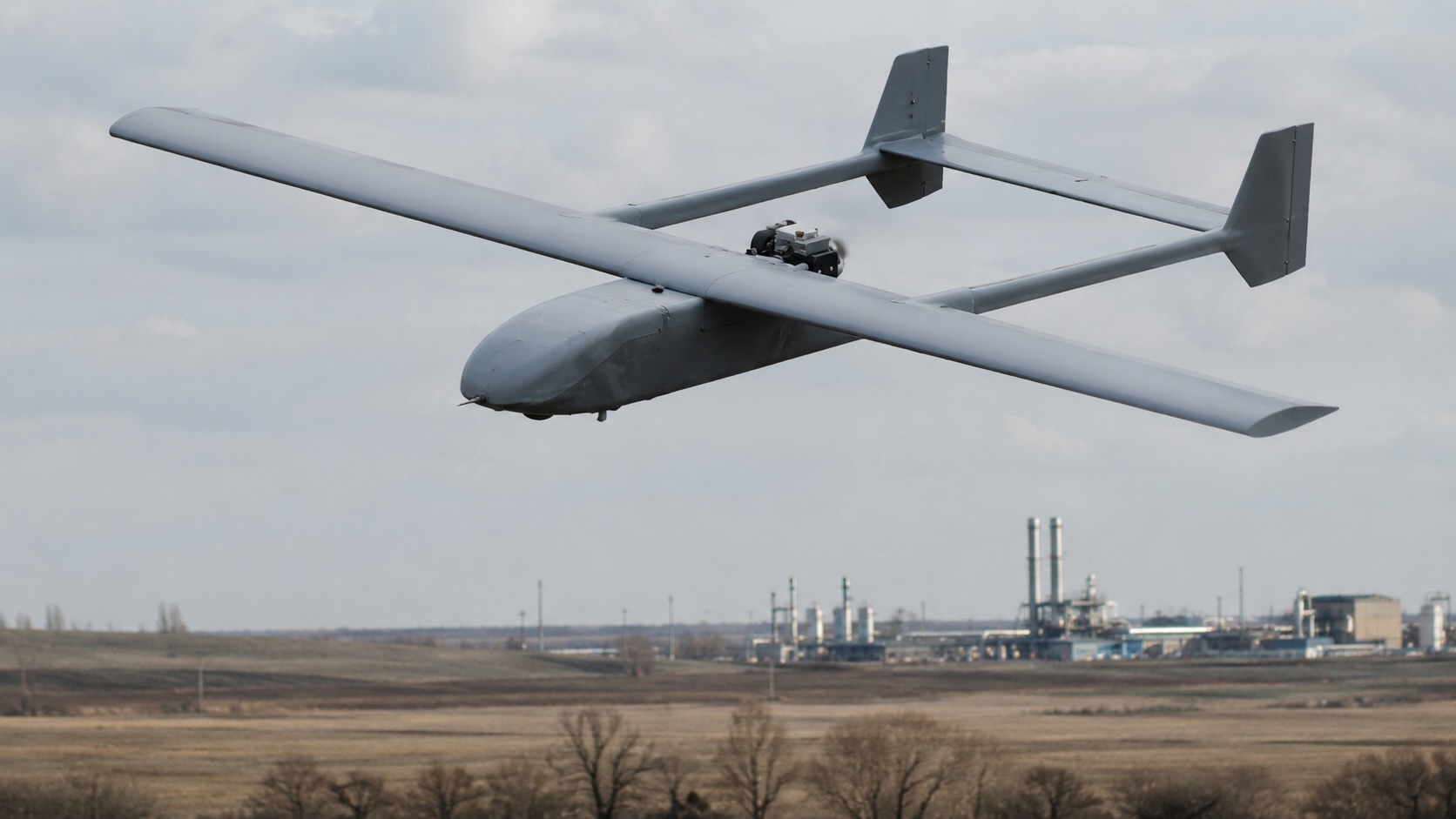
The Bulgarian defence ministry said preliminary analysis indicated that the wreckage was most likely from a Maya decoy, a type widely used by Ukraine. It said there was no reason at that stage to believe the incident was intentional. Ukraine said it had not deliberately targeted Bulgaria and was examining the circumstances.
Those findings remain preliminary. The drone should not be described as Ukrainian-owned or deliberately launched towards Bulgaria without firmer evidence about its route, operator and mission.
The operational fact is already serious: an aircraft carrying enough explosive material to produce a substantial blast passed through two allied airspaces and reached the vicinity of an international gas corridor without an effective warning or interception.
Romania recently demonstrated that it was willing and able to use fighters against unauthorised drones. Defence Matters reported on a second Romanian interception and then a third shootdown that tested the sustainability of NATO readiness on 26 July.
Those cases concerned detection, classification and the cost of using F-16s against relatively cheap targets. The Bulgarian incident raises the more basic question of whether a drone has been seen at all.
Radev said the aircraft had not been detected or identified during its passage through Romanian or Bulgarian airspace. If confirmed by the joint investigation, that would indicate a gap in the low-altitude surveillance picture rather than a failure to authorise engagement.
Small drones and decoys can fly close to terrain, present limited radar signatures and use routes that exploit gaps between fixed sensors. Border areas are particularly difficult because tracks must be transferred between national systems and assessed quickly enough for one country to act on information originating in another.
The Trans-Balkan pipeline system links energy infrastructure across south-eastern Europe. The blast did not damage the nearby compressor stations, but proximity matters.
Compressor facilities are concentrated nodes. They regulate pressure and keep gas moving through long pipeline sections. Damage to a compressor station can interrupt flows more seriously than localised damage to an underground pipe, while repair may require specialist equipment.
An accidental crash is therefore capable of producing a strategic effect even when the infrastructure was not the intended target. A decoy diverted by navigation failure or electronic interference can still reach fuel storage, power facilities, transport hubs or populated areas.
Critical-infrastructure protection cannot depend entirely on determining hostile intent. Operators and security authorities must plan around the physical consequence of an aircraft arriving, regardless of why it is there.
Military radar networks are designed to detect aircraft and missiles across large areas. Small, slow or low-flying drones create a different target set.
Terrain, buildings, vegetation and the curvature of the earth can mask low-altitude tracks. A sensor adjusted to exclude birds, vehicles and other clutter may also filter out objects with similar signatures. Decoys are designed to confuse defensive systems, although the precise characteristics of the recovered Maya device have not been publicly established.
The answer is not simply to increase radar sensitivity everywhere. Too many false contacts can overwhelm operators and make genuine threats harder to identify.
A layered system combines military radar with passive radio-frequency detection, acoustic and optical sensors, civilian air-traffic information and local counter-drone teams. Data must be fused into a common picture rather than displayed separately to police, military and infrastructure operators.
Romania and Bulgaria are NATO and EU members, but national authorities retain responsibility for their airspace. A drone crossing their border tests how quickly a track, confidence assessment and warning can move between commands.
If Romania did not detect the object, Bulgaria received no advance warning. If Romania detected an uncertain contact but could not maintain the track, the handover procedure may have been inadequate. If Bulgaria had data but could not classify the object, the problem lies elsewhere.
The investigation should establish a minute-by-minute sequence: first possible detection, confirmed border crossing, sensor coverage, alerts issued and the time of the explosion. Publishing a non-sensitive reconstruction would allow NATO partners to learn from the failure without revealing radar performance in detail.
Bulgaria has said it will move border-police anti-drone detection and countermeasure capacity from the Turkish frontier towards Romania. That is an understandable immediate step, but moving a scarce system can create another gap. Persistent coverage requires additional capacity rather than repeated redistribution after each incident.
Bulgaria’s defence minister said the incident would be raised with the North Atlantic Council. The useful outcome would be an operational review rather than a purely political expression of concern.
NATO should compare radar tracks, intelligence and recovered components; assess whether allied airborne surveillance could see the drone; and determine which sensors can close the low-altitude gap along the Romania–Bulgaria boundary.
The Alliance also needs compatible incident reporting. A drone should retain a shared track identity as it crosses borders rather than becoming a new national case in every airspace.
The Associated Press account and original Reuters report both record the absence of casualties, the preliminary Maya assessment and the official view that the event was probably accidental.
Accidental does not mean harmless. The device crossed two NATO countries and exploded beside infrastructure that supports regional energy security. Romania’s recent shootdowns showed that allied forces can act when they see a target. The Bulgarian blast shows why detecting it early enough remains the harder problem.