The fire at a Tallinn building used by Milrem Robotics is being investigated as possible sabotage, but the company says production and deliveries of unmanned ground vehicles remain on schedule.
Estonian investigators have identified suspects in connection with the fire at the Tallinn site. Prime Minister Kristen Michal said possible sabotage and Russian involvement were among the lines of inquiry, but responsibility had not been established at the time of reporting.
That distinction is important. The incident is being treated seriously as a potential hybrid operation, but suspicion is not attribution. Russia has repeatedly denied Western accusations that it organises sabotage against European infrastructure and defence-linked businesses.
Milrem chief executive Kuldar Väärsi said the incident had not affected the company’s production, supply chain or delivery schedule for this year or next. More than 200 of its robotic systems are expected to be deployed in Ukraine by the end of 2026, he told Reuters.
The operational significance lies in that continuity. Sabotage against a defence manufacturer can have several objectives: destroy output, interrupt a supply chain, intimidate employees, raise security costs or create doubt among customers about whether contracted equipment will arrive. Even a limited fire can succeed strategically if it causes delays at a critical point in production.
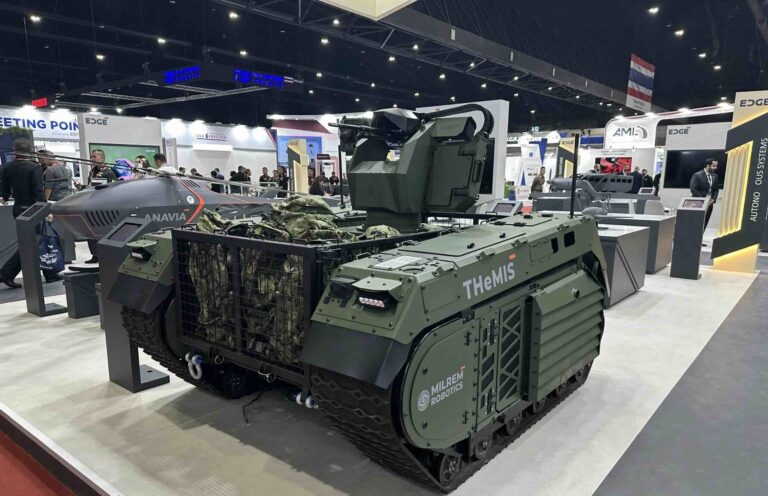
Milrem says that did not happen. Its principal THeMIS platform is a tracked unmanned ground vehicle that can be configured for logistics, casualty evacuation, reconnaissance and other battlefield tasks. Such systems help Ukrainian units move supplies or wounded personnel while reducing soldiers’ exposure to artillery, mines and drones.
The company has expanded production capacity substantially. Its Tallinn facility was designed to produce more than 500 THeMIS vehicles a year, and Milrem has broadened its European industrial footprint. That scale and distribution reduce the risk that damage at a single building will halt the entire programme.
Resilience of this kind is becoming a defence capability in its own right. European states are increasing weapons production while Russia is accused of running a campaign of arson, interference and covert disruption against logistics networks, industrial sites and other organisations connected to support for Ukraine. Defence Matters has documented similar suspected sabotage and espionage cases targeting European defence industry.
Estonia’s government has publicly assessed that one purpose of such activity is to weaken or sever the supply chains carrying military and civilian assistance to Ukraine. The Estonian Government Office says Moscow has sought to sow fear and push Western governments away from continued support.
Protecting factories therefore involves more than perimeter security. Companies need alternative production routes, redundant suppliers, protected data and engineering systems, secure transport arrangements and the ability to recover quickly after an incident. The threat can also involve technology theft alongside cyber activity and physical sabotage. A site may be physically damaged without the attacker achieving an operational interruption if those measures work as intended.
The Milrem case remains an active criminal investigation. Its immediate military result, however, is clear from the company’s account: robotic vehicles intended for Ukraine are still moving through the production and delivery pipeline.
That outcome does not make the suspected attack unimportant. It demonstrates why industrial resilience must sit alongside counter-intelligence and law enforcement in Europe’s response to hybrid threats. Preventing every attempt may be impossible; ensuring that attempts fail to affect battlefield supply is the other half of the defence.