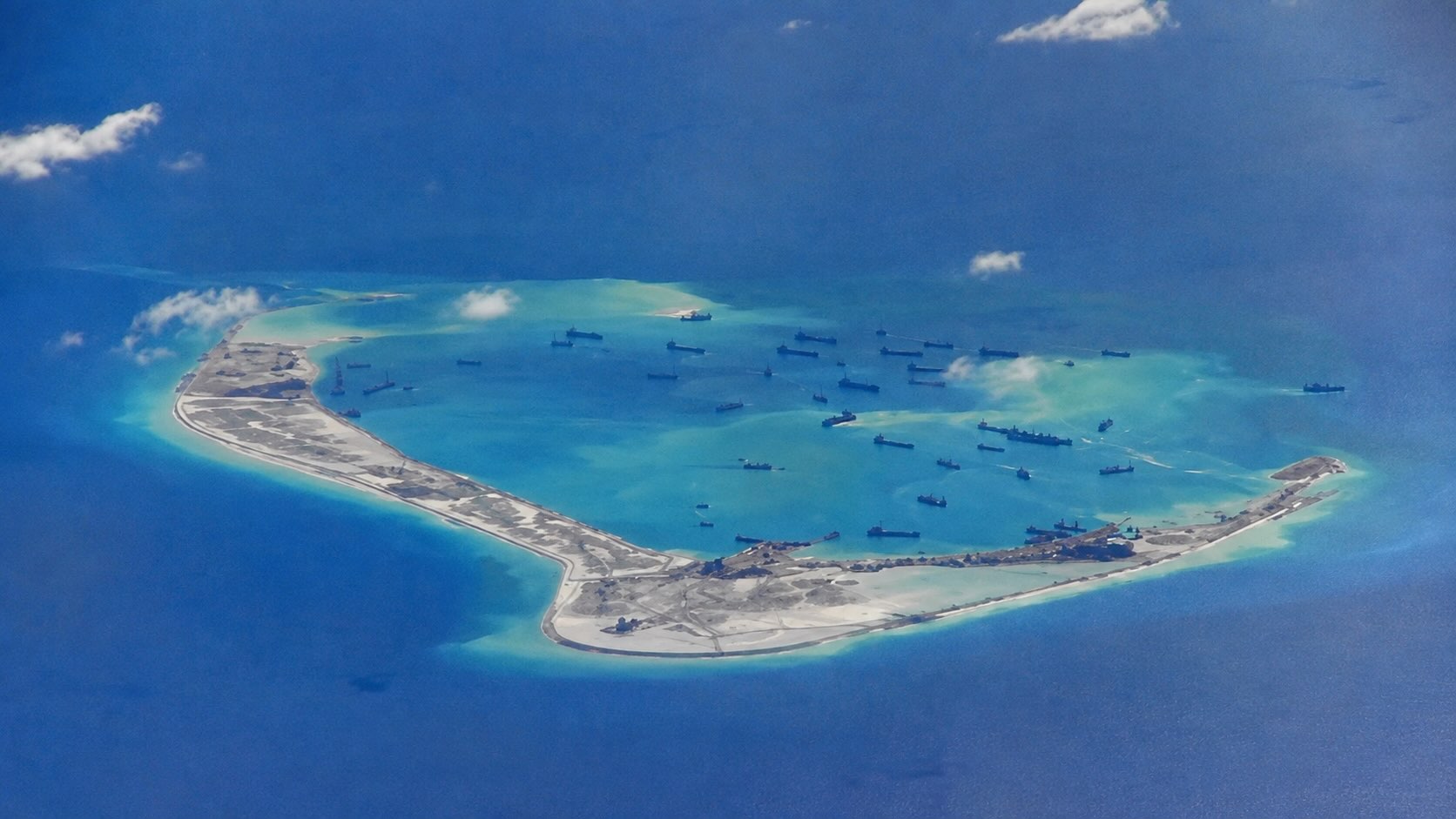
China has transformed Antelope Reef in the northern South China Sea from a small outpost into an artificial island covering roughly 1,500 acres in less than a year, with satellite imagery now showing preparations for infrastructure that could substantially expand the People’s Liberation Army’s operating capacity in the region.
Major dredging began in October 2025. By August, the reclamation fleet had largely departed and the new landmass extended for several kilometres across the reef. The latest satellite assessment of Antelope Reef found that dredging and landfill work appeared to be complete, with the resulting island approaching the size of Mischief Reef, China’s largest existing outpost in the South China Sea.
The next phase appears to be focused on permanent infrastructure.
Along the north-western side of the island, earth-moving work has created a long, straight corridor consistent with preparations for a major runway. No paved airstrip has yet been completed, but the dimensions of the area under construction correspond closely to runways at China’s established bases on Woody Island, Fiery Cross Reef, Subi Reef and Mischief Reef.
There is sufficient space for an airstrip of about 3,000 metres, allowing the facility to accommodate fighters, transport aircraft and other large military aircraft. Excavation close to the expected runway also measures about 60 by 60 metres, comparable with the footprint of large aircraft hangars at other Chinese South China Sea installations.
The scale of the development represents a sharp change for Antelope Reef. Before the current reclamation programme it was among China’s smaller positions in the Paracel Islands. By March, commercial satellite measurements already put reclaimed land at about 1,490 acres, compared with around 890 acres for Woody Island. Earlier analysis of the reclamation programme concluded that Antelope could equal or exceed the size of Mischief Reef if construction continued at the observed rate.
Airfield construction is only one element of the emerging base.
A quay roughly 680 metres long has been constructed on the southern side of the island beside the reef’s lagoon. A Chinese Coast Guard vessel has already been observed using the facility. The lagoon provides a large area of sheltered water that could support coastguard vessels, maritime militia and naval ships if additional berthing and logistical infrastructure is installed.
Buildings have also appeared near the eastern entrance to the lagoon, together with paved areas and a helicopter landing site. Two concrete plants established during reclamation remain on the island and can supply material for further construction.
Satellite imagery reviewed after the first phase of construction shows that the island already contains a wharf, harbour facilities and the beginnings of aviation-related infrastructure.
Its location gives the development particular military importance.
Antelope Reef lies about 162 nautical miles south of Sanya on Hainan Island, considerably closer to mainland Chinese bases than Beijing’s major artificial islands in the Spratly chain farther south. Hainan hosts some of the PLA Navy’s most important facilities, including infrastructure supporting aircraft carriers and nuclear-powered submarines.
A permanent air and naval installation at Antelope could therefore extend surveillance, air-defence and maritime coverage across the northern and central South China Sea while remaining within relatively easy logistical reach of Hainan.
It could also form another component of China’s wider anti-access and area-denial network. Aircraft, radar, air-defence systems, anti-ship weapons and naval forces deployed across a chain of fortified positions would complicate the movement of opposing forces through the South China Sea during a crisis.
The island’s proximity to Hainan has also prompted attention to its potential role in protecting the operating areas used by China’s ballistic-missile submarines. Additional sensors, aircraft and naval forces in the Paracels could increase China’s ability to monitor foreign submarine and surface activity approaching its principal naval bases.
Antelope Reef forms part of the Paracel Islands, controlled by China since 1974 but also claimed by Vietnam and Taiwan.
Vietnam formally protested against the new construction in March. The Vietnamese foreign ministry said activities at Antelope Reef conducted without Hanoi’s permission were illegal and invalid and reiterated Vietnam’s sovereignty claim over the Paracel chain.
The construction of artificial land does not in itself create new maritime entitlements. Under the law of the sea, reclamation cannot change the original legal status of a maritime feature for the purpose of generating territorial seas or exclusive economic zones. That principle was also addressed during the South China Sea arbitration proceedings under the UN Convention on the Law of the Sea, although that case concerned features elsewhere in the South China Sea rather than the Paracels.
Beijing has previously said its South China Sea construction serves civilian as well as security purposes. In 2015, President Xi Jinping said during a visit to Washington that China did not intend to pursue militarisation of its construction in the Spratly Islands.
China subsequently installed military infrastructure on several of its major artificial islands, including runways, radar facilities and weapons systems.
At Antelope Reef, the final configuration of the new installation is not yet clear. But the first phase has already provided China with the physical space required for a large airfield, substantial naval facilities and the sensors and weapons normally associated with a permanent military outpost.
What was a small reef less than a year ago is therefore becoming another potentially important node in China’s military network across the South China Sea.