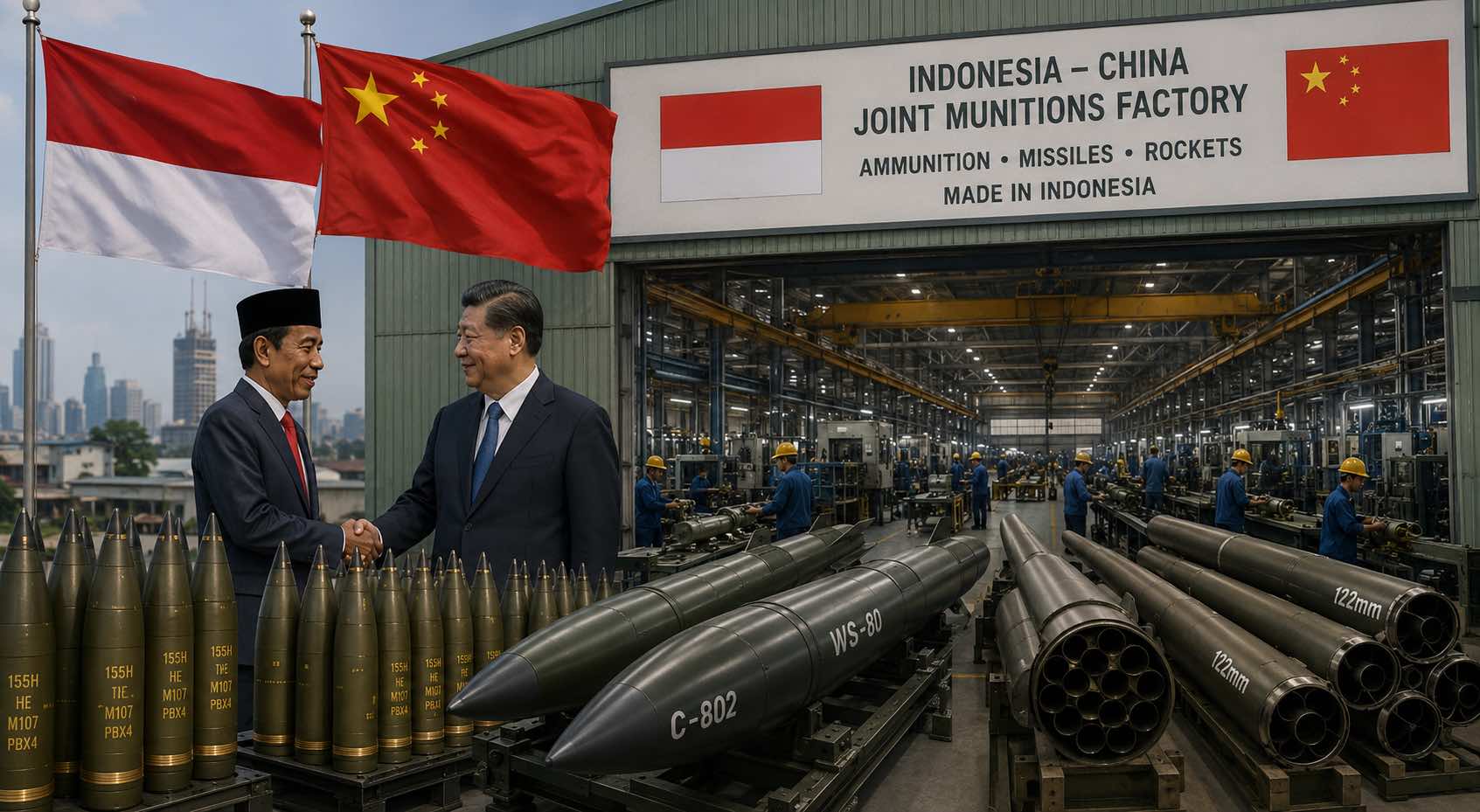
The proposed Indonesian facility would move bilateral defence co-operation towards local production and technology transfer from 2027, although its ownership, capacity and intended weapon systems remain undefined.
Indonesian Defence Minister Sjafrie Sjamsoeddin disclosed the plan after talks in Jakarta with his Chinese counterpart, Dong Jun. The two sides also discussed the transfer of production technology, with operations envisaged from 2027.
The timetable indicates political intent, but the project remains a proposal. Neither government has disclosed the ownership structure, investment, location, annual capacity, weapon families or the division of intellectual property. It is therefore too early to describe Indonesia as having acquired an indigenous missile-production capability.
The public account of the ministers’ meeting refers broadly to ammunition, missiles and rockets. Those categories cover systems of radically different complexity, from unguided artillery rockets and basic rounds to precision-guided weapons with sophisticated seekers, navigation and command links.
The depth of technology transfer will determine the military value. Local assembly from imported kits can improve availability and develop a skilled workforce, but it leaves the user dependent on foreign components. A more substantial capability would require access to energetic materials, rocket-motor production, guidance electronics, warhead engineering, environmental testing and reliable quality control.
Missile production also needs an ecosystem beyond the factory. Test ranges, telemetry, safe storage, trained engineers and integration with Indonesian launch platforms and command networks are essential. Without them, a production line may generate industrial activity without providing sovereign control over the full weapon lifecycle.
For Indonesia, the attraction is clear. A large archipelagic state needs stocks that can be dispersed and replenished across long distances. Recent wars have shown that precision weapons and even basic ammunition can be consumed far faster than peacetime procurement systems replace them. Domestic production can shorten supply chains and make availability less vulnerable to export delays.
The proposal also fits Jakarta’s long-standing policy of diversifying defence relationships. Indonesia buys equipment from multiple suppliers and avoids binding itself wholly to either China or the United States. It can pursue exercises and procurement with Beijing while maintaining extensive co-operation with Washington and other partners.
That balance is not free of tension. Indonesia does not describe itself as a claimant in the South China Sea disputes, but China’s expansive maritime claims overlap waters around the Natuna Islands that Jakarta regards as part of its exclusive economic zone. Chinese coastguard and fishing activity has repeatedly tested that boundary.
At the same time, China is Indonesia’s largest trading partner, with bilateral trade worth about $167 billion in 2025. Defence-industrial co-operation offers Beijing a durable relationship based on production and training rather than a single equipment sale.
The ministers also discussed expanding exercises, including the Heping Garuda series. Exercises build familiarity and can create the procedures needed to support equipment co-operation, but they do not make Indonesia a Chinese ally. Jakarta’s choices remain shaped by strategic autonomy and by a desire to avoid being forced into an exclusive bloc.
The wider regional context will draw scrutiny. Chinese forces are operating in an Indo-Pacific environment where the United States, Japan and the Philippines are increasing joint maritime training. Beijing’s own military effectiveness is also being assessed amid senior purges and uncertainty over the People’s Liberation Army’s command system.
The factory could eventually give Indonesia greater stockpile resilience and engineering expertise. Whether it produces genuine technological autonomy will depend on details that have not yet been supplied: which components are made locally, who controls upgrades and exports, and whether Indonesia can sustain the weapons without continuing Chinese support.
The relevant milestone is therefore not the announcement or even the opening date. It is the first independently verifiable evidence of what the plant can manufacture, at what scale and with how much Indonesian control.