The European Union is preparing to channel the first €5.9bn defence payout from its Ukraine loan into drones this month, while Hungary’s decision to lift a long-running veto on €6.6bn in European Peace Facility funds has reopened a second route for military support.
The two funding lines were confirmed during the informal meeting of EU defence ministers in Lefkosia on 8 June, where Ukraine support, maritime security and the European Security Strategy formed the core of the agenda.
Kaja Kallas, the EU’s foreign policy chief, said the Ukraine loan was “ready to roll out” and that the first €5.9bn payout would go to drones. She also said Hungary was lifting its veto on €6.6bn blocked under the European Peace Facility, the EU instrument used to reimburse member states for military support and finance common defence-related measures.
The development gives Brussels two parallel Ukraine-support channels at a time when drones have become one of the central battlefield requirements of the war. One is the loan mechanism, which will provide direct financing to Ukraine. The other is the European Peace Facility, which can reimburse member states for past deliveries, support new joint procurement and sustain the EU Military Assistance Mission for Ukraine.
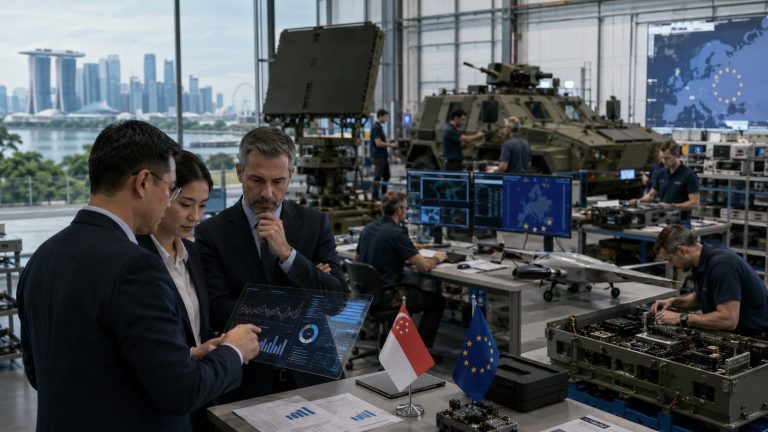
Kallas said she had proposed using the released EPF funds to reimburse member states for past weapons deliveries, finance new joint procurements and sustain operations in the EUMAM Ukraine mission. She also said ministers discussed deeper defence-industrial cooperation with Ukraine, particularly on air defence, and the possibility of facilitating production of Ukrainian systems in the EU and European companies in Ukraine.
The most immediate hard figure, however, is the €5.9bn drone allocation. A first tranche of €9.1bn under the Ukraine loan is expected in June, consisting of €5.9bn for defence and €3.2bn in budget support. Commission officials have previously said the military component would be used in particular to acquire drones, while discussions were continuing on financial support for air-defence equipment.
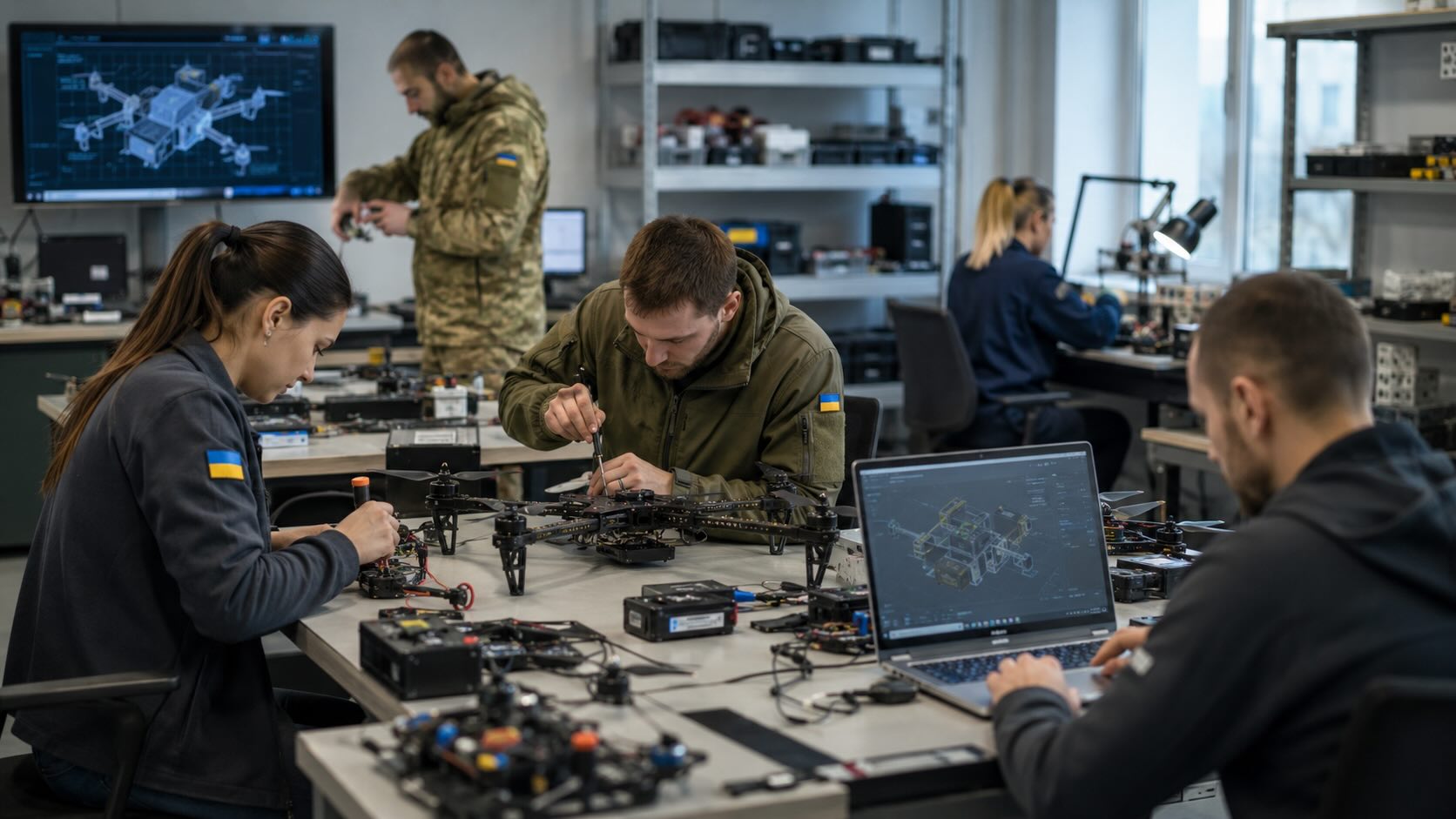
For Ukraine, the emphasis on drones reflects operational reality. Unmanned systems are now used across the front for reconnaissance, strike, targeting, logistics disruption and interception. Ukrainian forces have also developed domestic drone production at speed, but demand continues to exceed supply, particularly as Russia increases long-range drone attacks and adapts electronic warfare tactics.
For the EU, the drone allocation is politically and industrially significant. It shows that Ukraine support is being tied increasingly to specific battlefield capabilities rather than broad declarations of solidarity. It also tests whether European money can move quickly enough through procurement channels to affect the war before the battlefield requirement changes again.
The Hungarian veto had been a central obstacle. Budapest had blocked large parts of the European Peace Facility’s Ukraine-related reimbursements for an extended period, frustrating member states that had already delivered equipment and expected partial compensation. Kallas said the presence of a new Hungarian defence minister meant the EU was “moving on with the unblocking” of the €6.6bn, though she also made clear that member states still had to agree on how exactly the money would be used.
That distinction matters. The veto lift removes a political blockage, but it does not automatically settle the distribution of funds. Member states still face a choice between reimbursement for earlier contributions and directing more money into new procurement for Ukraine. The compromise proposed by Kallas is intended to address both objectives.
The issue goes to the centre of the EU’s defence-support problem. Reimbursement helps sustain political support among member states by spreading costs more evenly. New procurement, by contrast, is more directly relevant to Ukraine’s current military needs. The challenge for Brussels is to balance burden-sharing among EU capitals with battlefield urgency.
The discussion also reflects a wider shift in Europe’s defence debate. Since Russia’s full-scale invasion, European governments have approved large sums for Ukraine and for their own rearmament. Yet delivery has often been slowed by production constraints, procurement procedures and political disagreements. Drones have become a test case because they are cheaper, faster to produce and more rapidly adapted than many traditional weapons systems.
Ukraine’s own defence industry is increasingly central to that debate. Kallas said ministers had discussed cooperation between Ukrainian and European industry, including in air defence. She also noted that Ukraine has practical knowledge in drone warfare and that Europe should not try to reinvent systems where Ukrainian companies already have battlefield experience.
That approach could mark a change in how EU defence funding is used. Rather than treating Ukraine only as a recipient of European arms, Brussels is looking at Ukraine as a producer and technology partner. If implemented, that could mean more Ukrainian systems manufactured in EU countries, more European companies operating in Ukraine, and more procurement based on battlefield-proven designs.
The risks remain practical. The EU has often struggled to convert political decisions into rapid defence output. Member states retain control over much procurement, industrial priorities differ, and budget instruments were not originally designed for wartime production cycles. Drone warfare also evolves quickly, meaning systems funded today may require modification within months.
Nevertheless, the Lefkosia meeting produced a clearer operational line than many previous EU defence discussions. The first Ukraine-loan defence payout is expected to go to drones; EPF funds blocked by Hungary are moving towards release; and ministers are linking Ukraine support to industrial cooperation rather than treating it only as aid.
For Defence Matters readers, the significance lies in the move from pledge to capability. The central question is no longer only how much money Europe promises Ukraine, but whether that money can be turned into drones, air-defence systems and production capacity quickly enough to meet the next phase of the war.
The outcome of the June discussions will therefore be measured less by communiqués than by delivery. If the €5.9bn drone allocation is contracted and deployed rapidly, it could become one of the EU’s most concrete contributions to Ukraine’s war effort this year. If it is slowed by procurement and political bargaining, it will reinforce the criticism that Europe’s defence-policy machinery remains slower than the war it is trying to support.