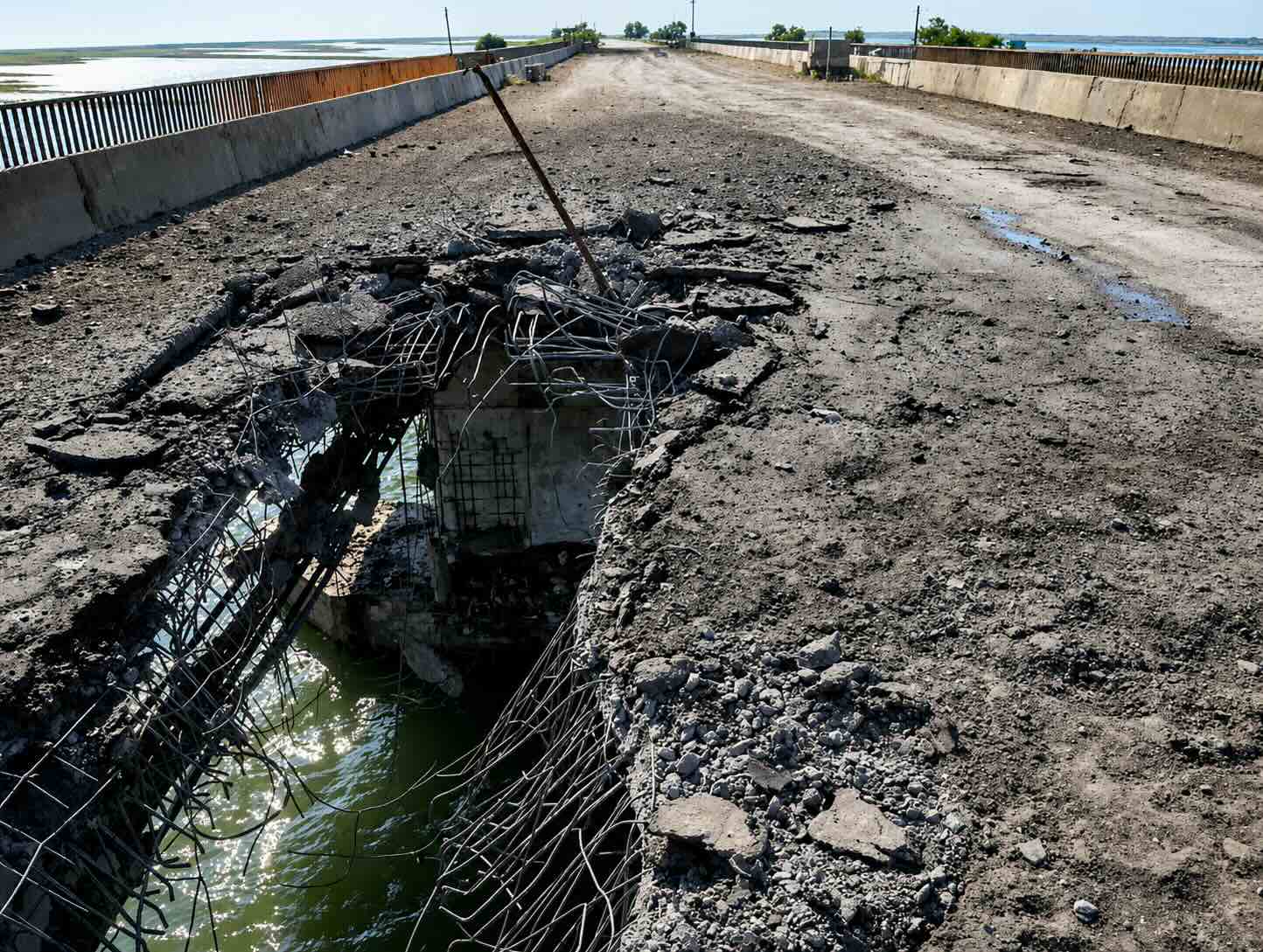
The latest strike follows an earlier attack on the bridge during the night of 6–7 June, when Ukrainian military units said they used domestically produced Behemoth and Fire Point drones against the crossing. The attack reportedly left holes in the bridge surface and forced occupation authorities to suspend traffic through the Dzhankoi checkpoint.
The Chonhar crossing has long been one of the key routes between Crimea and the mainland. It is part of the transport network used by Russian forces to move personnel, equipment and supplies between the peninsula and occupied areas of Kherson and Zaporizhzhia regions. Its disruption does not in itself isolate Crimea, but it complicates the movement of military and civilian traffic and increases pressure on alternative routes.
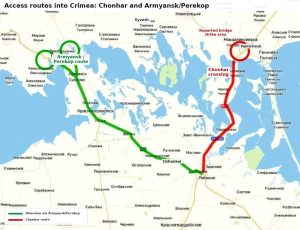
Russian-installed officials in occupied Kherson region confirmed after the first strike that a drone attack had damaged the bridge, with vehicles redirected through Armyansk and Perekop. That diversion adds a substantial distance to the route into Crimea and can create congestion at checkpoints already used for inspections and controlled access.
The reported second strike is therefore important less because of the scale of physical damage than because of its cumulative effect. Russian authorities had indicated that traffic had been restored, but renewed reports of closure suggest that even partial repairs may remain vulnerable to follow-up attacks. For military logistics, repeated interruption can be more damaging than a single strike, as it forces route changes, convoy delays, additional security measures and repair operations.
The use of drones against the bridge is also significant. Bridges are relatively difficult targets, particularly when the aim is to hit a specific part of the structure rather than simply strike nearby terrain. Ukrainian forces have increasingly used unmanned systems not only for battlefield reconnaissance and tactical strikes, but also for attacks on fixed logistical infrastructure. The Chonhar operation suggests that Ukrainian drone accuracy has improved sufficiently to threaten smaller, high-value transport targets.
According to Ukrainian military sources, the strike involved the new Behemoth drone, which was unveiled in late May 2026. The drone has been described as a mid-range system with a strike radius of up to 300 kilometres and a heavy warhead configuration. Its reported use at Chonhar indicates that Ukraine is continuing to expand its domestic long-range strike capability at a time when rear-area infrastructure has become a central part of the war.
The bridge’s importance is linked to Crimea’s wider role in Russia’s campaign. Since the full-scale invasion of Ukraine in 2022, the peninsula has served as a rear base for Russian operations in southern Ukraine. It hosts military facilities, air defence systems, logistics depots and command infrastructure. Road and rail links between Crimea and the mainland are therefore not only civilian transport corridors, but part of Russia’s operational supply network.
Ukraine has previously targeted transport infrastructure connected to Crimea, including bridges and routes used to supply Russian forces. The Chonhar bridge itself was struck in earlier phases of the war, including in 2023, when traffic was also redirected through alternative checkpoints after damage to the crossing. The renewed attacks in June 2026 show that the route remains a focus of Ukrainian planning.
The immediate military effect of the latest strike remains difficult to assess independently. There is no confirmed evidence that the bridge has been destroyed, and Russian forces retain other means of access to Crimea. However, the repeated targeting of Chonhar suggests a campaign aimed at narrowing Russia’s logistical options rather than achieving a single decisive interruption.
Such operations also have a psychological and administrative dimension. If occupation authorities are forced to close crossings repeatedly, reroute traffic and explain delays, it undermines the impression that Crimea remains a secure rear area. For Russian forces, the uncertainty around routes into and out of the peninsula can affect planning and tempo.
The attacks come amid a wider increase in Ukrainian strikes on Russian and Russian-controlled infrastructure. In recent weeks, Ukrainian drones have targeted fuel depots, airfields, ammunition sites and transport nodes. The pattern points to an attempt to weaken Russia’s capacity to sustain operations before supplies reach the front line.
For Kyiv, the Chonhar strikes demonstrate that domestically produced drones can be used against infrastructure targets with operational relevance. For Moscow, they highlight the difficulty of defending every bridge, road and logistics route across occupied territory, particularly against relatively low-cost unmanned systems.
The Chonhar bridge is unlikely to be the last such target. As Ukraine continues to develop longer-range drones and precision strike methods, Russia’s routes into Crimea may remain under sustained pressure. Even when damage is repairable, repeated closures can impose costs on a logistics system that depends on predictable movement and secure transport corridors.