The European Union is examining whether its naval operation in the Red Sea could play a wider role in protecting shipping near the Strait of Hormuz, one of the world’s most important maritime trade and energy routes.
The issue was raised after a meeting of EU defence ministers in Brussels, where the bloc’s foreign policy chief said the Strait of Hormuz was caught in a “grey zone between war and peace” and warned that closure of the route would be “untenable”. In a press conference following the Foreign Affairs Council in defence format, Kaja Kallas said EU naval operations in the region could play a role in restoring energy and trade flows if the situation deteriorates.
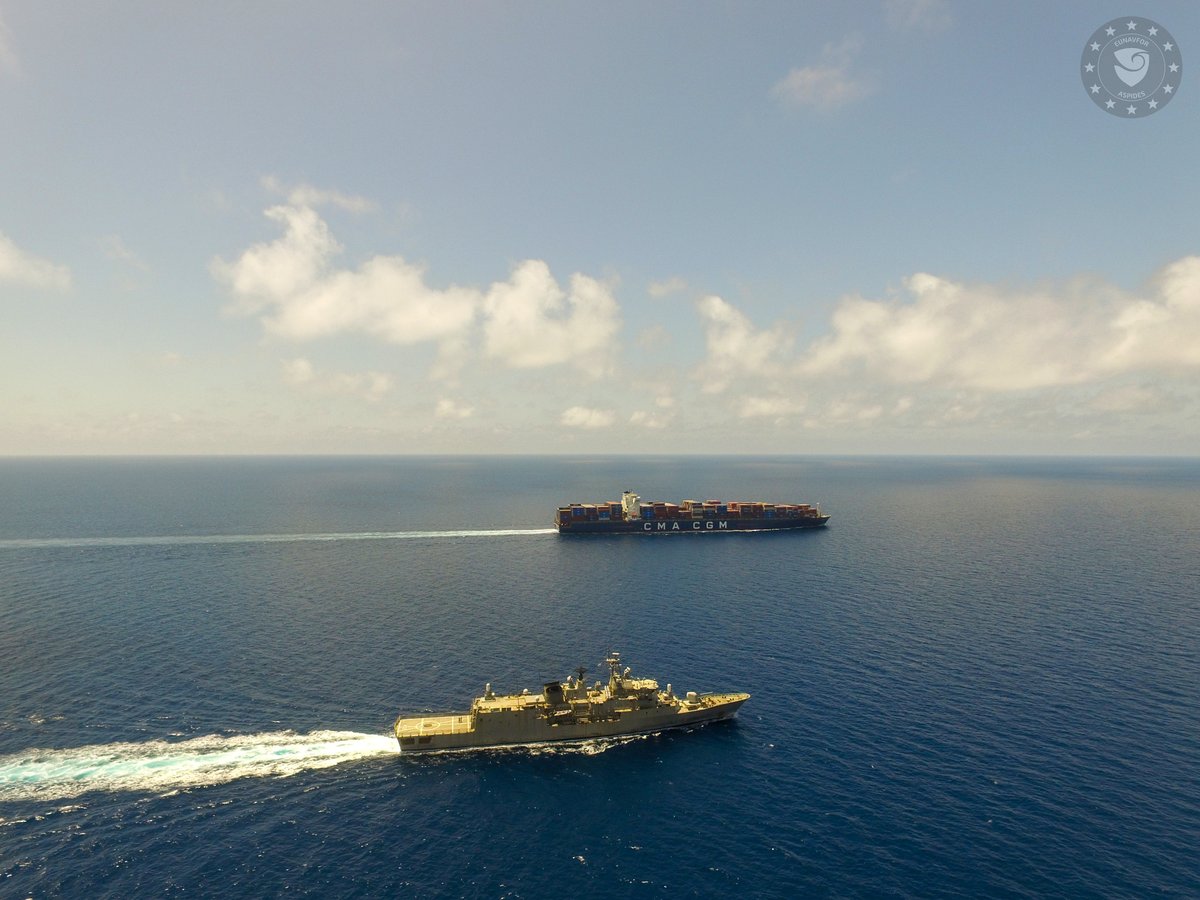
The immediate focus is Operation ASPIDES, the EU naval mission created in response to attacks on commercial shipping linked to the Red Sea crisis. Kallas said the operation already contributed to the protection of shipping in the Red Sea, but that its activities could also be extended to the Strait of Hormuz if conditions were appropriate. She added that this would require a change to the operational plan, rather than a new mandate.
That distinction is significant. The EU’s description of Operation ASPIDES states that it contributes to freedom of navigation and maritime security for merchant and commercial vessels in the Red Sea, the Indian Ocean and the Gulf. Within its defensive mandate, the operation provides maritime situational awareness, accompanies vessels and protects them against possible attacks at sea.
The Council has already extended the mission until 28 February 2027. In February, member states agreed to continue the operation after a strategic review, describing it as part of the EU’s response to continuing threats against merchant and commercial vessels. The Council decision underlined that ASPIDES remains a defensive maritime security mission conducted in accordance with international law.
The potential extension of its activity towards Hormuz would place the EU more directly inside a maritime security problem with immediate consequences for Europe’s economy. The strait links the Gulf with the Gulf of Oman and the Arabian Sea. It is central to the movement of oil and liquefied natural gas from Gulf producers to global markets. Any sustained disruption would affect insurance, freight costs, energy prices and the wider security environment.
For Europe, the issue is not only energy supply. The Red Sea crisis has already shown how disruption at maritime chokepoints can alter commercial routes, lengthen transit times and increase costs for importers and exporters. Many ships have avoided the Red Sea and Suez Canal route because of security risks, adding time and expense to trade between Asia, Europe and the Mediterranean.
A wider role for ASPIDES would therefore carry both strategic and practical implications. It would show that the EU is willing to use an existing naval mission to support freedom of navigation beyond the Red Sea. It would also test whether member states are prepared to provide enough vessels, aircraft, surveillance capacity and command resources for a larger operational area.
That remains the central constraint. A naval operation can be given a wider area of activity on paper, but it cannot protect shipping effectively without sufficient assets. Escorting vessels, monitoring suspicious activity, responding to threats and maintaining a credible presence across several maritime zones require ships, crews, intelligence and logistical support. The EU has often struggled to match the scale of its maritime security ambitions with available naval contributions from member states.
The political context is also complex. Operation ASPIDES was designed as a defensive mission. It does not conduct strikes ashore and is not intended to become an offensive operation. Extending its activities closer to Hormuz would require careful definition of its tasks, rules of engagement and relationship with other naval forces already operating in the region.
The EU’s advantage is that ASPIDES already has an operational structure, a legal framework and experience in protecting commercial shipping. Its limitation is that the Red Sea and Gulf maritime environment is broad, contested and resource-intensive. A move towards Hormuz would increase the pressure on a mission that already depends on national willingness to commit naval assets.
For Brussels, the question is whether maritime security can remain a secondary defence issue when Europe’s trade and energy flows are repeatedly exposed to regional conflict. The discussion after the defence ministers’ meeting suggests that EU governments are now considering the Strait of Hormuz not only as a Gulf security issue, but as a European economic and strategic vulnerability.
No decision to extend ASPIDES activity to the strait has been announced. The current position is that the operational plan could be adapted if conditions require it and if member states support the move. That leaves the EU with a policy option, but not yet a settled course of action.
The issue is likely to remain on the agenda if tensions around the Gulf continue. A wider EU naval role would not resolve the underlying conflict risks in the region, but it would give Europe a more direct instrument for protecting shipping and signalling that maritime