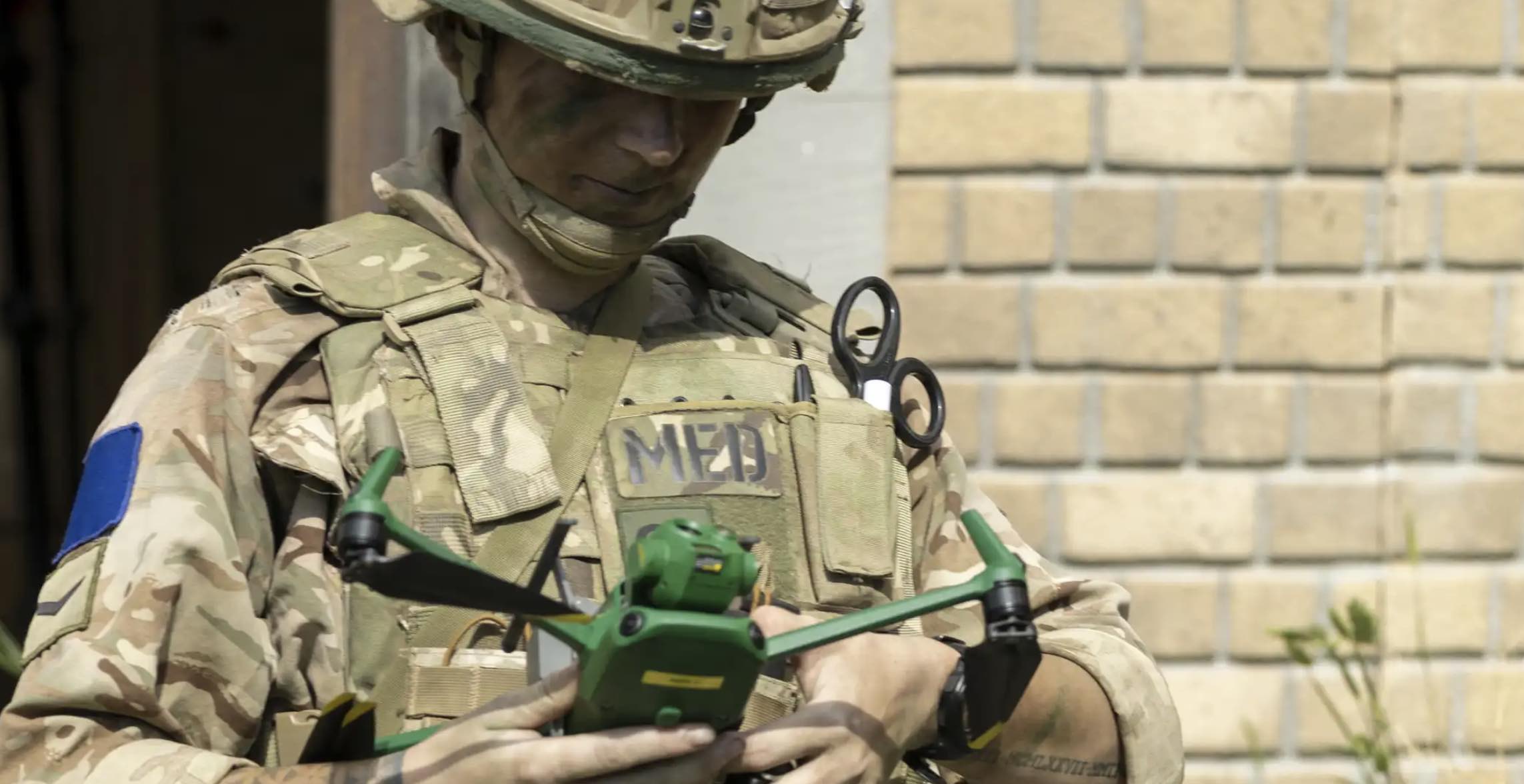
That is the thinking behind an experiment by medics from the British Army’s 2nd Battalion, The Parachute Regiment, who are using drones to transport blood across the battlefield. The initiative, tested during Exercise Rhino Bizz in Canada, illustrates how military medicine is adapting to a battlefield increasingly shaped by unmanned systems, electronic warfare and disrupted supply lines.
For airborne forces, the problem is particularly acute. Paratroopers may be deployed behind enemy lines and separated from conventional logistical support. A wounded soldier cannot necessarily wait for a medical evacuation aircraft or an ambulance to arrive. Blood, meanwhile, presents a logistical problem of its own: it is perishable, difficult to transport and indispensable when severe blood loss is involved.
The solution developed by 2 PARA is strikingly simple. Soldiers have their blood groups recorded, while their positions can be tracked on digital battlefield mapping. If a casualty requires blood, a medic can identify the nearest suitable donor, collect the blood and use a drone to transport it to the casualty.
It amounts to turning a military unit into a distributed blood bank.
The significance extends beyond the particular experiment. Modern armies are discovering that drones are transforming logistics almost as profoundly as they are transforming reconnaissance and combat. Ukraine has demonstrated the extraordinary potential of inexpensive unmanned systems to find, strike and disrupt enemy forces. The British experiment points towards the less discussed possibility: using the same technological ecosystem to make military operations more resilient and save lives.
There is something almost symbolic about the idea. Drones have become synonymous with destruction. Yet the technology is essentially neutral. An unmanned aircraft capable of carrying an explosive payload can, with different software and equipment, carry medical supplies instead.
For Lance Corporal Olivia Snoots, a combat medical technician and qualified drone pilot, this dual-use potential is precisely the point. She told the Army that she had not expected flying drones to become part of her medical role, but described the regiment as having a strong culture of experimentation.
That culture may prove increasingly valuable.
The second innovation being tested by the medics is perhaps even more consequential for the future of military healthcare. Using secure communications equipment, they can establish video links with specialist clinicians thousands of miles away. A battlefield medic dealing with a complex injury can therefore obtain advice from a consultant who can actually see the casualty.
This represents a subtle but important change in the economics of expertise. Historically, specialist medical knowledge has had to move physically towards the casualty. Digital communications reverse that equation. The casualty remains where the fighting is taking place, while the expertise travels electronically.
For an isolated medic, the psychological benefit may be almost as important as the clinical one. Sergeant Mark Gordon, 2 PARA’s medical sergeant, said that access to specialist advice could give casualties a better chance of survival while giving battlefield medics greater confidence that they are not working alone.
The broader lesson for defence planners is that battlefield resilience increasingly depends on networks rather than individual platforms.
A sophisticated tank, aircraft or missile system may attract headlines, but its effectiveness ultimately depends upon communications, logistics, maintenance, medical support and the ability to continue operating when conventional infrastructure has been disrupted. The emerging military model is therefore less about individual pieces of equipment and more about connecting people, sensors, vehicles, information and supplies into an adaptable system.
That is why experiments such as 2 PARA’s deserve attention. They demonstrate that innovation does not necessarily require a revolutionary weapons programme or billions of pounds of investment. Sometimes it involves taking an existing technology and applying it to a problem that armies have faced for centuries.
The battlefield of the future will undoubtedly be more dangerous. But it may also become more survivable for those caught in it.
A drone carrying blood rather than explosives is a modest technological development. Its underlying principle is much larger: if armies can make technology work harder to preserve human life, innovation becomes not merely a source of military advantage, but an investment in resilience.