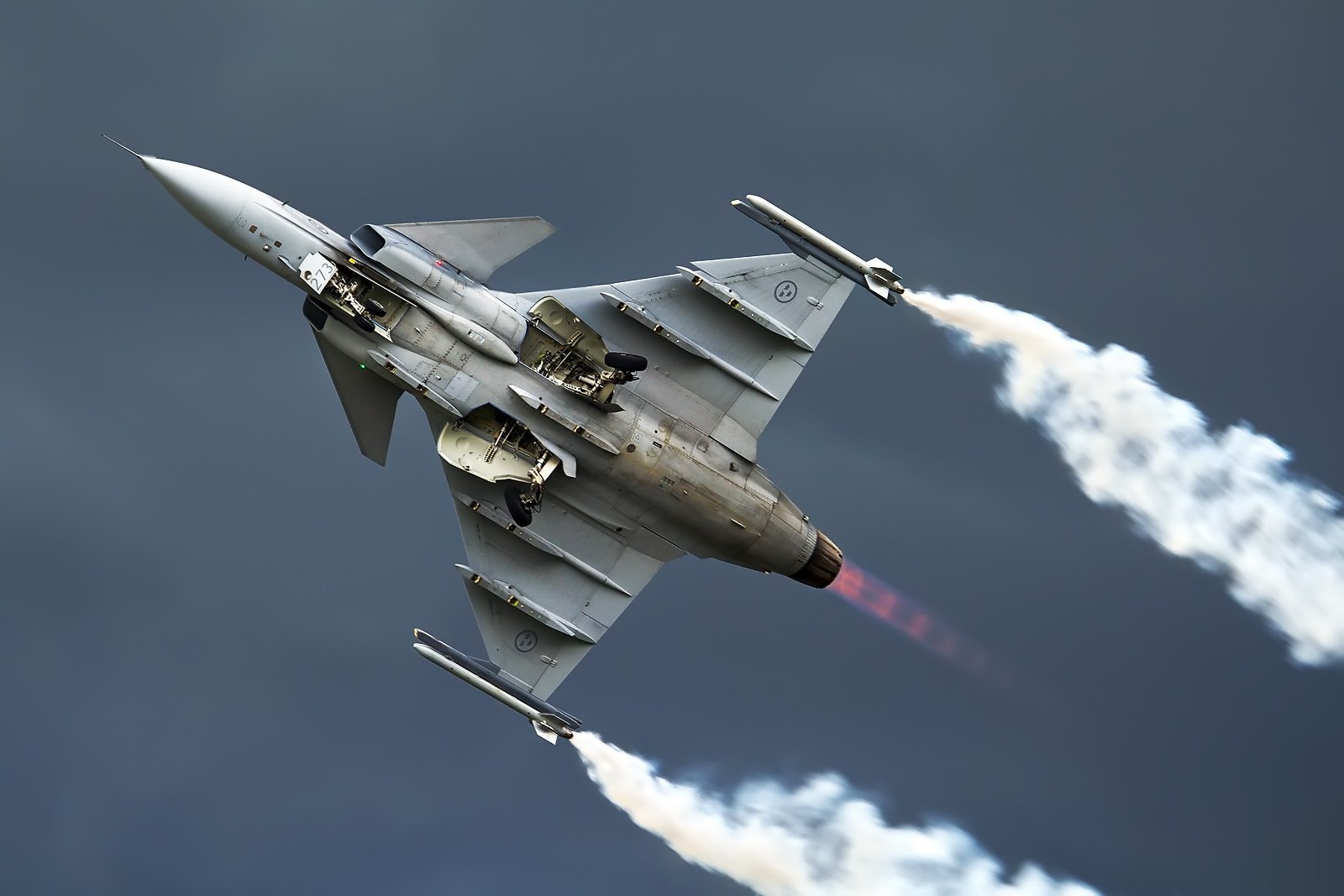
That proving ground may now have arrived.
Ukraine’s decision to make the Gripen a central component of its future air force marks a pivotal moment not only for Kyiv’s defence strategy but also for Swedish aerospace group Saab. The aircraft is poised to enter the most demanding operational environment faced by any Western fighter in recent years: a high-intensity war against Russia.
Under the agreement announced during President Volodymyr Zelenskyy’s visit to Sweden, Ukraine will purchase 20 new Gripen E fighters while receiving 16 older C/D models from Swedish stocks. Officials have indicated that the programme could eventually expand to as many as 150 aircraft, potentially making Ukraine one of the largest Gripen operators in the world.
The significance extends far beyond numbers.
For years, military analysts have argued that the Gripen is uniquely suited to Ukraine’s circumstances. Unlike many Western fighters designed around secure, well-equipped air bases, the Gripen emerged from Sweden’s Cold War doctrine of dispersal. Swedish planners anticipated that fixed airfields would be among the first targets in any conflict with the Soviet Union. As a result, the aircraft was engineered to operate from stretches of public road, improvised runways and austere operating locations.
That concept has become strikingly relevant in Ukraine.
Since Russia’s invasion, Ukrainian forces have repeatedly dispersed aircraft across the country to reduce vulnerability to missile strikes. According to Ukrainian defence officials, the Gripen’s ability to operate from highways and concealed locations mirrors the operating environment already imposed by the war.
Equally important is the aircraft’s maintenance philosophy. The Gripen has long been promoted as a fighter that can be rapidly turned around between sorties by a small team of personnel rather than the extensive ground crews typically associated with advanced combat aircraft. Ukrainian officials note that a handful of technicians can refuel, rearm and prepare the aircraft for another mission in less than ten minutes. In a prolonged war of attrition, where operational tempo often matters as much as technological sophistication, such characteristics carry considerable value.
Cost considerations also favour the Swedish aircraft. Ukrainian officials estimate operating expenses at roughly $8,000 per flight hour, substantially below those of more advanced Western platforms. While aircraft procurement frequently attracts political attention, sustainment costs often determine how intensively fleets can be employed during wartime.
Yet enthusiasm should not obscure the challenges.
The Gripen enters a battlespace dominated by sophisticated Russian surface-to-air missile systems, electronic warfare capabilities and long-range aviation assets. Analysts caution that no fighter aircraft, regardless of its design, can fundamentally alter the strategic balance on its own. Justin Bronk of the Royal United Services Institute has described the Gripen as highly suited to dispersed operations while warning that its effectiveness will still be constrained by the realities of Russian air defences.
The aircraft’s most immediate contribution may therefore be less about achieving air superiority and more about complicating Russian operations. Ukraine has highlighted the Gripen’s compatibility with the Meteor air-to-air missile, a weapon capable of threatening Russian aircraft at considerable distances. By forcing Russian pilots to operate farther from the front, Kyiv hopes to reduce the effectiveness of the glide-bomb campaign that has become a central feature of Moscow’s air strategy.
For Saab, the stakes are equally high.
Despite export successes in countries such as Brazil, South Africa, Hungary and the Czech Republic, the Gripen has often struggled to compete against the political influence and industrial scale behind aircraft such as the F-35. The Ukrainian war offers something that marketing campaigns and air shows cannot: real-world validation under combat conditions.
A strong performance could strengthen Sweden’s position in a rapidly expanding European defence market. Interest in the Gripen has already resurfaced in several countries, while Brazil is reportedly considering additional purchases. Saab has stated that it can expand production capacity should demand accelerate.
The irony is difficult to miss. The Gripen was conceived during the final years of the Cold War as a fighter optimised for resisting Russian military pressure. More than three decades later, it is finally approaching the mission for which it was originally designed.
Whether it succeeds will influence not only Ukraine’s air war but also the future standing of one of Europe’s most distinctive combat aircraft.
Main Image: – Gallery page http://www.airliners.net/photo/Sweden—Air/Saab-JAS-39C-Gripen/2279593/L Photo http://cdn-www.airliners.net/aviation-photos/photos/3/9/5/2279593.jpg
Hungarian Gripens intercept five Russian aircraft near Latvian airspace