The US Department of State has authorised the potential sale of counter-unmanned aircraft system (C-UAS) equipment valued at approximately $1.98bn, reflecting growing concern among Gulf states over the rapid proliferation of drones and loitering munitions across the region.
The package represents more than a simple acquisition of hardware. Instead, it offers a layered defensive architecture designed to detect, track, identify and neutralise aerial threats ranging from small commercial drones to more sophisticated unmanned aircraft.
The deal arrives at a time when military planners worldwide are reassessing air defence doctrines. Conflicts in Ukraine, the Red Sea and the broader Middle East have demonstrated that relatively inexpensive drones can threaten critical infrastructure, military installations and even naval vessels. Traditional air-defence systems, designed to intercept fast-moving aircraft or ballistic missiles, often struggle to provide a cost-effective response to swarms of low-cost unmanned systems.
At the heart of the Kuwaiti package is Anduril’s Roadrunner-M, a novel interceptor drone that has attracted considerable attention since its unveiling in 2023. Unlike conventional missile interceptors, the Roadrunner is a reusable vertical take-off and landing aircraft powered by twin turbojet engines. It is capable of achieving high subsonic speeds and can be launched rapidly against incoming threats.
The Roadrunner-M variant carries a high-explosive warhead and is designed to destroy hostile drones and other aerial targets. Its most distinctive feature is its ability to return to base and land vertically if it is not required to engage a target. This recoverability addresses one of the central economic challenges facing modern air defence: the prospect of expending expensive interceptors against comparatively cheap drones.
Military analysts increasingly argue that future air-defence networks must focus as much on affordability as capability. A reusable interceptor capable of multiple deployments could significantly reduce operational costs while allowing commanders to respond aggressively to uncertain threats.
Complementing the Roadrunner is the Anvil interceptor system. Far smaller and electrically powered, Anvil is essentially a highly manoeuvrable quadcopter designed to hunt and destroy hostile drones at close range. The standard version employs kinetic impact, colliding directly with the target to disable it without the need for an explosive charge. An alternative variant, known as Anvil-M, incorporates a warhead for engagements where greater destructive effect is required.
Together, Roadrunner and Anvil illustrate a growing trend in air defence towards specialised interceptors tailored to different threat profiles. Rather than relying on a single weapon, modern C-UAS networks increasingly employ multiple layers of defence, with each system optimised for specific ranges, speeds and target types.
The package also includes Anduril’s Pulsar electronic warfare system, which adds a non-kinetic dimension to Kuwait’s defences. Electronic warfare capabilities can disrupt communications, navigation signals and control links used by hostile drones, potentially neutralising threats without firing a shot. Such systems are particularly valuable when facing large numbers of inexpensive drones, where the economics of using physical interceptors may become unfavourable.
Detection and situational awareness form another key component of the proposed sale. Kuwait is set to receive several variants of Anduril’s Sentry surveillance tower, including long-range, maritime and mobile configurations. Equipped with a combination of sensors, radar and optical systems, these towers are intended to provide persistent monitoring across diverse operational environments.
For a country whose security concerns extend from critical energy infrastructure to maritime approaches in the Gulf, the inclusion of maritime and mobile surveillance assets is particularly significant. The ability to maintain continuous awareness across coastal zones and remote facilities has become an increasingly important element of national defence planning.
Binding the various components together is Lattice, Anduril’s command-and-control software platform. Often described as the company’s digital backbone, Lattice employs advanced data fusion techniques to integrate information from multiple sensors and present operators with a coherent operational picture. The software can help identify threats, prioritise targets and recommend responses in real time.
Supporting this networked approach is the Menace tactical operations centre, which provides commanders with a deployable command hub from which to manage engagements.
The proposed acquisition complements Kuwait’s broader effort to modernise its air-defence capabilities. The country has also been moving forward with plans to acquire the National Advanced Surface-to-Air Missile System (NASAMS), a highly regarded medium-range air-defence platform already used by several NATO members.
Taken together, the NASAMS programme and the Anduril package suggest Kuwait is pursuing a comprehensive, layered air-defence strategy that spans conventional aircraft, cruise missiles and the rapidly expanding spectrum of unmanned threats.
For Washington, the deal underscores the growing importance of emerging defence technology firms in US security exports. While established contractors continue to dominate major weapons programmes, companies such as Anduril are increasingly shaping the future of military procurement through software-driven systems, autonomous technologies and integrated sensor networks.
As drone warfare evolves at remarkable speed, Kuwait’s investment may offer a glimpse of how many countries intend to defend their airspace in the decade ahead: not with a single missile battery, but with interconnected layers of sensors, electronic warfare capabilities and autonomous interceptors working in concert.
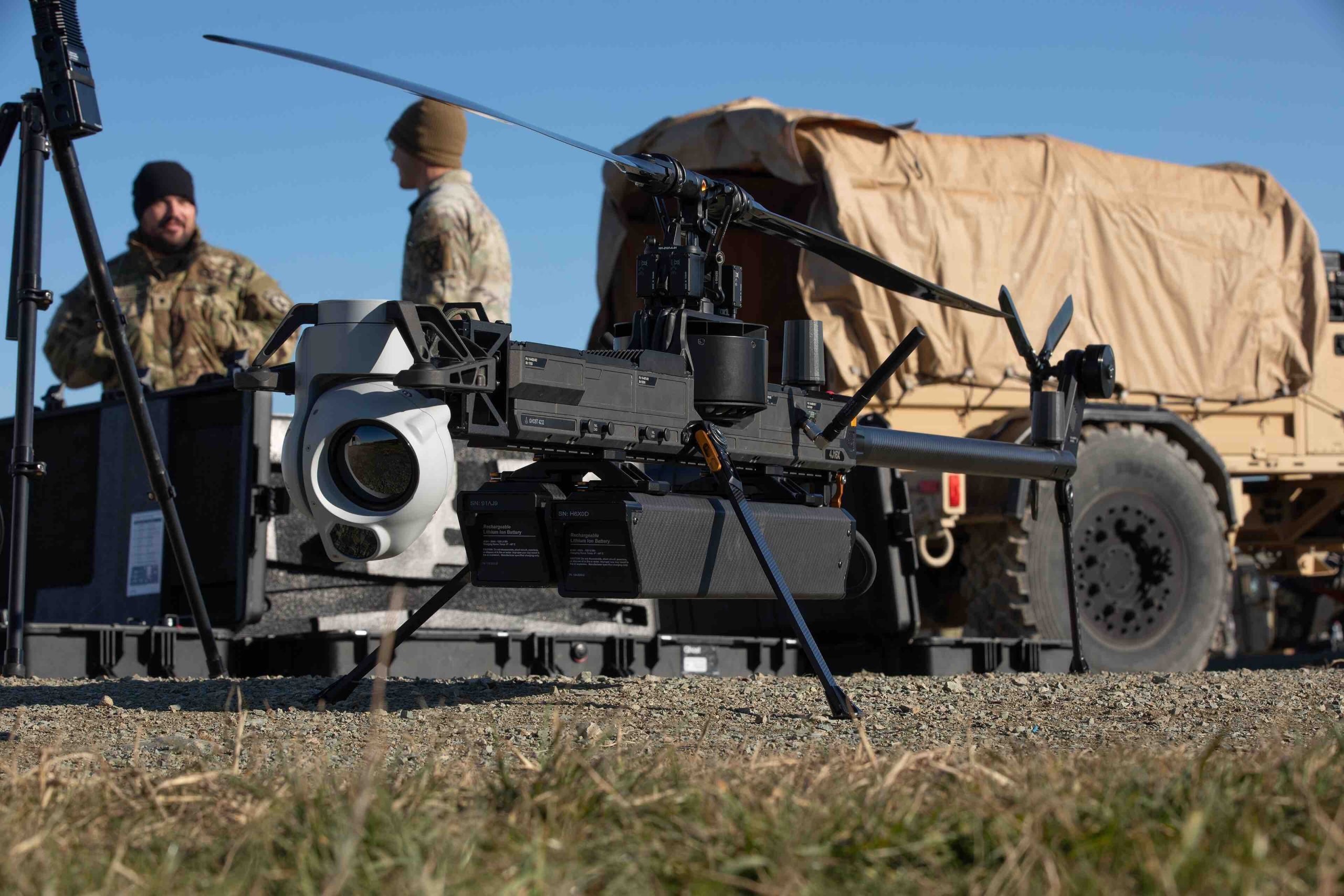
Main Image: U.S. Army photo by Pfc. Nathan Arellano Tlaczani, Public Domain, https://commons.wikimedia.org/w/index.php?curid=156387884
US Army signs major Anduril agreement for drones, software and battlefield integration