NATO and European Union representatives have called for more sustained and coordinated support to Ukraine, following a joint meeting in Brussels focused on Kyiv’s military and institutional needs.
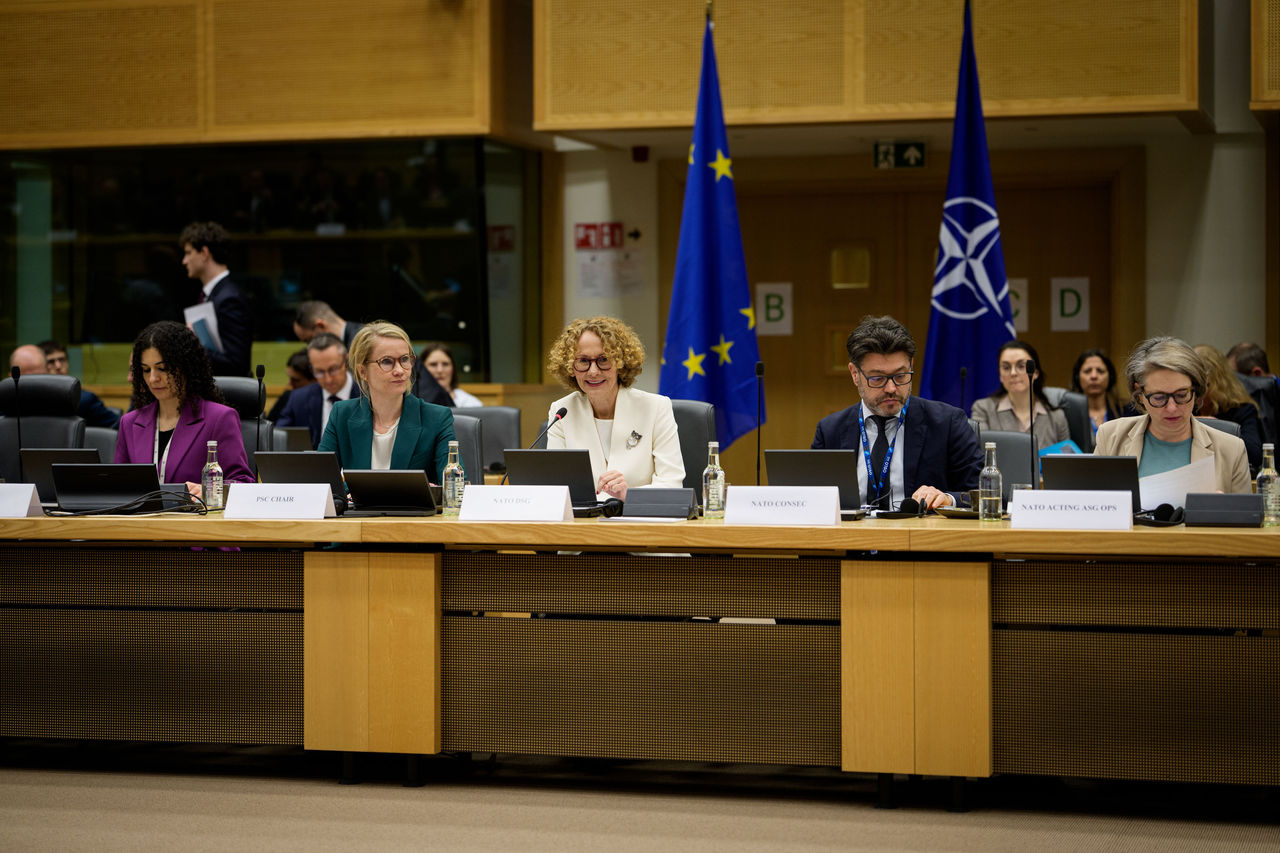
The meeting took place on Thursday 23 April at the Egmont Palace in Brussels. It brought together the North Atlantic Council and the EU’s Political and Security Committee, two bodies central to transatlantic and European security policy coordination. The meeting was led by NATO Deputy Secretary General Radmila Shekerinska and Lene Mandel Vensild, chair of the EU Political and Security Committee.
According to a NATO statement on the meeting, Shekerinska called on participants to continue providing Ukraine with support that is predictable, coordinated and sustained over the long term.
The meeting comes as NATO and the EU seek to align their respective instruments of assistance to Ukraine. The alliance provides military coordination, training and capability-related support, while the EU has combined financial, military, sanctions and civilian security measures in its response to Russia’s war.
NATO said that allies, 23 of which are also EU member states, already account for the overwhelming majority of military, financial and humanitarian aid to Ukraine. The statement also said ensuring that Ukraine has what it needs to defend itself now and deter future aggression remains essential.
The Brussels meeting underlined the overlap between NATO and EU security policy. While the two organisations have separate mandates, they share many of the same member states and are increasingly operating in parallel on Ukraine, defence production, military mobility, resilience and deterrence.
NATO’s current support mechanisms include the Prioritised Ukraine Requirements List, known as PURL, the NATO Security Assistance and Training for Ukraine, the Joint Analysis, Training and Education Centre, the Comprehensive Assistance Package, the NATO Representation to Ukraine and the NATO-Ukraine Council.
The PURL initiative has become one of the mechanisms through which Ukraine’s most urgent capability requirements are identified and matched with support from allies. NATO Security Assistance and Training for Ukraine is intended to coordinate security assistance and training in a more structured way, while the NATO-Ukraine Council provides a political forum for consultation between Kyiv and allies.
The EU’s role has developed along different lines. The bloc has provided macro-financial support, adopted successive sanctions packages, financed military assistance through EU-level instruments and supported training through the EU Military Assistance Mission. NATO said the mission has trained 90,000 Ukrainian soldiers.
The EU Advisory Mission also continues to support Ukraine in civilian security sector reform. That role is separate from direct battlefield assistance, but remains relevant to Ukraine’s wider institutional resilience, rule-of-law structures and post-war governance planning.
The timing of the NATO-EU meeting is significant. On the same day, the Council of the EU announced that it had finalised a €90 billion support loan to Ukraine. The facility is intended to provide Ukraine with further financial assistance while also supporting defence-related priorities.
The EU also adopted its 20th package of sanctions against Russia, targeting energy, finance, crypto assets, trade, Russia’s military-industrial complex and vessels linked to Moscow’s shadow fleet.
Taken together, the three developments point to a more integrated Western approach: financing Ukraine, constraining Russia’s ability to sustain the war, and coordinating military assistance through NATO and EU channels.
The meeting also reflects a longer-running issue in European security policy. NATO remains the principal framework for collective defence and military planning among allies, while the EU controls major financial, regulatory, industrial and sanctions tools. For Ukraine, the effectiveness of Western support depends in part on how well these instruments are aligned.
Defence-industrial capacity is likely to remain a central challenge. Ukraine’s needs include air defence, ammunition, drones, training, repair capacity and long-term force development. NATO and the EU have both acknowledged the need to increase production and reduce fragmentation, but implementation depends on national budgets, procurement decisions and industrial output.
The Brussels meeting did not announce a new weapons package or a separate operational decision. Its importance lies instead in the coordination message. The first joint meeting of the year between the North Atlantic Council and the Political and Security Committee was used to reinforce the position that Ukraine support should be planned over the long term rather than handled as a sequence of short-term pledges.
Further joint meetings are scheduled for September and December 2026. Those meetings are expected to provide further opportunities to assess whether NATO and EU support mechanisms are becoming more predictable, and whether political commitments are being translated into sustained capability delivery for Ukraine.