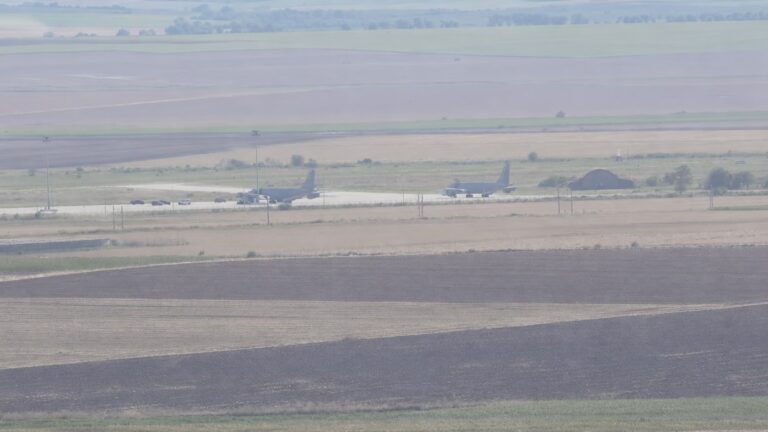
NATO aircraft have conducted a large-scale exercise over Poland and the Baltic region close to Russia’s Kaliningrad exclave, with the deployment including the US Air Force’s new EA-37B Compass Call electronic-warfare aircraft.
Military flight tracking on Tuesday, 18 August, identified a concentration of allied aircraft including F-35A fighters, E-3A airborne warning and control aircraft, aerial-refuelling tankers and specialised intelligence platforms. Reports also placed a British P-8A Poseidon maritime-patrol aircraft over the Baltic.
The Polish Operational Command described the activity as a planned exercise under US leadership intended to improve interoperability among allied forces. NATO subsequently confirmed the operation but declined to disclose further details on operational-security grounds. The Polish military said the exercise was not a direct response to a particular episode of Russian air activity.
That distinction is important. The available evidence does not establish that NATO was rehearsing an attack on Kaliningrad, nor that the EA-37B was actively jamming Russian systems. What makes the operation noteworthy is the collection of capabilities assembled in an area central to NATO planning on its eastern flank.
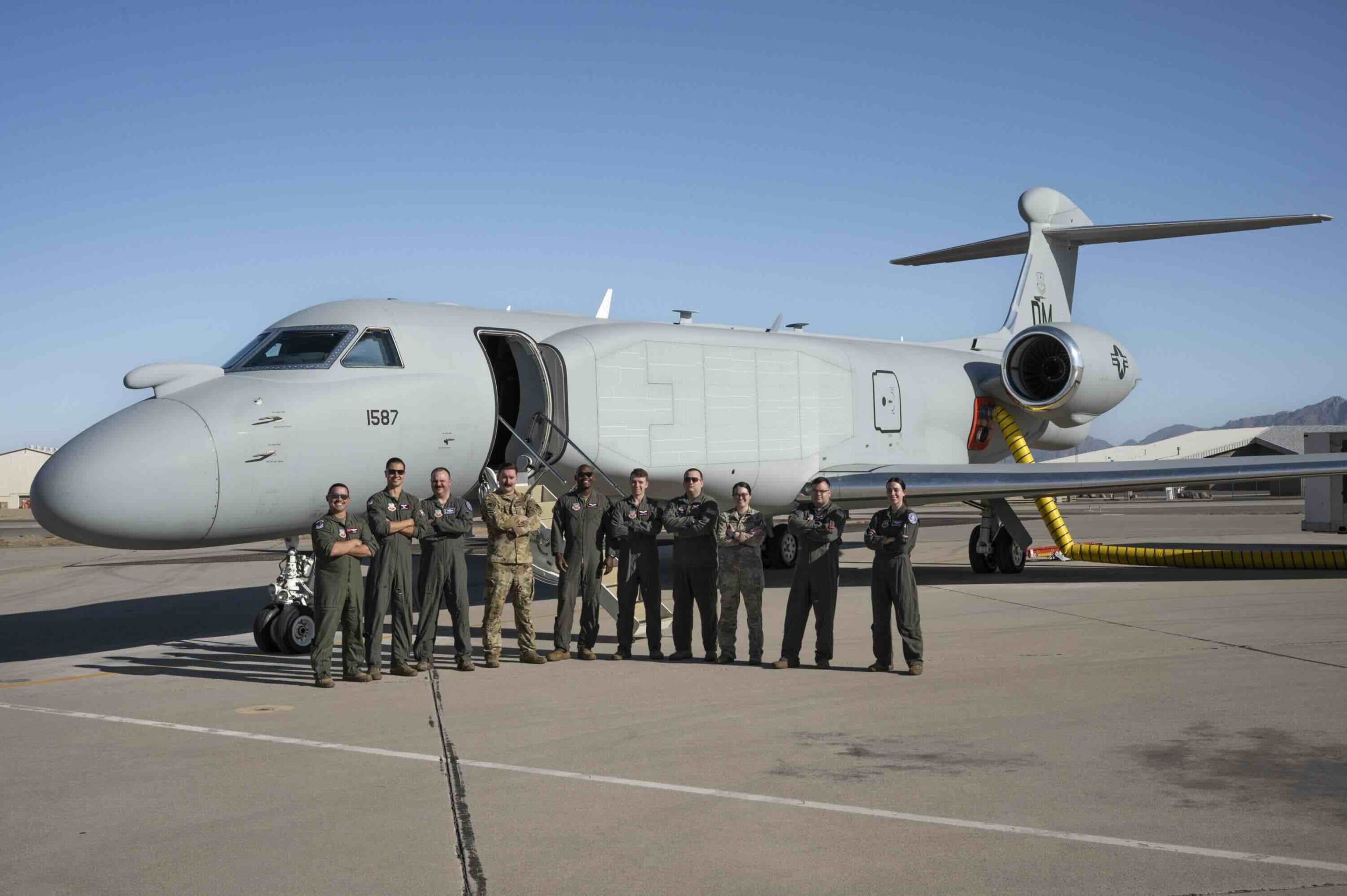
The EA-37B is among the newest aircraft in the American electronic-warfare inventory.
Built around a modified Gulfstream G550 airframe, it is replacing the much older EC-130H Compass Call. According to the US Air Force’s description of the aircraft’s mission, the system is designed to deny, degrade or disrupt an adversary’s communications, information processing, navigation, radar and radio-controlled systems.
Its role is therefore different from that of a conventional reconnaissance aircraft. Rather than simply detecting emitters or building an electronic order of battle, Compass Call provides an airborne electromagnetic-attack capability that can interfere with the networks on which modern air defence, command and military communications depend.
The US Air Force flew the aircraft’s first official mission-training sortie only in May 2025 and plans a fleet of ten. Its appearance on NATO’s eastern flank consequently provides an indication of how the platform may eventually be integrated into allied operations in Europe.
That does not mean its classified systems were employed against Russia during Tuesday’s exercise. Training can instead involve mission planning, identification of emitters, coordination with other aircraft and simulated electronic effects.
The accompanying aircraft provide the relevant context. An E-3A AWACS can build the wider air picture and direct allied aircraft; intelligence platforms can collect information across the electromagnetic spectrum; tankers extend time on station; and F-35s provide a low-observable combat component.
Together, those assets represent a more complex operation than routine air policing.
Kaliningrad sits between Poland and Lithuania and contains Russian air-defence systems, missiles, naval facilities and electronic-warfare infrastructure. Its position also places it immediately beside the Suwałki corridor, the relatively narrow land connection between Poland and Lithuania linking the Baltic states with the rest of NATO territory.
The region has become an increasingly active intelligence and air-policing environment.
Lithuania’s Defence Ministry reported that NATO fighters were scrambled five times between 3 and 9 August to identify Russian aircraft operating over international waters near the Baltic states. The intercepted aircraft included Su-24M, Su-30SM and Il-20 types; several were flying without transponders, filed flight plans or radio communication with regional air-traffic control.
US ARTEMIS II intelligence aircraft have also repeatedly flown missions around Kaliningrad this month while remaining in Polish, Lithuanian or international airspace. Russian reporting acknowledged several such flights in early August.
The 18 August activity therefore sits within a broader pattern of persistent surveillance, air policing and military training around the Baltic.
Kaliningrad is also associated with repeated disruption of satellite-navigation signals in the region. Such interference has affected both civilian and military users and gives electronic warfare particular relevance to any NATO operation around the Baltic.
The most important element of Tuesday’s exercise is consequently not whether 25, 50 or another number of aircraft were visible on tracking services. Different estimates cover different geographic areas and stages of the operation.
The more consequential development is the integration of surveillance, command-and-control, stealth aviation and airborne electronic attack close to one of Russia’s most heavily defended military regions.
NATO has not disclosed the detailed scenario practised. The deployment nevertheless shows that electronic warfare is being incorporated alongside conventional air power in eastern-flank exercises rather than treated as a separate specialist capability.