In reality it looks rather more consequential than that. If confirmed at next week’s Ankara summit, the move would amount to a small but telling marker of where the Atlantic alliance is heading — strategically, industrially and politically.
The immediate case for replacement is straightforward enough. NATO’s Boeing E-3 Sentry aircraft, based in Geilenkirchen and in service since the early 1980s, are relics of a different era. They remain useful and symbolically important — a rare genuinely alliance-owned capability crewed by personnel from multiple member states — but they are also expensive to maintain, technologically dated and increasingly ill-suited to an age in which the air picture must be fused with maritime, land and electronic surveillance.
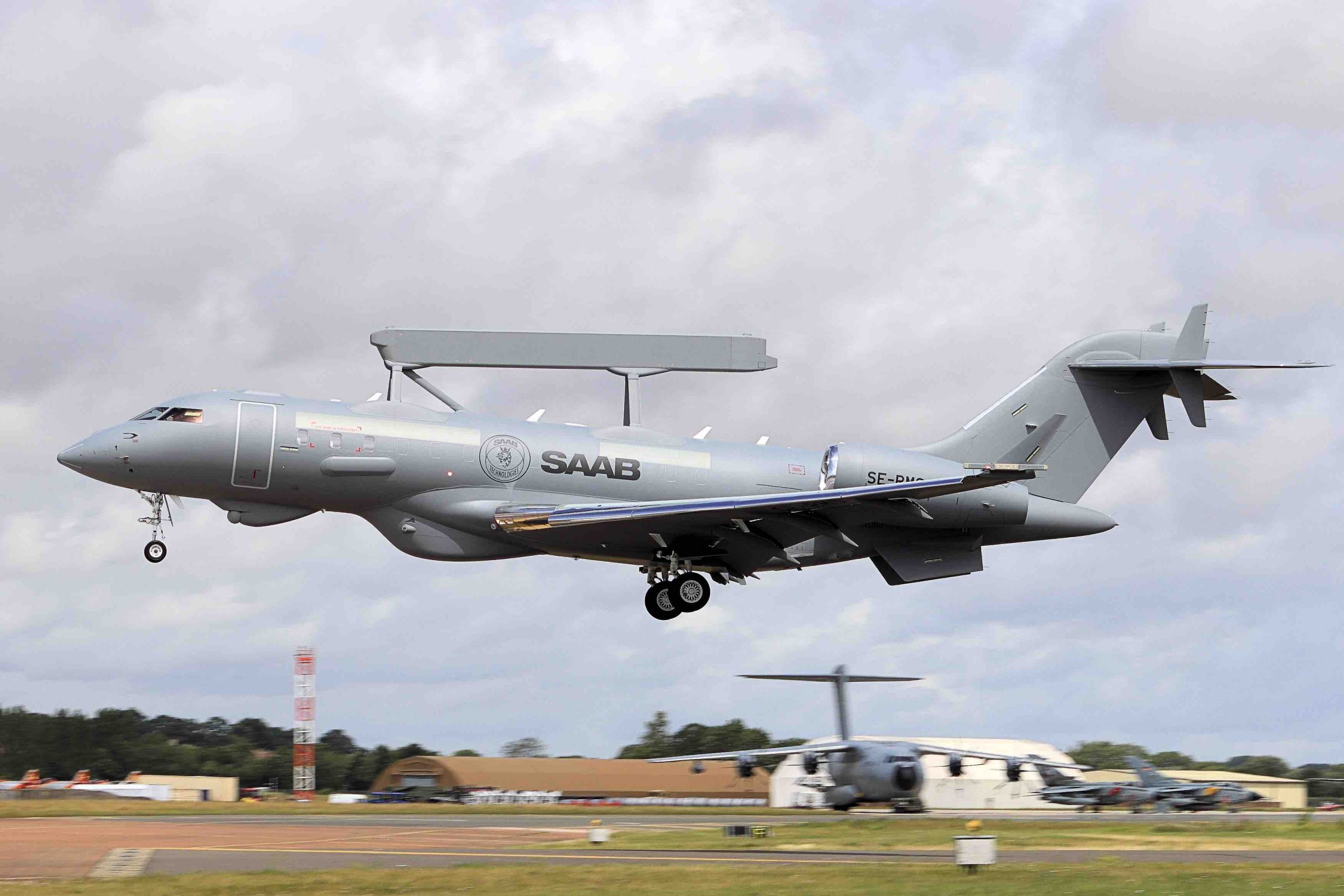
Reuters reports that the alliance is poised to opt for Saab’s GlobalEye, a platform built around Bombardier’s Global 6500 business jet and equipped with a suite of sensors designed to track threats across multiple domains.
That matters because the choice is not merely about replacing one radar aircraft with another. It is about how NATO wants to monitor a battlespace transformed by the war in Ukraine, by the proliferation of drones and cruise missiles, and by the growing need to detect, classify and share information quickly across dispersed forces. The old AWACS model was built for the central European battlefield and for large, manned Soviet air formations. The newer requirement is broader: persistent surveillance of airspace, sea lanes and ground movements, especially along NATO’s eastern flank, where warning time is short and ambiguity has become a weapon in its own right. GlobalEye’s appeal lies in that multi-role flexibility.
But the deeper significance lies in what the choice says about the alliance’s politics. Had NATO simply proceeded with Boeing’s E-7 Wedgetail, the procurement would have slotted neatly into the familiar transatlantic script: Europe talks about strategic autonomy, then signs the cheque in America. Instead, the alliance appears ready to buy Swedish. That is awkward timing for President Donald Trump, who has made a habit of telling Europeans that if they want American protection they should buy American kit too. The symbolism is not trivial. In one of NATO’s most visible common programmes, Europe is choosing a European prime contractor at precisely the moment Washington is demanding more burden-sharing and more deference.
There is, however, an irony here. Trump’s pressure may have helped create the conditions for this outcome. His long-running complaints about European free-riding, coupled with the Pentagon’s own shifting priorities, have forced allies to think harder about what “European responsibility” actually means in practice. Reuters reported this week that European members have already moved to fill most of the gaps left by a reduction in some US force contributions to NATO planning. The Saab decision fits that pattern. It suggests an alliance beginning, slowly and imperfectly, to accept that greater European responsibility cannot just mean spending more money; it must also mean making procurement choices that build European capacity.
That does not mean NATO is turning its back on the US defence industry. The alliance remains deeply dependent on American lift, intelligence, logistics, munitions and nuclear deterrence. Nor is Saab’s GlobalEye some revolutionary break with the past. It still relies on a Canadian airframe, and any NATO surveillance aircraft will need to plug into an alliance command architecture built over decades with heavy US involvement. Yet it would be a mistake to dismiss the decision as marginal. Defence procurement has a habit of revealing where power is moving long before communiqués do.
There are also practical reasons why the GlobalEye option looks attractive. A business-jet platform is cheaper to operate than a lumbering 707-derived AWACS aircraft. It is likely to be easier to sustain, more fuel-efficient and more adaptable to the dispersed operating model NATO increasingly favours. Reuters also notes that the eventual order could be larger than Canada’s recent six-aircraft purchase and may include air-to-air refuelling capability, implying that NATO is not merely seeking a stopgap but a surveillance fleet with serious endurance and reach.
Still, one should resist the temptation to overstate the romance of European defence independence. NATO summits are littered with grand declarations that age badly. Buying a Swedish surveillance aircraft is not the same as solving Europe’s chronic shortages in stockpiles, missile defence, strategic lift or industrial capacity. Nor does it settle the larger question hanging over Ankara: whether Europe can organise itself for a world in which American military support is more conditional, more selective and more openly transactional.
What it does show is that the alliance is adjusting, however reluctantly, to that world. NATO’s AWACS replacement is a technical decision with political overtones. It reflects a harder strategic environment, a more anxious relationship with Washington and a gradual European recognition that dependence is no longer a comfortable default setting. In that sense, the aircraft itself is almost beside the point. The real story is that NATO’s radar is finally sweeping a little closer to home.
Sweden Stakes Its Air Power on Saab’s Next-Generation Fighter
Main Image: By Airwolfhound from Hertfordshire, UK – Globaleye, CC BY-SA 2.0, https://commons.wikimedia.org/w/index.php?curid=134845884