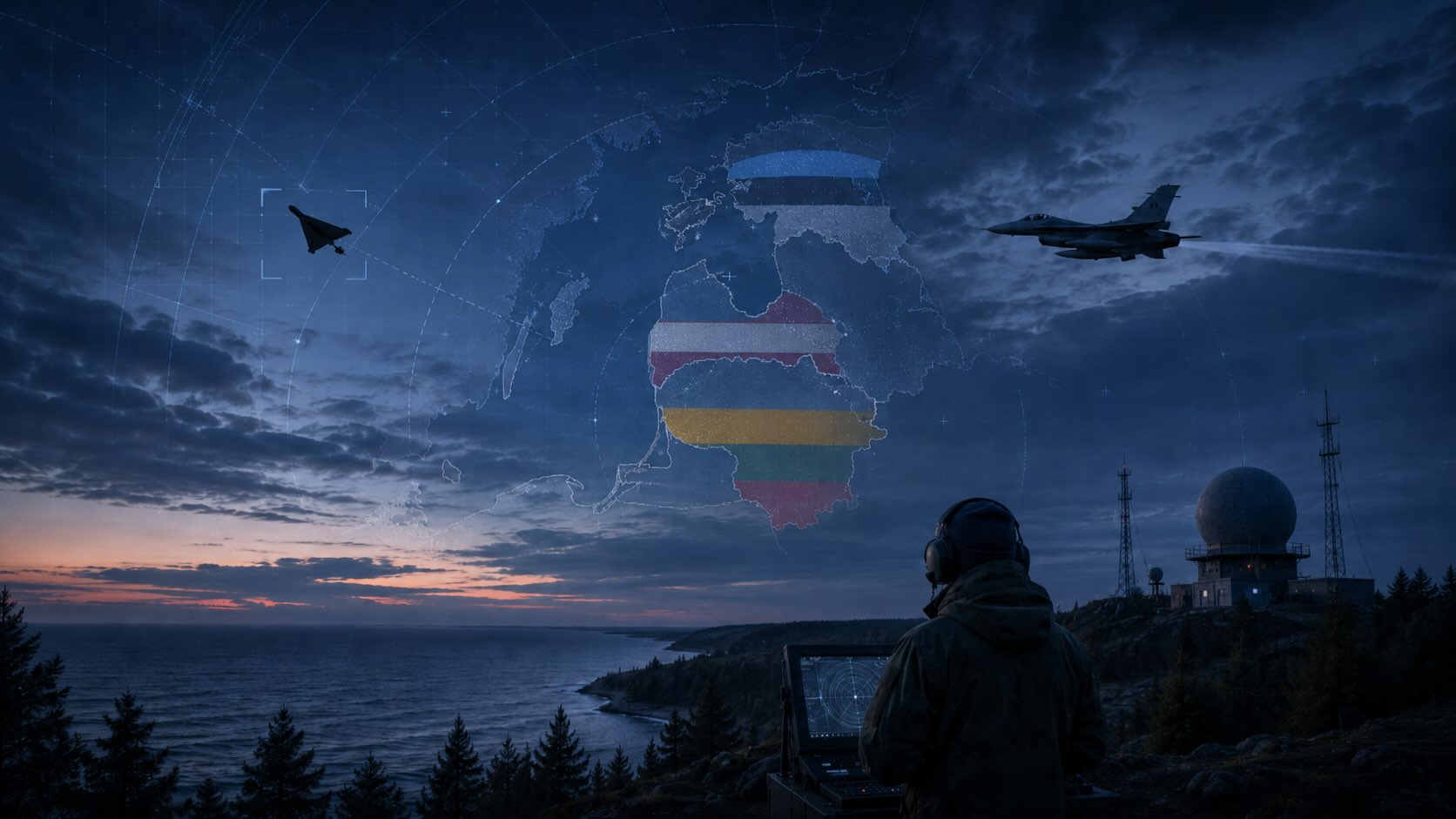
Russia has warned Latvia that it could face retaliation over alleged Ukrainian plans to launch drones from Baltic territory, in a claim rejected by Riga and Kyiv as false but treated by Western governments as a serious escalation in language towards a NATO member state.
The warning was delivered at the UN Security Council on 19 May, where Russia’s ambassador, Vasily Nebenzya, accused Ukraine of planning to use Latvia and other Baltic countries as launch sites for attacks on Russian territory. Nebenzya said NATO membership would not protect countries involved in such operations. Latvia’s UN envoy, Sanita Pavļuta-Deslandes, dismissed the allegation as “pure fiction”, while the Latvian foreign ministry summoned Russia’s acting mission head to protest against what it called false and provocative claims.
The allegation comes amid a series of drone-related incidents around the Baltic region. A Ukrainian military drone was shot down over Estonia by a NATO-operated Romanian F-16 after entering Estonian airspace. Kyiv said the aircraft had been diverted by Russian electronic warfare, including jamming and spoofing, and denied any intention to use Baltic airspace for strikes against Russia. Estonia also said it had not permitted its territory to be used for attacks on Russia.
The immediate security issue is not whether Russia has substantiated its claim. No public evidence has been presented to support the allegation that Ukraine is launching drones from Latvia or other Baltic states. The risk is that such claims can be used by Moscow to construct a basis for political pressure, military signalling or future provocation against a NATO member.
Latvia is especially exposed to this form of pressure. It borders Russia, hosts NATO forces, and has long warned that Moscow uses information operations alongside military activity to test allied responses. In the current case, Russia’s accusation links three sensitive issues: Ukraine’s expanding long-range drone campaign, Baltic airspace security, and NATO’s collective defence obligations.
The United States responded at the UN by reaffirming its commitment to Article 5 of the North Atlantic Treaty, the clause under which an attack on one ally is considered an attack on all. That response was important because Moscow’s message was not directed only at Latvia. It was also a test of how explicitly NATO members would restate deterrence in the face of a Russian threat framed around alleged Ukrainian operations.
For NATO, the episode highlights a growing problem on the eastern flank. Drone warfare has compressed the distance between the battlefield in Ukraine and allied territory. Long-range systems, electronic interference and air-defence responses now create incidents that are difficult to classify quickly. A drone entering allied airspace may be accidental, diverted, captured, spoofed, or deliberately sent as a provocation. Each scenario requires a different response, but decision-makers may have only minutes to act.
That ambiguity is useful to Russia. By alleging that Ukrainian drones are being launched from Baltic countries, Moscow can present itself as responding to a threat rather than escalating against NATO. The same method has appeared repeatedly during the war: accusations are made before evidence is provided, responsibility is shifted to Ukraine or its partners, and the information environment is shaped before technical facts are established.
The incident over Estonia also shows the operational pressure facing NATO air policing. Fighter aircraft can intercept and destroy drones that pose an immediate risk, but that does not solve the wider problem of persistent low-cost aerial threats, electronic warfare spillover, and civilian disruption. Latvia issued air alerts after drone-related concerns, though no confirmed drone was found in its airspace, according to Reuters’ account of the wider Baltic incidents.
The Baltic states have invested heavily in civil defence, border security and NATO integration since Russia’s full-scale invasion of Ukraine. Yet drone incursions expose a vulnerability that cannot be addressed by conventional deterrence alone. Air defence systems are expensive, drones are comparatively cheap, and hostile actors can use uncertainty itself as a tool.
For Ukraine, the issue is also sensitive. Kyiv has expanded attacks on Russian military and energy infrastructure as part of its effort to weaken Moscow’s war capacity. However, any incident involving NATO airspace gives Russia an opportunity to claim that Ukraine’s campaign is drawing the alliance directly into the conflict. Ukrainian officials have therefore denied any use of Baltic territory and apologised to Estonia over the drone incident, while maintaining that Ukrainian strikes are aimed at targets in Russia.
The wider implication is that NATO’s north-eastern flank is becoming a more active arena for hybrid pressure. Russia does not need to cross a border with conventional forces to create a security test. A drone incident, an electronic-warfare disruption, a false allegation or a threat delivered at the UN can all force NATO members to respond publicly and operationally.
Latvia’s position is clear: it denies Russia’s accusation and regards the claim as part of a broader pattern of intimidation. The more difficult question is how NATO manages repeated incidents below the threshold of armed attack, particularly where the facts may be contested in real time.
Moscow’s warning does not prove that a military escalation is imminent. It does, however, show how Russia is seeking to frame the Baltic states as participants in Ukraine’s drone war. That makes the issue larger than one allegation against Latvia. It is a test of NATO’s ability to deter Russia while avoiding being drawn into a narrative designed by Moscow.