Video circulating on social media shows a large liquid-fuel rocket rising only a few hundred metres from the Yasny test site before pitching over and plunging back to earth, where it explodes in a purple-tinged cloud associated with nitrogen tetroxide and other toxic propellants used in older intercontinental ballistic missiles (ICBMs).
Open-source analysts and Ukrainian media have identified the vehicle as an RS-28 Sarmat, Russia’s new silo-based heavy ICBM intended to replace the Soviet-era R-36M2 “Voyevoda”, known in Nato parlance as the SS-18 “Satan”.
The Orenburg accident follows at least one confirmed catastrophic failure at the Plesetsk cosmodrome in September 2024, when satellite imagery revealed that a Sarmat test silo had been obliterated, leaving a crater some 60 metres wide.
Arms-control experts concluded that the missile or its fuel load had detonated either during launch or defuelling. An earlier Sarmat test in February 2023, conducted around the time of US President Joe Biden’s visit to Kyiv, appears to have failed.
Despite this record, Russia has repeatedly announced that Sarmat has entered service. President Vladimir Putin first highlighted the system in 2018 as a flagship element of Russia’s nuclear modernisation, and Russian officials said in 2023 that the missile complex had been placed on “official combat duty” even as testing continued. The apparent gap between public declarations and technical performance has led analysts to see the programme as illustrative of wider strain on Russia’s defence-industrial base.
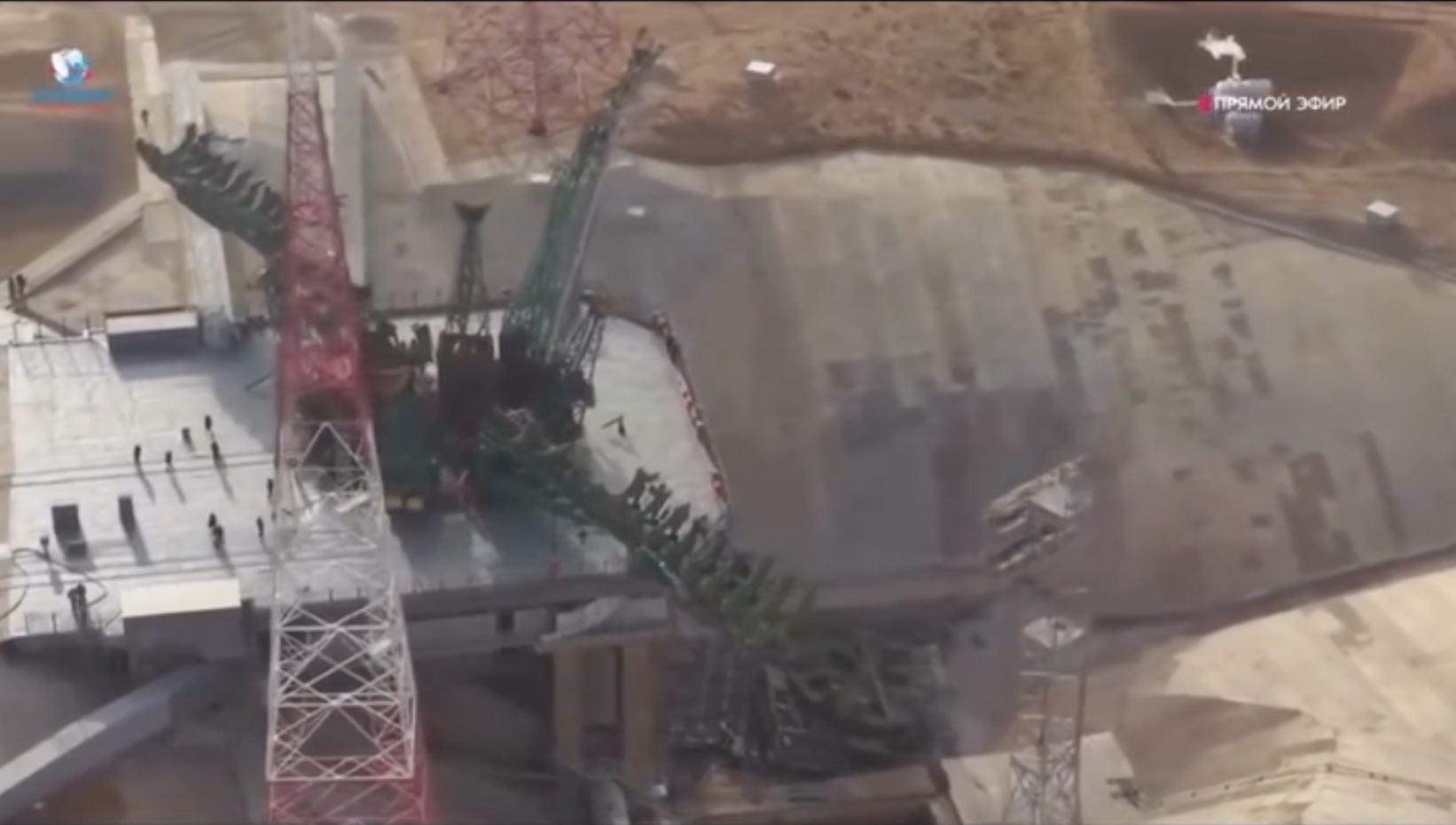
Russia’s civil space sector is facing parallel difficulties. On 27 November a Soyuz MS-28 spacecraft lifted off from Site 31/6 at the Baikonur cosmodrome in Kazakhstan, successfully delivering two Roscosmos cosmonauts and a NASA astronaut to the International Space Station. Subsequent imagery, however, showed that part of the service platform and other structures of the launch complex collapsed into the exhaust trench during liftoff. Russian officials have confirmed “damage to several launch pad components”, and independent analysts describe the incident as significant because 31/6 is currently Russia’s only crew-certified launch pad for Soyuz flights.
Specialists quoted by space industry media have warned that repairs could take many months, potentially leaving Russia without an operational crewed launch site for the first time since Yuri Gagarin’s flight in 1961. Vostochny, the new cosmodrome in Russia’s Far East, is not yet equipped for crewed launches, while the Plesetsk military range is used only for uncrewed missions.
These setbacks contrast with the ambitions laid out by Roscosmos and the Russian government. In January this year Yury Borisov, then head of Roscosmos, said a new national project on multi-satellite orbital infrastructure aims to build a constellation of about 650 government satellites by 2030, more than doubling Russia’s 290-strong state orbital fleet reported in late 2024. Independent launch statistics indicate that Russian providers conducted 17 orbital launches in 2024, a modest share of global activity and slightly down on the previous year.
Meeting the 2030 target would require a sustained increase in launch cadence and spacecraft production at a time when the Russian economy is under pressure from sanctions and high military expenditure. Sanctions have limited access to high-end electronics and other components, while the growth of private launch providers elsewhere has eroded Russia’s former role as a major commercial launch service provider.
Critics, including independent Russian commentators, argue that repeated failures in flagship programmes such as Sarmat, the Luna-25 lunar probe and now the Baikonur crewed pad point to structural weaknesses: ageing infrastructure, skills shortages, and the diversion of resources to the war in Ukraine.
For now, the failed missile test over Orenburg and the damaged launch complex at Baikonur have become visible symbols of those tensions. Both incidents involve legacy Soviet-era technologies—heavy liquid-fuel missiles and R-7-derived launchers—that Russia has sought to adapt and extend, rather than replace with new-generation systems. The extent to which Moscow can stabilise these programmes will help determine not only its future strategic nuclear posture but also its status as a spacefaring power in an increasingly competitive orbital environment.