A joint Nordic-Baltic investigation, based on satellite imagery, has identified new barracks, equipment areas, ammunition storage facilities and other military construction at several Russian locations close to European borders. The findings suggest that Russia may be preparing infrastructure capable of supporting up to 115,000 personnel in areas facing northern Europe and the Baltic states.
The sites identified include Pechenga, near Norway and Finnish Lapland; Petrozavodsk and Sapyornoye, close to Finland; Luga, near the Baltic region; Baltiysk, Russia’s main naval base in Kaliningrad; Kirillovskoye, around 70 kilometres from Finland; and Kandalaksha, on the White Sea. The pattern points not to an isolated renovation of individual garrisons, but to a broader military reorganisation along NATO’s newly extended northern frontier.
The timing is politically significant. After Finland and Sweden joined NATO, President Vladimir Putin warned that Russia would respond to the Alliance’s enlargement. At the time, those threats were often interpreted through the prism of Russia’s heavy commitment in Ukraine. The latest evidence suggests, however, that Moscow’s focus on Ukraine has not prevented it from building the foundations for a larger military presence on NATO’s northern flank.
The most immediate concern is Finland. Finnish Army commander Lieutenant General Pasi Välimäki has reportedly assessed that Russian forces near the Finnish border could rise from around 20,000 to as many as 80,000 once the infrastructure programme is complete. In Pechenga, the expanded base could eventually hold up to 17,000 troops, compared with around 7,000 previously.
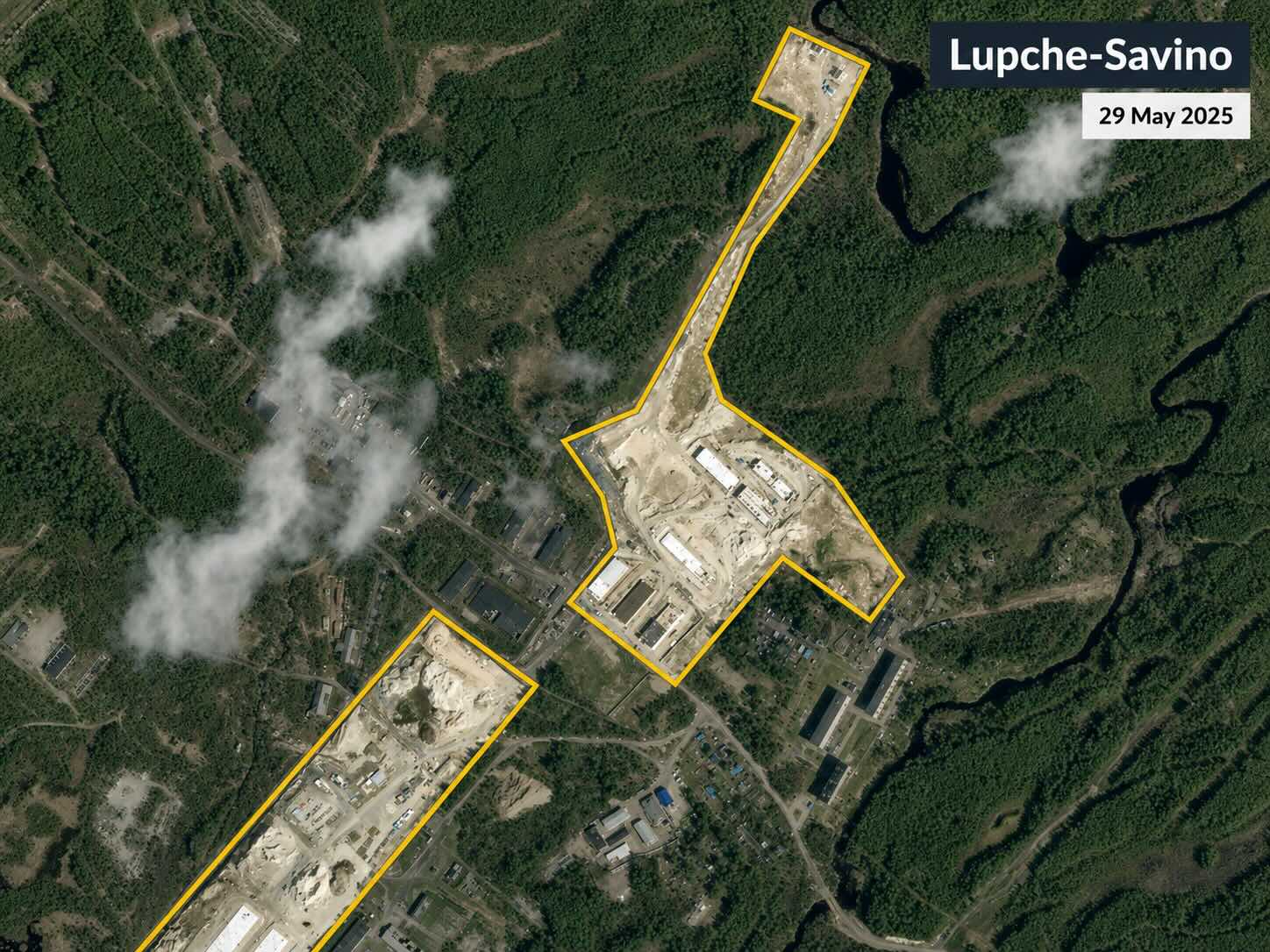
Earlier satellite-based reporting on Kandalaksha showed construction at the Lupche-Savino garrison, including new barracks, dormitories, ammunition depots, fuel storage and a headquarters building. The site lies about 110 kilometres from Finland and is being prepared for a new artillery brigade and elements of an engineer brigade. Separate reporting has also pointed to military activity around Petrozavodsk, where Russia’s reconstituted forces in Karelia could become part of a larger northern grouping.
Norway is also watching the build-up closely. General Eirik Kristoffersen, the country’s Chief of Defence, has warned that if Russia builds forces to the levels it has announced, the military threat to Norway will increase. This matters not only because of Norway’s land border with Russia in the Arctic, but because of the wider strategic geography of the High North, the Barents Sea and the Kola Peninsula, where Russia maintains major naval and nuclear assets.
For NATO commanders, the immediate threat remains limited while Russia is still heavily engaged in Ukraine. Major General Brian Nissen, commander of NATO forces in the Baltic region and Poland, has reportedly assessed that Russia’s direct military threat is low while its forces remain tied down in Ukraine. But that could change quickly if there is a pause in the war.
This assessment is not confined to one national military establishment. A separate security analysis reached a similar conclusion: Russia is unlikely to launch an immediate attack near Finland while the war in Ukraine continues to consume manpower and equipment, but the infrastructure now being built could support a much larger force once Moscow is able to regenerate and redeploy.
That point is central to northern Europe’s security debate. The war in Ukraine is now viewed across the region not only as a conflict on Europe’s eastern edge, but as a period in which NATO has time to prepare for a possible future Russian challenge. As long as Russia remains committed in Ukraine, the immediate risk to northern Europe is reduced. If the fighting slows, freezes or ends on terms that leave Russia able to rebuild, the military balance on NATO’s northern frontier could shift quickly.
The danger may not take the form of a traditional armoured invasion. Russia’s war against Ukraine has shown how Moscow increasingly combines ground pressure with missile strikes, drone attacks, sabotage, cyber operations and coercive signalling. A future confrontation with NATO’s northern or Baltic members could begin with attacks on military infrastructure, logistics hubs, airfields, ports or facilities linked to support for Ukraine, rather than with tanks crossing a border.
That scenario would create a difficult political and military test for NATO. Russia may calculate that limited strikes, drone incursions, airspace violations or attacks on facilities used to assist Ukraine could fall below the threshold of an immediate collective military response. Such calculations would be shaped by Moscow’s perception of Western caution over escalation between nuclear powers.
This is why the build-up cannot be understood only as a question of troop numbers. Barracks, depots, rail connections, equipment parks and fuel storage create options. They allow forces to be moved, sustained and dispersed. They also support missile, drone and air-defence activity, and could be used to complicate any NATO response in the event of a wider crisis.
The expansion of Baltiysk in Kaliningrad adds another dimension. The Baltic Sea has changed strategically since Finland and Sweden joined NATO, with Russia now facing an Alliance-dominated maritime environment. A stronger Russian posture in Kaliningrad, combined with military activity around Luga, Pskov and the Gulf of Finland, would increase pressure on Estonia, Latvia, Lithuania and Poland, as well as on NATO’s reinforcement routes.
NATO has begun to respond. The Alliance’s newest Forward Land Forces structure started operations in Finland and Sweden in June 2026. Sweden acts as the framework nation for the new formation, which is designed to strengthen deterrence and defence in the High North and on NATO’s north-eastern flank. The Swedish government has also confirmed that troops will be placed under NATO command in Finland, with an initial contribution of around 600 personnel and the option to expand it.
These steps mark a major change in the military map of northern Europe. Finland’s accession gave NATO a 1,344-kilometre border with Russia, while Sweden’s membership changed the strategic position of the Baltic Sea. Moscow’s current construction programme appears to be a response to that new geography, but also an attempt to create leverage for future crises.
The key question is therefore not only whether Russia intends to attack a NATO member. It is whether European states are prepared to respond if Russia tests them with limited strikes, hybrid operations or attacks on facilities linked to Ukraine’s defence. Russia’s nuclear posture and its testing of new missile systems are intended partly to constrain Western decision-making and to raise the perceived cost of retaliation.
For Moscow, intimidating European publics and weakening military assistance to Ukraine are practical objectives. If Russia can make support for Ukraine appear dangerous for NATO members themselves, it may hope to alter public opinion, slow arms deliveries and reduce Europe’s willingness to sustain Kyiv over a long war.
The build-up near northern Europe should therefore be viewed as part of the same strategic contest as the war in Ukraine. Russia is not only fighting on Ukrainian territory. It is preparing the military and psychological conditions for pressure on the states that enable Ukraine to continue fighting. Whether that pressure remains coercive or becomes kinetic will depend not only on Russian intentions, but on the clarity and credibility of NATO’s response.