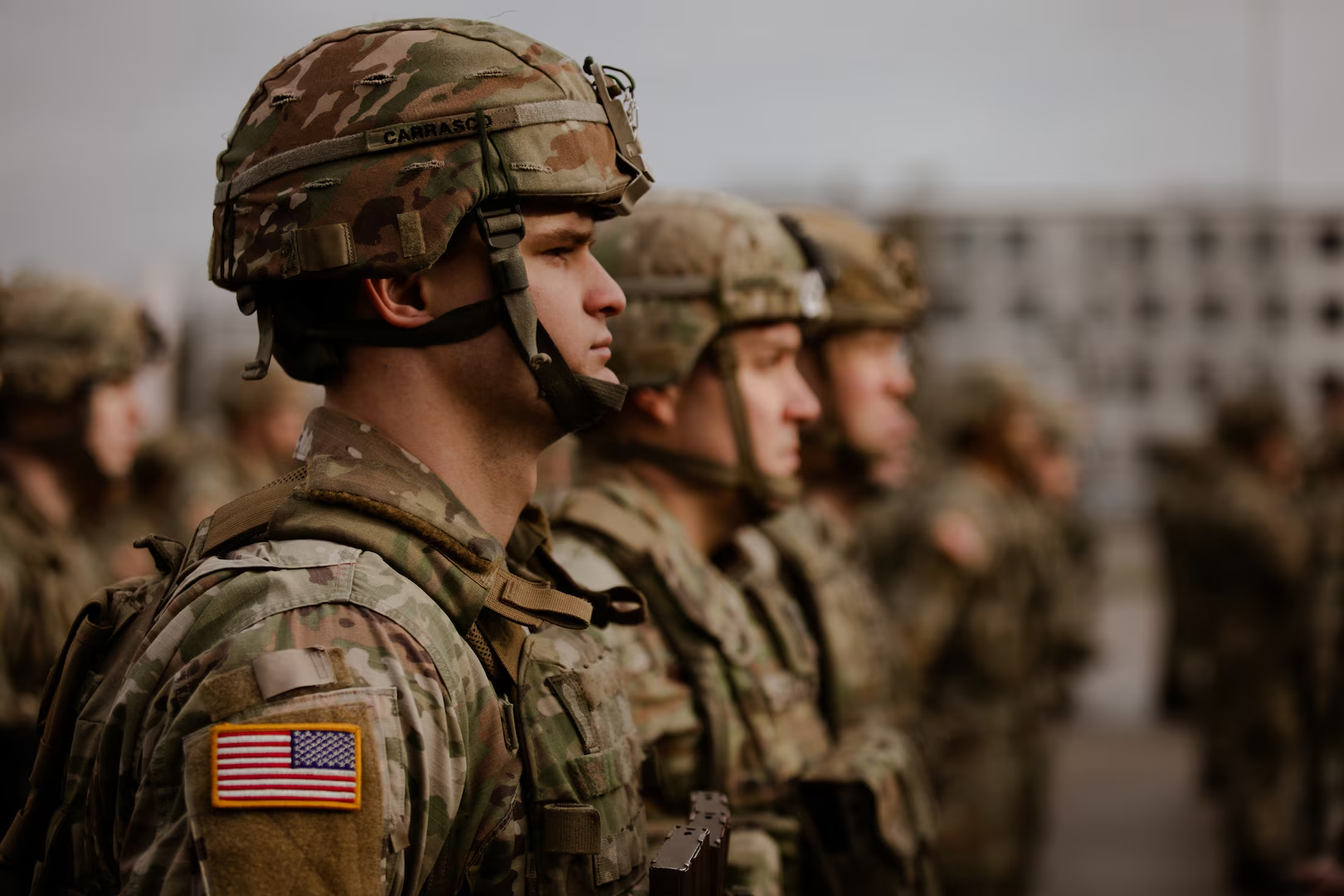
President Donald Trump’s decision to reduce the United States military presence in Germany has reopened a central question for NATO: how far Europe can continue to rely on Washington as its principal security guarantor. The Pentagon has confirmed the withdrawal of approximately 5,000 US troops from Germany over the next six to 12 months, describing the move as the result of a review of American force posture in Europe.
The drawdown affects one of the most important American military hubs outside the United States. Germany hosts major US facilities, including bases used for operations, logistics and command functions across Europe, the Middle East and Africa. The immediate military impact may be limited, but the political signal is more substantial: Washington is prepared to adjust its European posture at short notice, even when allies and parts of Congress express concern.
The decision has met resistance from senior Republicans on Capitol Hill. Senator Roger Wicker, chairman of the Senate Armed Services Committee, and Representative Mike Rogers, chairman of the House Armed Services Committee, said they were “very concerned” by the decision. They argued that American troops should not be removed from Europe, but if redeployed should be moved eastwards to strengthen deterrence on NATO’s front line.
The troop reduction has been accompanied by the cancellation of a planned Long-Range Fires Battalion in Germany. That deployment had been expected to include ground-launched Tomahawk missiles, part of a wider effort to reinforce NATO’s long-range conventional deterrence. Reuters reported that the cancelled deployment had been supported by Berlin and was viewed as an important element in NATO’s response to Russia’s military threat.
For European governments, the missile issue may be more significant than the troop numbers. Europe has increased defence spending since Russia’s full-scale invasion of Ukraine, but it still depends heavily on the United States for strategic enablers, including intelligence, airlift, missile defence, precision strike and long-range fires. The loss of a planned US Tomahawk deployment highlights a capability gap that European states have not yet closed.
NATO has avoided open confrontation with Washington. Alliance officials have said they are still assessing the details of the American decision. The alliance is working with the United States to clarify which units and bases will be affected.
The German government has also tried to limit the diplomatic damage. Chancellor Friedrich Merz has played down tensions with Trump, despite recent disagreement over Washington’s handling of Iran. Merz had questioned whether the Trump administration had a clear strategy for the conflict, while Trump has maintained pressure on European allies over defence spending and burden-sharing.
The wider context is a deteriorating transatlantic relationship. The troop decision comes as Washington faces criticism over its Iran policy and as European governments remain divided over how far they should align themselves with US military operations in the Middle East. Trump has described recent Iranian terms as unacceptable, while reports say Tehran has advanced a 14-point proposal focused on ending hostilities and reopening the Strait of Hormuz.
For Moscow, any reduction in the US military footprint in Europe will be closely watched. Congressional concern reflects a broader fear that the Kremlin could interpret the decision as evidence of weakening American commitment to European security. The administration’s defenders argue that Europe must assume a larger share of its own defence. Its critics argue that abrupt withdrawals risk undermining deterrence at a time when Russia remains engaged in war against Ukraine.
Europe is not facing an immediate security vacuum. Germany will continue to host a large American presence, and NATO’s command structures remain intact. Yet the political lesson is clear. European security planning can no longer assume a consistent American approach across administrations, or even within a single administration.
The result is likely to be renewed pressure on European governments to expand joint defence procurement, accelerate missile and air-defence programmes, and strengthen Ukraine’s role as a core element of the continent’s security architecture. The Germany decision does not end the US role in Europe, but it does weaken assumptions that have shaped NATO planning for decades.