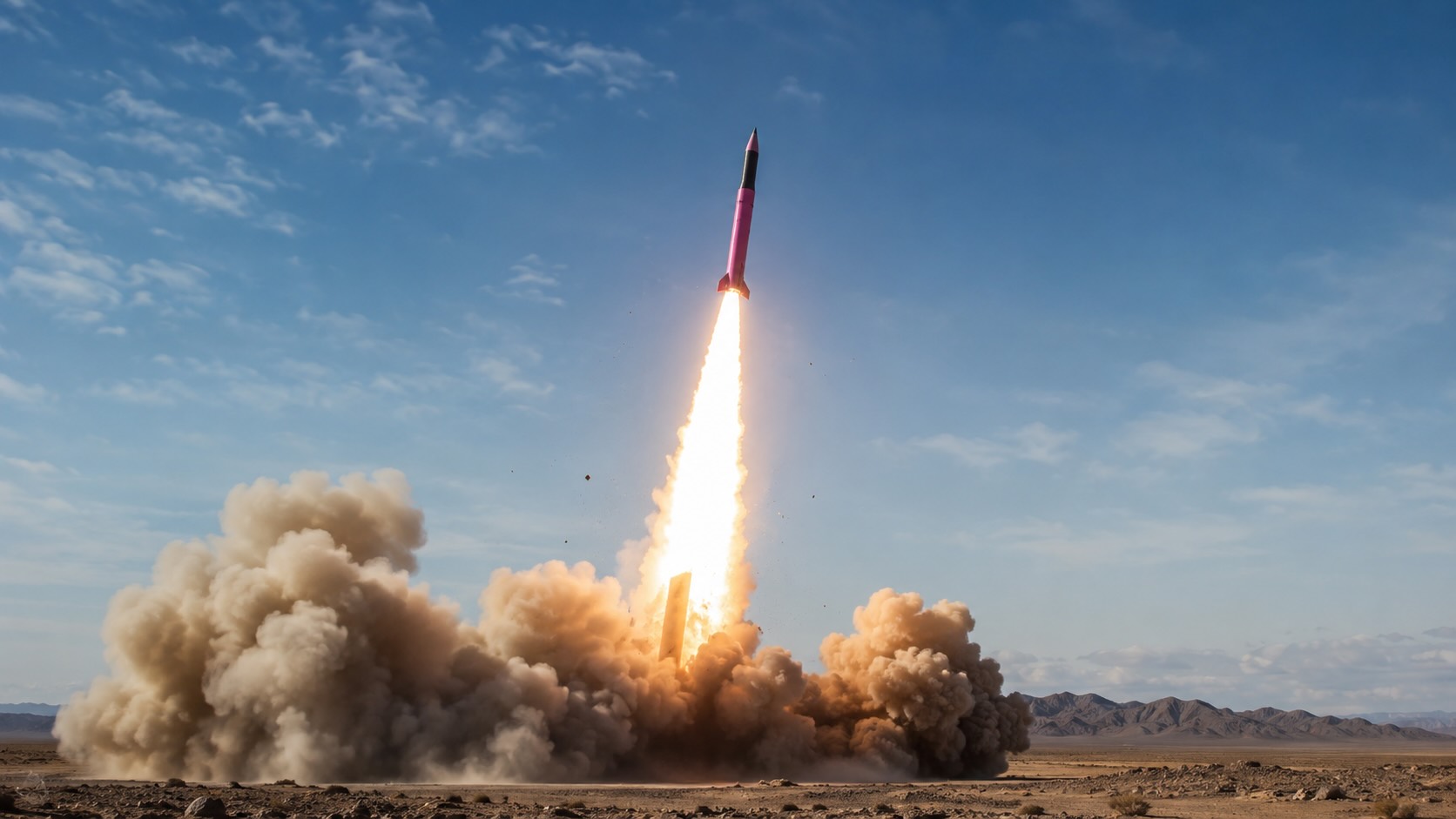
The test, described as a fully guided manoeuvring flight, does not by itself confirm that the system is ready for operational deployment. It does, however, indicate that the project has moved beyond a purely conceptual stage and is now in active flight testing. For Ukraine, which continues to face repeated Russian ballistic missile attacks, the development is relevant both for deep-strike capability and for future air defence.
Fire Point is already known for the FP-1 long-range strike drone and the FP-5 Flamingo cruise missile. The company has become part of Ukraine’s wider wartime effort to reduce dependence on foreign-supplied weapons by developing domestic systems capable of reaching targets deep inside Russian territory. Earlier reporting on Ukraine’s expanding long-range strike industry described Fire Point as one of the companies that emerged after the 2022 full-scale invasion to build low-cost systems adapted to battlefield requirements.
The FP-7 appears to represent the company’s move from drones and cruise missiles into ballistic missile technology. According to details released in connection with the company’s Freyja concept, the missile is being developed in more than one configuration. One version is intended as a ground-strike ballistic missile, broadly comparable in operational role to the US ATACMS system, though reported specifications suggest a smaller warhead. A second version, the FP-7.X, is being developed as an interceptor intended to engage ballistic missile threats.
This dual-use design is important, but it should be treated with caution. A ground-strike ballistic missile and an anti-ballistic interceptor may share propulsion, materials and high-speed flight technologies, but they require different guidance and targeting architecture. A strike missile must reach a fixed or pre-programmed target. An interceptor must detect, track and destroy a moving ballistic threat within a very short engagement window.
Fire Point has presented the FP-7.X as the kinetic element of the proposed Freyja air defence system. The wider project envisages cooperation with European companies, with Ukraine providing the missile and European partners potentially contributing radars, computing systems and other components. This would make Freyja not simply a missile, but a layered missile defence architecture requiring sensors, command-and-control systems, engagement software and launch infrastructure.
The company has indicated that the FP-7.X is intended to reach speeds of about 1,500 to 2,000 metres per second. That range would place it within the speed bracket relevant for ballistic missile interception. Speed, however, is only one factor. Effective interception also depends on acceleration, manoeuvrability, sensor integration, target discrimination and the ability of the wider system to calculate an intercept point with sufficient precision.
The project comes as Ukraine and its European partners face continued pressure on missile defence stocks. Fire Point has said it is in talks with European companies to create a lower-cost air defence alternative to the increasingly scarce Patriot system, with the company aiming to bring the project forward by 2027. The shortage of Patriot interceptors has become a recurring concern as Russia continues to use ballistic missiles against Ukrainian cities, military sites and energy infrastructure.
For Kyiv, a domestic interceptor would therefore have clear strategic value. It could reduce dependence on imported missiles and give Ukraine greater control over production, adaptation and deployment. For Europe, the project could be relevant if it develops into a lower-cost additional layer of missile defence. That prospect explains why Fire Point’s proposed cooperation with European industry is politically as well as technically important.
There are still several unresolved questions. It remains unclear when the FP-7 strike version could enter serial production, what its operational range and accuracy will be, and how many missiles Ukraine could manufacture under wartime conditions. For the FP-7.X interceptor, the more complex question is whether Fire Point and its partners can integrate the missile into a reliable air defence network. Without that system architecture, the missile would remain a promising component rather than a complete anti-ballistic capability.
The development also reflects a broader shift in Ukraine’s defence sector. Since the start of Russia’s full-scale invasion, Ukraine has accelerated the production of drones, naval systems and long-range strike weapons. The FP-7 programme suggests that Kyiv is now seeking to move further up the technological chain, from unmanned strike systems and cruise missiles towards ballistic missiles and missile defence.
The available evidence does not support treating FP-7 as a fully operational weapon. The more accurate assessment is that Fire Point has demonstrated progress in advanced development and testing. If the programme reaches production, it could give Ukraine a domestic ballistic strike option and, in the longer term, contribute to a European-supported missile defence system. For now, its importance lies in the direction of travel: Ukraine is attempting to build an integrated domestic missile ecosystem at a time when missile warfare has become central to the conflict.