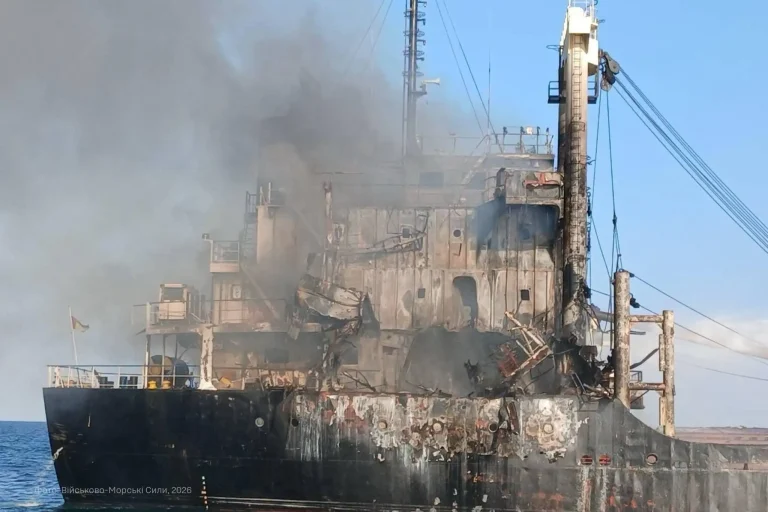
The vessel, Bella 1—later renamed Marinera—was taken in the North Atlantic on 7 January under a warrant issued by a US federal court, according to a statement by US European Command. The command said the operation was carried out by components of the Department of Homeland Security in coordination with the Department of Justice, with support from the Department of Defense, after the ship was tracked by the US Coast Guard cutter Munro.
The seizure followed earlier attempts by the US Coast Guard to board the tanker as it approached Venezuelan waters in late December. US officials said the vessel was in ballast—travelling without cargo—when it was first intercepted and again when it was ultimately seized.
During the pursuit, the tanker changed its name and claimed Russian protection. Reporting in late December described the crew painting a Russian flag on the hull and taking steps consistent with a rapid reflagging, a tactic maritime analysts have associated with so-called “dark” or “shadow” fleets operating around sanctions regimes.
By the time of the 7 January seizure, US and UK reporting identified the vessel as Russian-flagged. The UK Ministry of Defence confirmed it provided operational support to the US interdiction effort, including the use of a Royal Fleet Auxiliary vessel and Royal Air Force surveillance assets in the North Atlantic.
US officials have linked Bella 1/Marinera to sanctions evasion involving Venezuelan oil shipments and networks connected to Iran. Associated Press reported that Bella 1 had been sanctioned in 2024 for alleged ties to a Hezbollah-linked company and that US authorities described it as part of a “ghost fleet” moving sanctioned oil, mainly to Asia.
Industry and maritime reporting has identified the tanker’s registered ownership and management as opaque and frequently changing—another common feature of sanctions-linked shipping. Seatrade Maritime reported the vessel was sanctioned by the US Office of Foreign Assets Control for links to Iran and cited maritime databases associating it with networks tied to Iran’s Islamic Revolutionary Guard Corps.
Russian officials condemned the operation and framed it as a breach of international maritime rules. AP cited Russian criticism asserting that no state has the right to use force against vessels properly registered under another jurisdiction, with reference to the UN Convention on the Law of the Sea. Russia’s transport ministry said it lost contact with the tanker after US forces boarded, and quoted a senior Russian lawmaker describing the seizure as “piracy”.
US statements have emphasised that the seizure was conducted pursuant to a court warrant and on the basis of alleged violations of US sanctions. The Pentagon has not published detailed operational or legal filings, but US European Command’s statement placed the action within a wider enforcement effort against sanctioned shipping.
The tanker seizure comes amid a broader escalation in US pressure on Venezuela’s oil trade under President Donald Trump. US media and wire reporting in recent days has described a US maritime campaign targeting tankers linked to Venezuelan exports, alongside a separate operation in which Nicolás Maduro was captured in Caracas and transferred to US custody.
Maduro has since appeared in a US court and pleaded not guilty to drug trafficking-related charges. Reuters reported that his legal team is expected to argue he is entitled to head-of-state immunity, a claim likely to be contested given the US position on Venezuela’s leadership and the circumstances of his capture.
US officials have presented the maritime seizures as an extension of sanctions enforcement aimed at disrupting revenue streams and logistical networks that Washington says support sanctioned states and designated entities. AP reported that a second tanker, Sophia, was also seized in the Caribbean as part of the same enforcement push.
The case illustrates an emerging contest over how sanctions are enforced in international waters when vessels rapidly change flags, names and corporate documentation. Maritime analysts have noted that while a ship’s flag state generally determines jurisdiction, vessels that are unregistered, falsely flagged, or subject to domestic court orders can become targets for interdiction, especially when states are prepared to accept the diplomatic costs.
For Washington, the seizure of Marinera will be treated as a practical test of whether reflagging to Russia can complicate or deter enforcement. For Moscow, the episode adds another point of friction with the US at a time when the Kremlin is simultaneously managing sanctions pressure and wider geopolitical disputes.