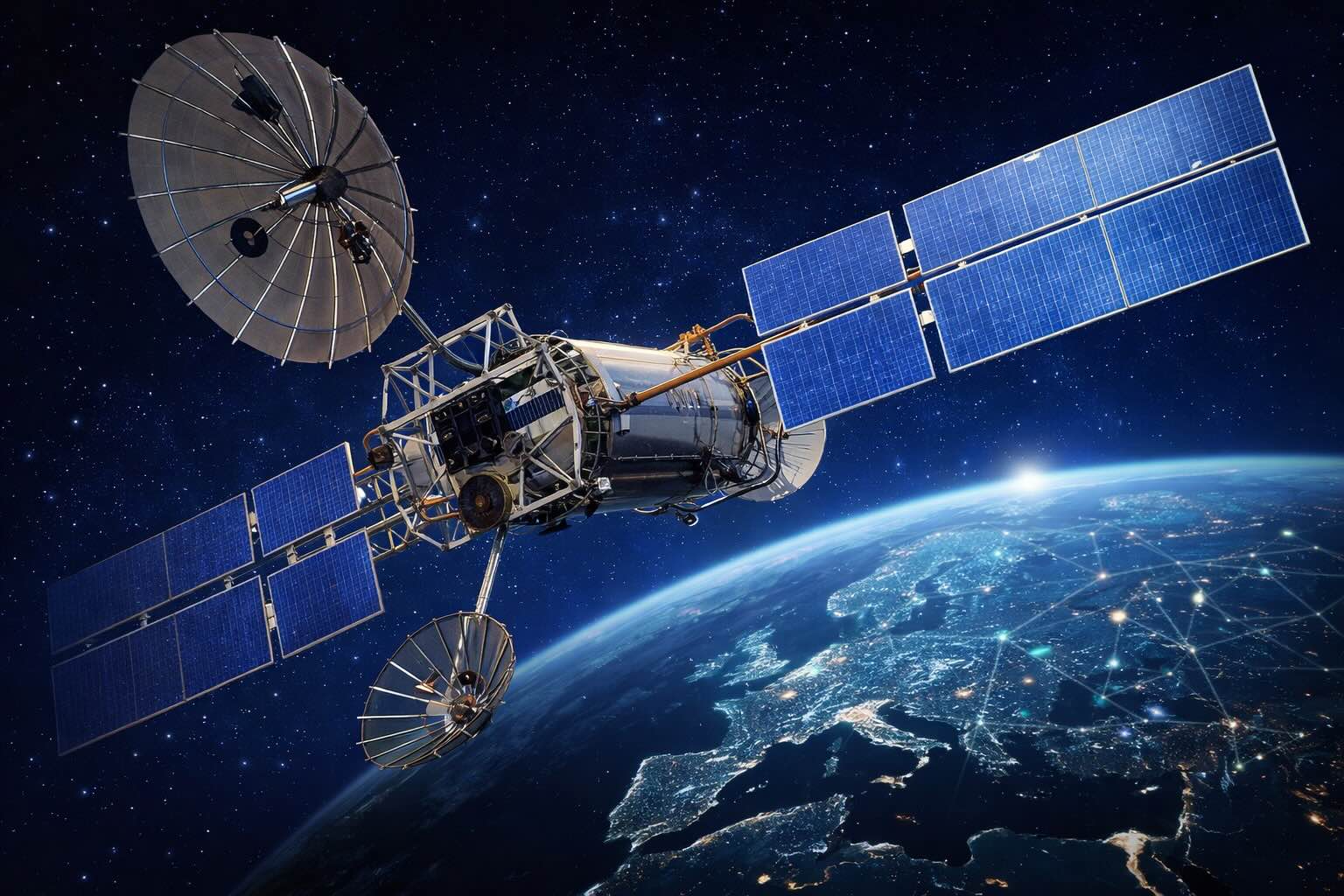
In a report published by the Financial Times, two Russian satellites, identified as Luch-1 and Luch-2, had approached and “shadowed” European communications satellites for extended periods, in some cases lingering nearby for weeks. Officials and analysts quoted in the report said the manoeuvres appeared consistent with signals intelligence collection, including the interception of unencrypted communications links.
The core risk lies not only in the possible capture of message traffic but in access to command-and-control channels used to operate spacecraft. These links allow ground stations to send instructions for routine station-keeping, minor orbit adjustments and other operational tasks. If a hostile actor can obtain or replicate command data, the concern is that satellites could be subjected to spoofed instructions, forced off their assigned orbital slots, or placed into hazardous proximity with other spacecraft.
Michael Traut, a major general and head of Germany’s military space command, told Reuters in early February that European governments now treat space as a contested domain, particularly since Russia’s full-scale invasion of Ukraine in 2022. Reuters reported that Germany is examining a substantial expansion of military space investment, including encrypted communications satellites and defensive tools such as jamming and “inspector” satellites designed to monitor hostile systems.
The issue of encryption has become central to European deliberations. The Financial Times report described “unencrypted European communications” as a target, with officials warning that some satellite links were not protected to a standard commensurate with their operational use. In practice, commercial satellites built for television, broadband and corporate connectivity can also carry governmental traffic through leased capacity, and ground terminals may be used by a mixture of civil and military customers. That creates opportunities for an intelligence service to learn not only the content of transmissions where encryption is weak, but also patterns of use, network architecture and the locations of terminals on the ground.
European tracking data and ground-based observations cited by the Financial Times suggested that the two Russian spacecraft had intensified understanding of European geostationary systems over the past three years, including during periods when European governments relied heavily on satellite links for coordination and information sharing connected to the war in Ukraine. The report said at least 17 European geostationary satellites were assessed to have been approached in a pattern consistent with deliberate surveillance.
One additional concern is escalation from surveillance to interference. The officials quoted by the Financial Times warned that close-proximity operations could enable more aggressive actions, ranging from signal disruption to physical interference. While the Luch satellites are primarily described as intelligence collectors, the wider anxiety is that operational knowledge gathered now could support future attempts to jam, spoof, or otherwise degrade satellite services during a crisis.
The broader political framing has been reinforced by recent statements from Germany’s defence minister, Boris Pistorius. Reuters reported in September 2025 that Pistorius warned of a growing Russian threat in space and highlighted the vulnerability of satellite networks to disruption. In related coverage, Pistorius described satellite networks as an “Achilles heel” for modern societies, arguing that an attack could paralyse entire countries.
The Financial Times also reported a recent complication affecting one of the suspected Russian spacecraft: Luch-1 may have been disabled following a fragmentation event observed in January 2026. Officials cited in the report nonetheless stressed that the operational model — using manoeuvrable satellites to approach others and exploit weak links — remains a continuing challenge for European and allied space security.
This debate is unfolding amid wider European moves towards resilience in orbit. Reuters reported this week that Germany is considering an encrypted network of more than 100 satellites as part of a proposed spending initiative aimed at reducing exposure to hostile space activity and ensuring that critical services can continue if individual systems are compromised.
For European governments, the immediate policy questions are practical: which links remain insufficiently protected; how rapidly encryption and authentication can be upgraded for satellites and ground stations; and how operators should respond when foreign spacecraft conduct close approaches that are not prohibited by current space law. The emerging consensus, reflected in recent official statements and reporting, is that satellite security is now treated as part of national infrastructure protection, rather than a technical issue confined to the space sector.