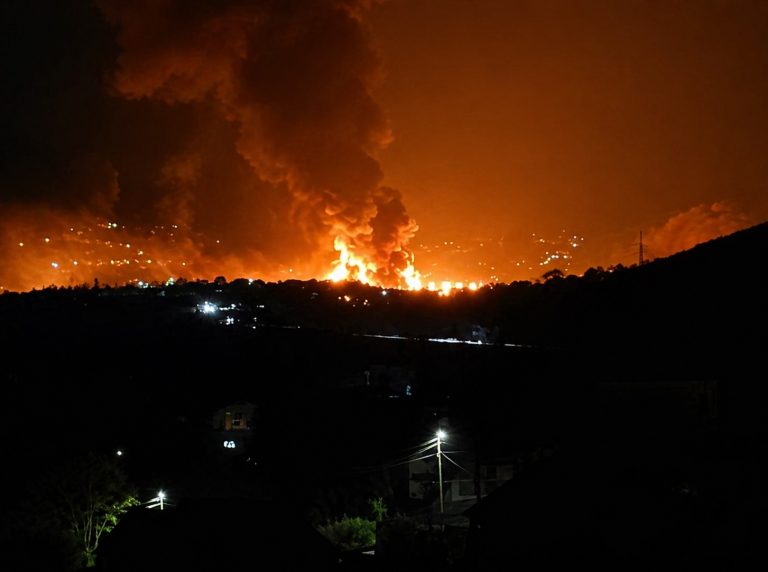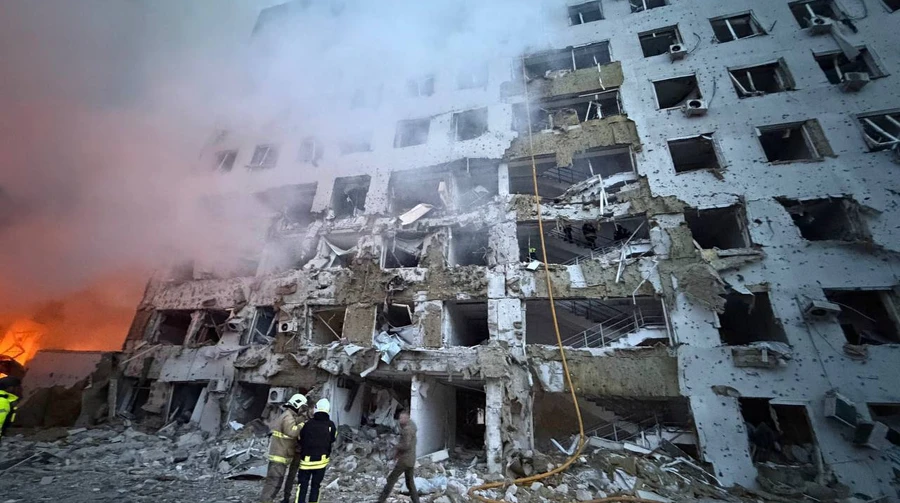
Russia’s overnight attack on Odesa left nine dead and 23 wounded, according to Ukrainian regional authorities, after missiles and drones hit residential and infrastructure targets in the Black Sea city. Officials said rescue and recovery work continued through the morning as emergency crews searched damaged buildings and dealt with fires and structural destruction. Local reporting also said Odesa declared a day of mourning.
The strike caused heavy damage across several parts of the city. Ukrainian officials said port, critical and residential infrastructure was hit, while at least three multi-storey buildings suffered major façade and glazing damage. A dormitory and adjacent buildings were also affected, and blast waves shattered hundreds of windows. Further damage was reported later in the morning in other districts, including commercial property and a market area.
For Odesa, the attack was not simply another entry in the daily war ledger. The city is both a population centre and a strategic maritime hub, central to Ukraine’s Black Sea trade and export routes. Repeated Russian attacks on the Odesa region and nearby port infrastructure have therefore carried both a civilian and an economic dimension. Reuters reported earlier this week that Russian strikes had damaged vessels and infrastructure linked to Ukraine’s Danube export corridor, underlining the wider strategic pressure on the region.
The latest strike on Odesa came as part of a broader Russian assault across Ukraine. Russia launched a mass wave of drones and missiles overnight, striking several cities including Kyiv, Odesa and Dnipro. Ukraine’s air force intercepted or otherwise neutralised the majority of incoming targets, but not all of them. The scale of the attack demonstrated a familiar pattern: Ukraine’s air-defence network remains capable, but it is being forced to absorb large barrages with incomplete coverage and finite missile stocks.
That is the point Kyiv has been making with increasing bluntness to its partners. President Volodymyr Zelenskyy said on Thursday that he had instructed the commander of the Air Force to contact countries that had committed missiles for Patriot and other systems, stressing that assistance must arrive on time. His remarks amounted to a direct message to partners, including European governments, that pledges alone do not protect cities when deliveries are delayed.
Zelenskyy had already framed the issue in stark terms at the Munich Security Conference in February. In a passage that has since become one of his clearest statements on the problem, he said that “one of the worst things a leader can hear in wartime” is a report from the air force commander saying “the air defense units are empty – they used their missiles to stop Russian strikes, and there was no resupply”. He added that replacement missiles sometimes arrive only at “the last, very last moment”.
After Odesa, that warning carries a very immediate relevance. The issue is no longer whether Ukraine can shoot down a large share of incoming targets. It often can. The issue is that even a relatively small number of missiles or drones that penetrate defences can inflict fatal damage on densely populated urban areas. In a port city such as Odesa, the consequences are multiplied: apartment blocks, transport nodes, energy facilities and commercial infrastructure all lie within the same urban fabric.
For Brussels, the political implication is clear. European leaders have repeatedly affirmed that support for Ukraine is a matter of continental security, not charity. But Odesa illustrates the gap between that formulation and the operational reality on the ground. When deliveries of interceptors, launchers or supporting systems slip behind schedule, the cost is measured not in diplomatic language but in dead civilians, damaged housing and disrupted infrastructure.
The argument from Kyiv is therefore becoming more precise. Ukraine is not simply asking for more weapons in the abstract; it is demanding predictable, timely replenishment of the systems already defending its cities. Wednesday’s strike on Odesa gave that demand another brutal point of evidence. If Europe wants to sustain its claim that Ukraine’s defence is part of Europe’s own security architecture, then the delivery of air-defence support can no longer remain a matter of slow implementation and deferred commitments.