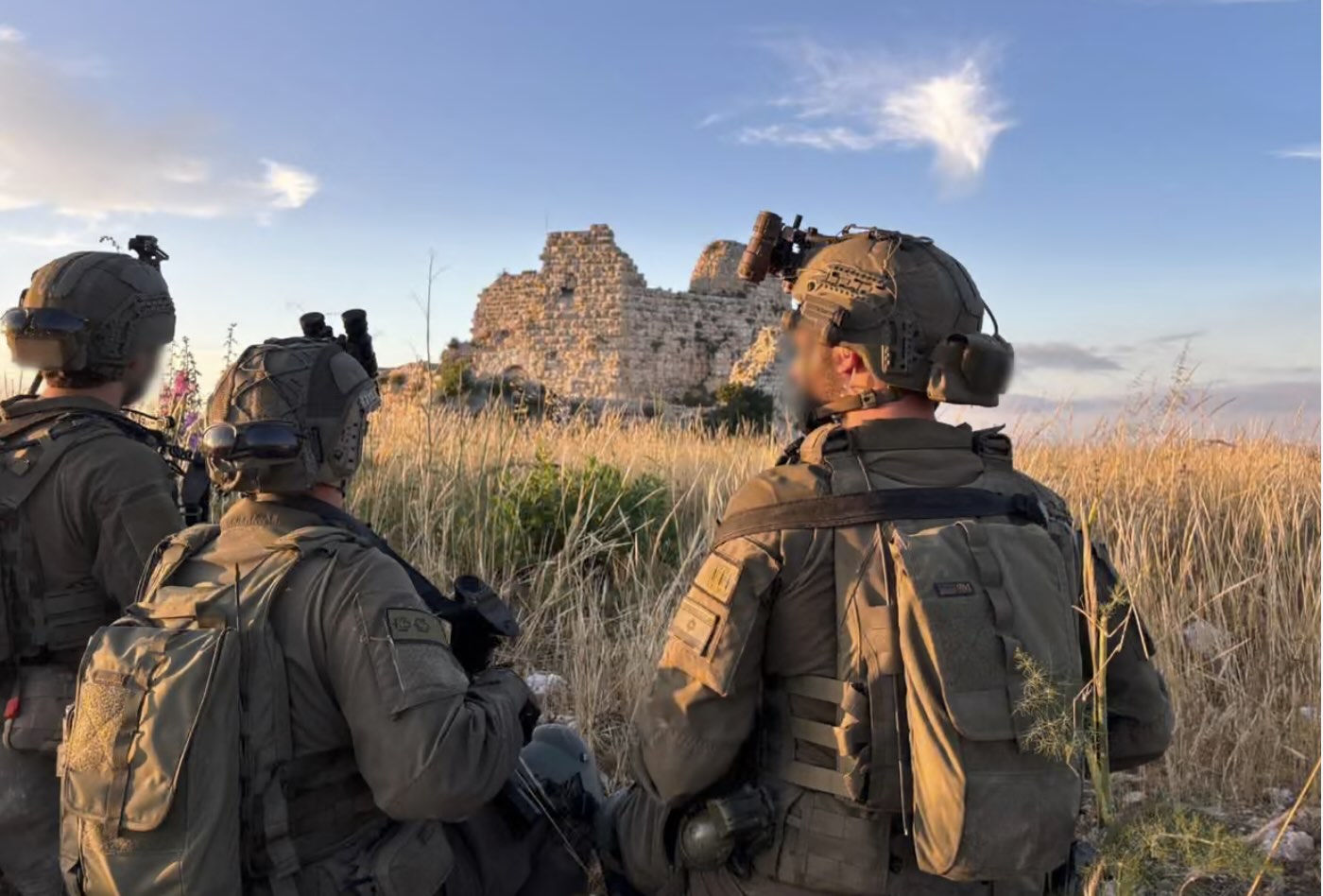
Israeli troops have captured Beaufort Castle and its surrounding ridge in southern Lebanon, marking one of the most significant advances against Hezbollah since the latest ceasefire was announced more than six weeks ago.
The Israeli military said on Sunday that its forces had seized the 900-year-old hilltop fortress and adjacent high ground near Nabatieh after days of fighting in the area. According to Reuters, the operation followed heavy Hezbollah rocket fire into northern Israel and forms part of a wider Israeli effort to weaken the group’s infrastructure in the Beaufort Ridge and Wadi al-Saluki area.
The significance of the advance lies in geography as much as symbolism. Beaufort Castle, built during the Crusader period and later used by multiple forces operating in southern Lebanon, sits on commanding terrain overlooking parts of southern Lebanon and northern Israel. Its ridge gives military value to whoever controls it, particularly in a conflict shaped by observation, anti-tank fire, drones, rockets and artillery.
The move also carries historical weight. Israel held parts of southern Lebanon from 1982 until its withdrawal in 2000, and Beaufort Castle became one of the better-known positions linked to that long occupation. Its capture now, more than a quarter of a century later, is likely to be read in Lebanon not only as a tactical action but as a renewed Israeli push into territory that remains politically sensitive.
The operation comes despite a ceasefire declared in April after a period of wider regional escalation involving Israel, Iran and Hezbollah. The ceasefire has not produced a stable end to fighting along the northern front. Instead, it has left a pattern of continuing strikes, retaliation and localised ground operations. AP described the capture as Israel’s deepest incursion into Lebanon in 26 years, underlining the extent to which the ceasefire has been overtaken by events on the ground.
Israel’s stated objective is to dismantle Hezbollah positions and reduce the threat to northern communities. Hezbollah’s fire into northern Israel has kept pressure on civilians, schools and local authorities, while drones and rockets have forced restrictions and disruptions. Israeli officials argue that the group’s presence close to the border remains incompatible with security for northern Israel.
Lebanon sees the operation differently. Israeli ground advances, airstrikes and evacuation orders deepen pressure on the Lebanese state, which has limited ability to restrain Hezbollah but is still responsible for the consequences of conflict on its territory. The Lebanese government has pursued diplomacy, including through US-backed channels, but its capacity to impose security arrangements in the south remains constrained.
That imbalance is central to the crisis. Hezbollah is not the Lebanese state, but its military infrastructure has repeatedly drawn Lebanon into conflict with Israel. Israel, in turn, is acting militarily inside Lebanese territory while arguing that the Lebanese state has failed to prevent Hezbollah from operating there. This leaves diplomacy trying to manage a confrontation in which one of the main armed actors is not fully controlled by the government nominally responsible for the territory.
For Europe, the development matters because southern Lebanon is not an isolated front. It is tied to Iran’s regional network, Israel’s security doctrine, the stability of the eastern Mediterranean and the wider risk of escalation affecting energy prices, shipping routes and diplomatic engagement with the Middle East. A renewed Israeli ground presence beyond limited border areas would further complicate any attempt to restore a durable ceasefire.
The timing is also important. US-brokered security talks are expected to resume shortly, while international concern over the northern front has increased as fighting continues. A military advance into a symbolic and strategic position strengthens Israel’s position on the ground, but it may also make political compromise harder if Hezbollah and Lebanon treat the move as an occupation rather than a temporary security measure.
There is no simple diplomatic formula. Israel is unlikely to accept a return to a pre-war status quo if Hezbollah retains forward positions and rocket capacity close to the border. Hezbollah is unlikely to accept Israeli control of prominent Lebanese terrain without seeking to contest it. Lebanon’s government is caught between formal responsibility, limited coercive power and the risk of wider national damage.
The capture of Beaufort Castle therefore matters less as a single battlefield event than as a signal of where the conflict may be heading. It shows that the ceasefire remains fragile, that Israel is prepared to use ground forces to reshape the security zone in southern Lebanon, and that Hezbollah’s continued military presence near the border is likely to remain a trigger for escalation.
If the advance becomes temporary leverage before negotiations, it may still be folded into a broader security arrangement. If it becomes part of a longer Israeli military posture inside southern Lebanon, the April ceasefire will look less like a pause in hostilities and more like a failed attempt to contain a new phase of the conflict.
The immediate outcome will depend on whether the fighting around Nabatieh and the Beaufort Ridge expands, whether Hezbollah intensifies rocket and drone attacks, and whether Washington can extract security commitments that both Israel and Lebanon can present as enforceable. Until then, Beaufort Castle has become more than a military position. It is now a test of whether diplomacy can still keep pace with facts created by force.