 ByDefencematters.eu Correspondents
Russia has warned European states that they could become military targets if they host French nuclear-capable aircraft, in a further escalation of rhetoric around Europe’s nuclear deterrence debate.
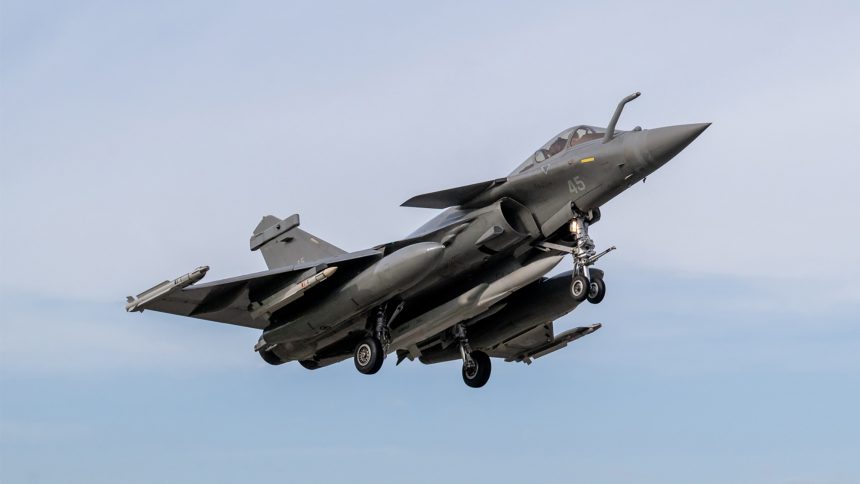
The warning was issued on 23 April by Russian Deputy Foreign Minister Alexander Grushko, who said that any European country accepting deployments of French nuclear-capable strategic bombers would be considered a target in the event of conflict. His remarks followed French discussions about a greater European role for France’s nuclear deterrent.
The statement comes amid a wider debate over whether France’s nuclear forces could contribute more directly to European security as the continent reassesses its defence posture.
French President Emmanuel Macron has said Paris is discussing possible arrangements with several European partners, including Britain, Germany, Poland, the Netherlands, Belgium, Greece, Sweden and Denmark. The issue is linked to wider concerns about Russia’s war against Ukraine, European defence readiness and the long-term credibility of deterrence in Europe.
France is the European Union’s only nuclear-armed member state. The United Kingdom also has a sovereign nuclear capability, but is outside the EU. Several NATO members in Europe participate in nuclear-sharing arrangements involving United States weapons. Russia has also placed nuclear weapons in Belarus and has long maintained nuclear-capable systems in and around its western military districts.
The French discussion is not a formal EU nuclear policy. France’s nuclear deterrent remains under national command, and Paris has historically guarded the independence of its nuclear decision-making. However, French governments have also argued that the country’s vital interests have a European dimension, particularly where the security of the continent is concerned.
The latest Russian warning is therefore aimed at both France and potential host countries. Moscow has framed any such deployments as part of an expansion of NATO’s nuclear potential. That position is consistent with Russia’s wider opposition to increased European military cooperation with Ukraine and to NATO’s strengthened eastern posture.
The warning does not in itself change the military balance. No publicly confirmed deployment of French nuclear-capable aircraft to partner states has been announced. Nor has France transferred nuclear command, control or weapons to other European states. The issue remains at the level of political consultation and deterrence signalling.
Even so, the statement is significant because it shows how quickly European deterrence discussions are being folded into the wider confrontation between Russia and NATO. Since Russia’s full-scale invasion of Ukraine in 2022, nuclear rhetoric has become a recurring element of Moscow’s public messaging. European governments have responded by increasing defence spending, strengthening NATO deployments and reopening debates that had been politically limited before the war.
For France, the question is how far its nuclear deterrent can be presented as part of European security without diluting national control. Paris has previously invited European partners to engage in strategic dialogue on deterrence, but many practical questions remain unresolved. These include consultation mechanisms, basing arrangements, exercises, command authority, financing and the political risks for any participating state.
For potential host countries, the issue is equally sensitive. Hosting nuclear-capable aircraft, even without hosting nuclear weapons permanently, would carry political and security implications. It could strengthen deterrence signalling, but it would also expose governments to direct Russian threats and domestic political scrutiny.
The matter also intersects with NATO policy. The alliance already has nuclear planning structures, and the United States remains the main nuclear guarantor for NATO’s European members. Any French initiative would therefore need to be understood alongside existing NATO arrangements rather than as a simple replacement for them.
A recent UK parliamentary research briefing noted that the UK and France both maintain sovereign nuclear capabilities, while the United States continues to deploy nuclear weapons in several European NATO countries under nuclear-sharing arrangements. The same briefing also noted Russia’s reported deployment of nuclear weapons in Belarus, illustrating the broader nuclear context in Europe.
The renewed focus on French deterrence also comes as arms control between Russia and the West has weakened. The last major United States-Russia nuclear arms control treaty is approaching expiry, and prospects for a replacement remain uncertain. That raises the importance of signalling, transparency and crisis management, particularly as more European states discuss deterrence in national and regional terms.
Moscow declares freedom to expand nuclear arsenal after New START ends
For NATO and EU member states, the central issue is whether Europe can strengthen deterrence without increasing instability. Supporters of a greater French role argue that Europe needs additional strategic insurance as the security environment deteriorates. Critics may question whether wider nuclear consultation could provoke further Russian threats or create ambiguity over decision-making.
The practical consequences of the 23 April warning are likely to depend on whether Paris and its partners move from discussion to formal arrangements. If consultations remain political, Moscow’s statement may be treated largely as deterrence messaging. If deployments, exercises or basing agreements are later announced, the issue could become a more direct military and diplomatic flashpoint.
For now, the warning underlines the sensitivity of Europe’s nuclear debate. France is seeking to frame its deterrent in broader European terms, while Russia is signalling that any attempt to extend that role through host-country deployments would be treated as a direct security concern.