 ByDefencematters.eu Correspondents
France and Poland are considering a closer form of strategic defence cooperation, with nuclear deterrence now becoming part of discussions that until recently would have remained largely confined to national doctrine and NATO’s established nuclear arrangements.
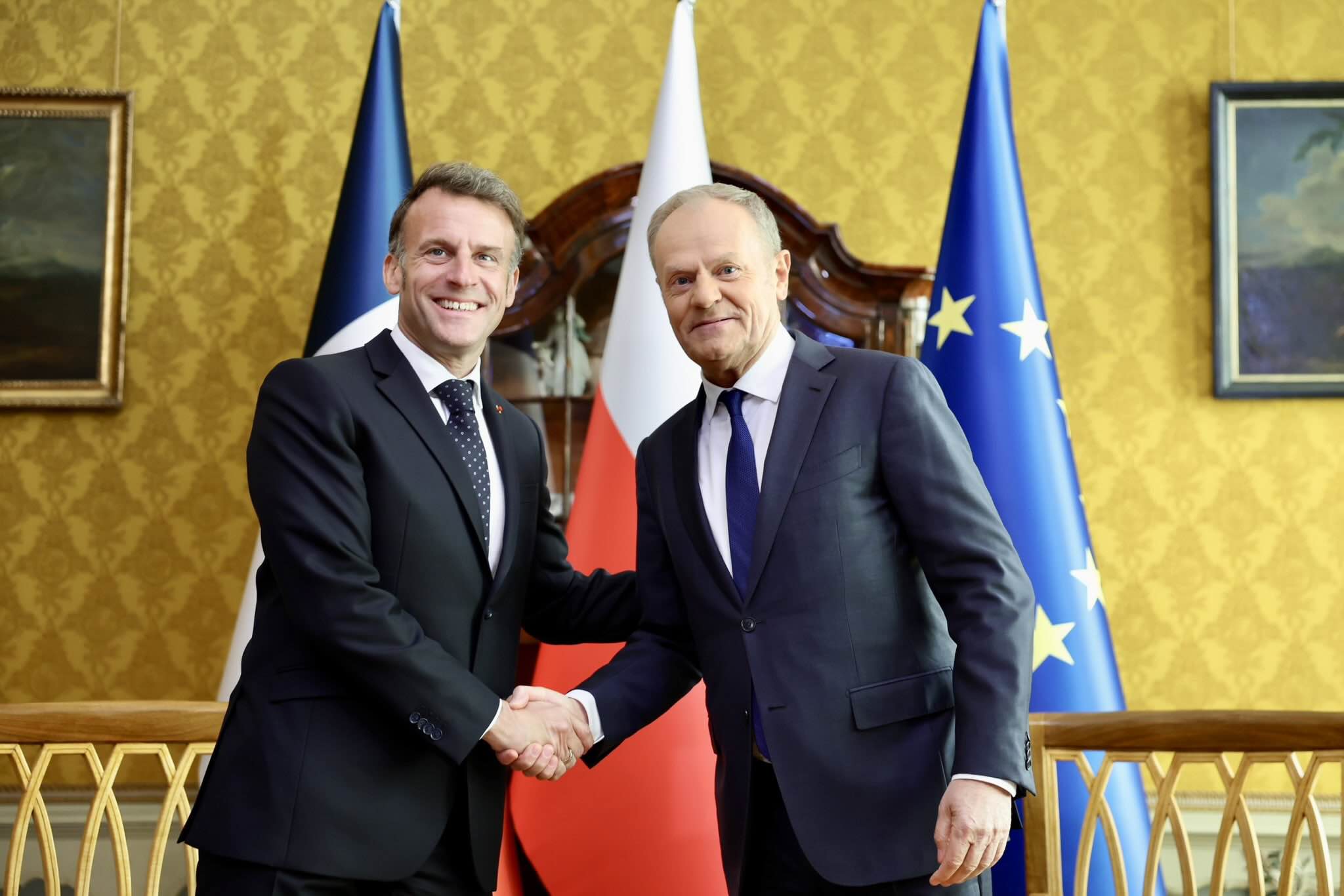
The issue came into focus after President Emmanuel Macron’s visit to Gdańsk on 20 April, where he met Polish Prime Minister Donald Tusk for a French-Polish intergovernmental summit. The two leaders discussed defence, nuclear deterrence, energy, military communications, and wider European security cooperation. The summit produced plans for a French-Polish military telecommunications satellite, while nuclear deterrence was also discussed as part of the wider strategic agenda.
According to Polish media reports, France and Poland are preparing joint air exercises over the Baltic Sea and northern Poland involving French Rafale aircraft capable of carrying nuclear-armed ASMP cruise missiles. The reported scenario would see Polish aircraft conducting reconnaissance and target-identification roles, while French aircraft would simulate nuclear deterrence missions against a potential adversary. Wirtualna Polska reported that the exercises would not involve permanent storage of French nuclear warheads in Poland, but would form part of a model of periodic deployment and joint training.
These claims require careful treatment. Publicly, Macron has confirmed that France is considering “exchanges of information” and “joint exercises” with Poland on nuclear issues. Tusk, however, also said that discussions on nuclear security cooperation would remain discreet, and joked that he would not want French Rafales carrying nuclear bombs over Poland, adding that he understood there were no such plans.
Even with those qualifications, the political direction is clear. Macron’s nuclear speech at Île Longue on 2 March set out what has been described as one of the most important adjustments to French nuclear doctrine since the end of the Cold War. A UK House of Commons Library briefing summarised the shift as a move towards “forward deterrence”, under which willing European partners could participate in French nuclear deterrence exercises, contribute conventional capabilities, and, in the longer term, host temporary deployments of French nuclear forces. The same briefing noted that nuclear decision-making would remain exclusively with the French president.
This is not NATO-style nuclear sharing. France does not participate in NATO’s nuclear planning mechanisms, and its nuclear forces are not formally assigned to NATO. The French deterrent remains sovereign. The change lies in the geographical and political framing: France is now presenting its deterrent less as a purely national instrument and more as a contribution to European security.
For Poland and other eastern-flank states, the attraction is evident. Russia’s war against Ukraine, its repeated nuclear signalling, and doubts about the durability of US security guarantees have led several European governments to examine whether Europe’s existing deterrence architecture is sufficient. Poland is not part of the US nuclear-sharing arrangement, and Warsaw has sought stronger deterrence options against Russia and Belarus.
For France, the move supports Macron’s long-standing argument that Europe must assume greater responsibility for its own defence. It also gives practical content to the idea of European strategic autonomy, not as a replacement for NATO, but as a reinforcement of Europe’s ability to act within a less predictable transatlantic environment.
The military implications are significant. French Rafale aircraft equipped for nuclear missions, if temporarily deployed or exercised closer to NATO’s eastern flank, would alter Russia’s operational calculations. Aircraft operating from or near Poland would bring targets in western Russia and Belarus within a more immediate deterrence framework. That does not mean France is preparing a nuclear strike; it means Paris is considering how to make its deterrent more visible, flexible, and relevant to allies exposed to Russian pressure.
The political risks are also clear. Moscow has warned European states against hosting French nuclear-capable aircraft, saying such moves would make them targets in a conflict. Russian Deputy Foreign Minister Alexander Grushko described potential deployments as contributing to NATO’s military build-up and said Russia would adjust its target planning accordingly.
Russia warns European states against hosting French nuclear-capable aircraft
The French-Polish discussions therefore mark more than another bilateral defence initiative. They indicate a possible redefinition of Europe’s nuclear landscape, with France moving from declaratory solidarity towards practical deterrence cooperation with selected partners.
The central question is not whether France has abandoned its sovereign nuclear doctrine. It has not. The question is whether French nuclear deterrence is now being placed at the centre of a broader European security architecture. On the evidence of Macron’s March speech, the Gdańsk discussions, and the reported planning for joint exercises, the answer is increasingly yes.