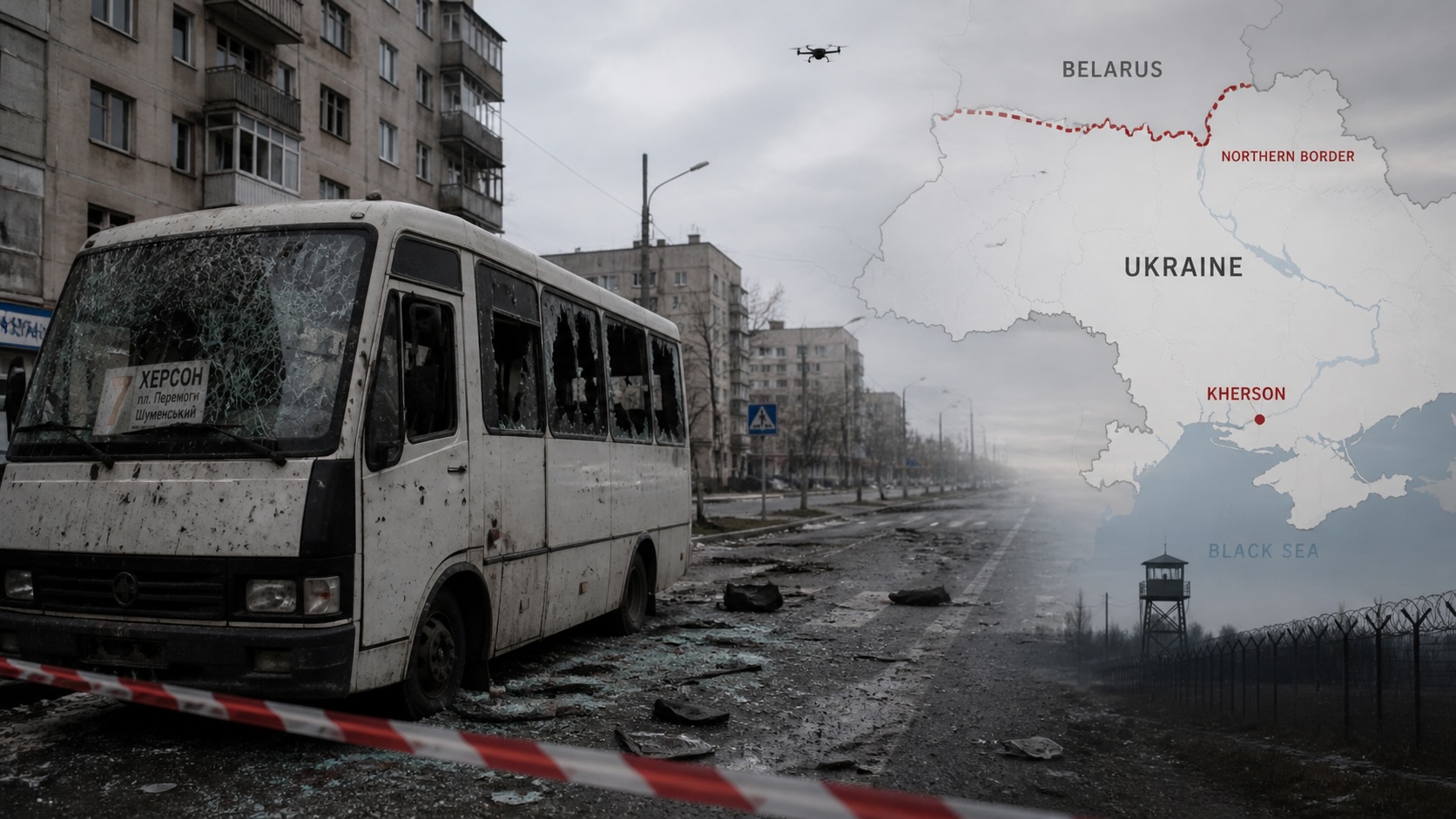
A Russian drone strike on a civilian minibus in Kherson has killed two people, as Ukraine also reported unusual activity on the Belarusian side of its northern border.
The attack on the minibus took place on 2 May in Kherson, a southern Ukrainian city that has remained under repeated Russian fire since its liberation in 2022. Local authorities said the strike hit public transport in the city’s Dniprovskyi district, killing two people and wounding several others. Hours later, another minibus was struck in Kherson, injuring its driver.
The incident was confirmed in President Volodymyr Zelenskyy’s evening address on 2 May. Zelenskyy said he had received a report from Interior Minister Ihor Klymenko on the work of emergency services after Russian strikes. He said drones had targeted civilian transport in Kherson and that passenger minibuses had been hit.
Kherson has become one of the most exposed cities in Ukraine’s south. Russian forces withdrew from the city in November 2022 but remained on the opposite bank of the Dnipro River, from where they have continued to shell and strike civilian areas. Drones have added another layer of danger, allowing Russian forces to target vehicles, streets and individual movements across the city.
The targeting of public transport has a particular effect in a front-line urban environment. Minibuses remain part of daily civilian life, carrying workers, pensioners and residents who often have few alternatives. A drone strike against such a vehicle is not only a casualty-producing incident; it disrupts movement, discourages essential travel and increases pressure on municipal services already operating under wartime conditions.
The same day, Zelenskyy also drew attention to Ukraine’s northern frontier. He said that on 1 May there had been “rather peculiar activity” on sections of the border with Belarus, on the Belarusian side. He did not give operational details, but said Ukraine was recording and monitoring the situation and would respond if necessary.
The timing matters. Belarus has been a central part of Russia’s military geography since the start of the full-scale invasion. Russian forces used Belarusian territory during the opening phase of the invasion in February 2022, including for the northern advance towards Kyiv. Minsk has also allowed Moscow to use Belarusian territory for military purposes, while remaining formally outside direct combat operations.
That does not mean a renewed northern ground threat is imminent. Zelenskyy’s statement gave no indication of an immediate attack, and no detailed Ukrainian military assessment was published alongside it. The available information supports a more cautious conclusion: Ukraine has detected activity it considers unusual and is publicly signalling that the border is being watched.
Even so, such warnings have operational significance. Ukraine must defend a long front in the east and south while maintaining forces, surveillance and contingency planning along its northern border. Any credible sign of pressure from Belarusian territory forces Kyiv to consider whether Russia is trying to stretch Ukrainian attention and resources.
The Kherson strike and the Belarus border warning are different kinds of development, but they point to the same military reality. Ukraine is facing pressure not only along the front line, but also through strikes on civilians, disruption of urban life, attacks on infrastructure and the possibility of diversionary activity elsewhere.
In Odesa, Russian strikes also damaged port infrastructure on 2 May, according to current accounts of the day’s attacks. No casualties were reported there. The combination of attacks on Kherson, damage in Odesa and monitoring along the Belarusian border gives a snapshot of the breadth of Ukraine’s security problem: civilian areas in the south, Black Sea logistics and the northern frontier all remain in play.
For Ukraine’s partners, the immediate issue is air defence and counter-drone capability. Kherson’s problem is not only missile defence or protection against large drone swarms. It is also the more granular threat of smaller drones used against vehicles, repair crews and civilian movement. That requires detection, electronic warfare, localised protection, rapid medical evacuation and sustained support for municipal services.