

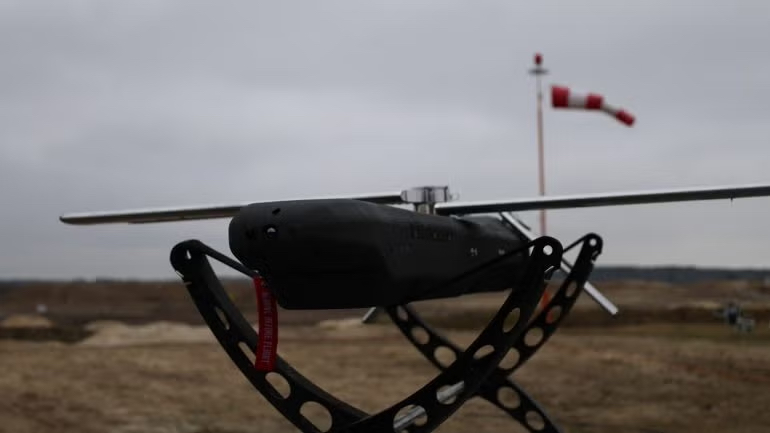
The Ministry of Defence confirmed that the system, has been trialled in Jordan, marking a significant milestone in the UK’s response to the proliferating threat posed by Iranian-designed Shahed-style attack drones.
The tests coincided with a regional visit by the Minister for Defence Readiness and Industry, Luke Pollard, who travelled to both Kuwait and Jordan. His visit was not merely ceremonial. It served as a pointed reminder of Britain’s growing military footprint in a region where aerial threats—once sporadic—have become relentless.
At the heart of the development lies a stark strategic calculation. The Middle East conflict has underscored the vulnerability of both fixed installations and mobile forces to relatively inexpensive, mass-produced drones. These weapons, often deployed in swarms, have challenged even sophisticated air defence systems by exploiting cost asymmetry: cheap to launch, but expensive to intercept.
Skyhammer seeks to redress that imbalance.
Developed by the British start-up Cambridge Aerospace, the interceptor is designed specifically to counter these drone threats with greater efficiency and at lower cost than traditional surface-to-air missile systems. Its successful trial suggests that Britain is edging closer to a scalable solution—one capable not only of defending its own forces but also of reinforcing the air defences of key Gulf allies.
The timing is hardly coincidental. British personnel and assets in the region have come under increasing pressure in recent months, with Iranian missile and drone attacks targeting bases and infrastructure across multiple देशों. The UK has already responded by bolstering its military presence, deploying additional air defence systems and personnel to support allied nations.
Pollard’s meetings with regional leaders were therefore as much about reassurance as they were about strategy. He praised the role played by UK forces in helping partners defend their skies, particularly during the height of recent hostilities, prior to a fragile ceasefire.
Behind the diplomatic language lies a more hard-edged reality. The contest for air superiority in the Middle East is increasingly defined not by high-end fighter jets, but by the ability to neutralise persistent, low-cost aerial threats. In that contest, interceptor missiles such as Skyhammer may prove decisive.
There is also a domestic dimension. The programme reflects a broader push by the government to harness British innovation in defence manufacturing. Cambridge Aerospace, a veteran-founded start-up, represents precisely the kind of agile, technology-driven enterprise that ministers are keen to champion.
Indeed, the rapid progression from contract award to successful testing—within a matter of weeks—speaks to an urgency that would have been unthinkable in peacetime procurement cycles. It also underscores a shift in defence thinking: away from long timelines and towards rapid, iterative development in response to real-world threats.
Initial deliveries of the interceptor system are expected imminently, with both UK forces and Gulf partners set to benefit. Reports suggest that hundreds of missiles could be deployed in the region within weeks, reinforcing a layered air defence network already under strain.
Yet questions remain. While Skyhammer appears well-suited to countering drones, critics have pointed out that Britain’s capability against more advanced ballistic missile threats remains limited—a gap that could prove significant should the conflict escalate further.
For now, however, the successful trial represents a tangible step forward. It signals not only a technological advance but also a strategic intent: that Britain intends to remain an active—and capable—player in the defence of Middle Eastern airspace.
In a theatre where the skies have become increasingly contested, the quiet arc of an interceptor missile may yet prove one of the most consequential developments of all.
Main Image: Cambridge Aerospace.

Ukraine’s Defence Industry and Its European Future