Ukrainian forces have released footage of what they describe as a fully robotised operation against a Russian position in Kupiansk, offering a detailed example of how unmanned ground systems are moving from support roles into direct assault operations.
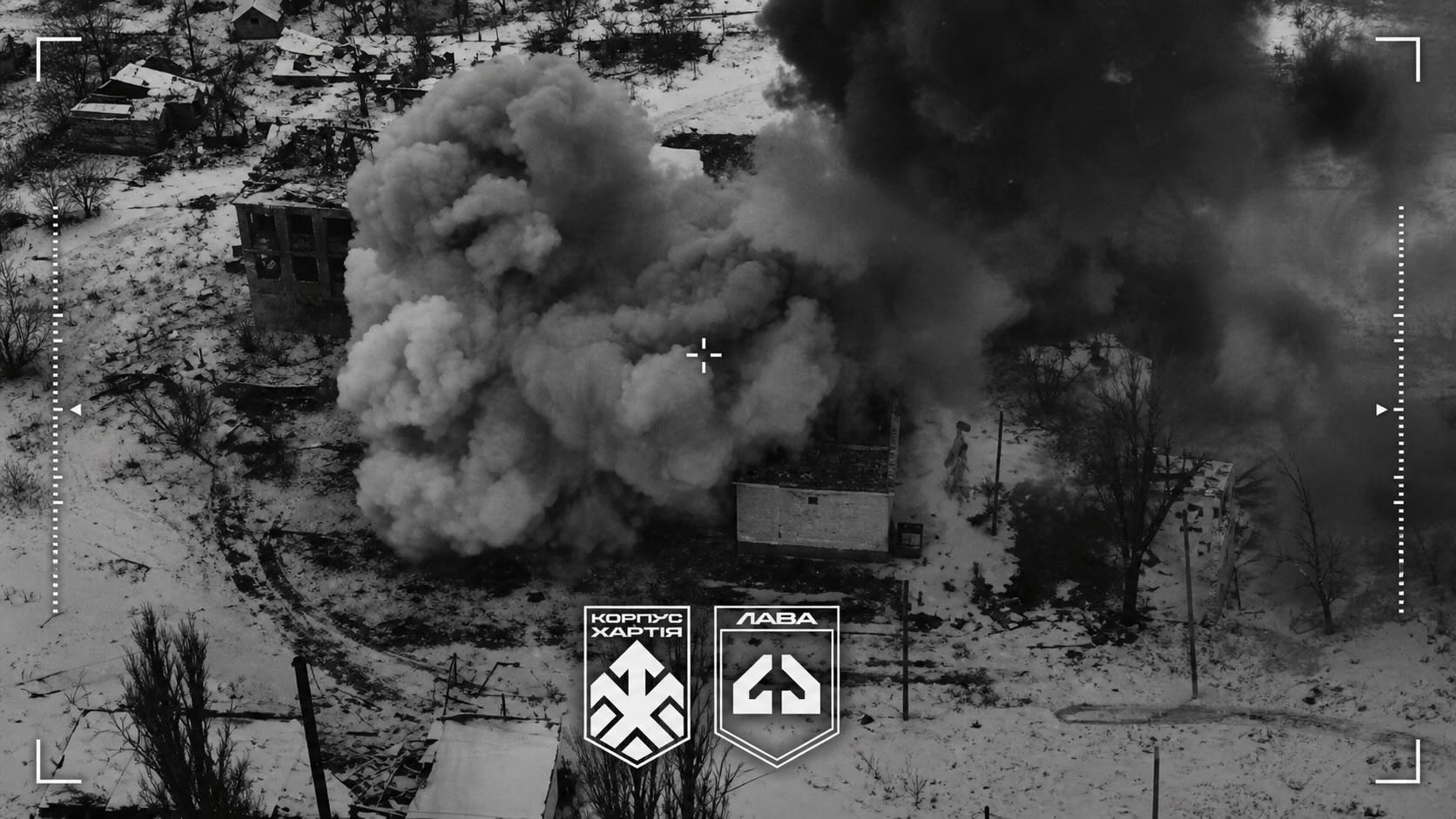
The operation was carried out by the Lava Regiment of the 2nd Khartiia Corps of Ukraine’s National Guard. According to the unit’s public account, Russian troops had taken up positions inside a building in the city, which they were using as a strongpoint. The Ukrainian side said the position was destroyed without deploying infantry directly onto the battlefield.
The footage, published through Khartiia’s official channel, shows unmanned systems being used in a coordinated strike against the building. Public descriptions of the operation state that Ukrainian forces used several types of drones and robotic platforms, including strike systems fitted with grenade launchers and kamikaze drones carrying explosives.
The Ukrainian account said the Russian strongpoint was destroyed, personnel were eliminated and an ammunition depot was hit. Those battlefield claims cannot be independently verified from the public footage alone. However, the video and accompanying statements provide a clear indication of the tactical method: reconnaissance, target confirmation, ground-based robotic movement, close-range fire and explosive delivery without a conventional infantry assault.
The significance lies less in a single engagement than in the direction of travel. Ground robots have already been used in Ukraine for medical evacuation, logistics, mine-laying, explosive delivery and casualty extraction. The Kupiansk operation shows them being integrated into an offensive sequence against a fortified position in an urban environment.
That matters because urban fighting remains among the most dangerous forms of combat. A building held by infantry can be difficult to clear without exposing assault troops to machine-gun fire, mines, drones, artillery and close-range ambush. Tanks and armoured vehicles can deliver heavier fire, but in Ukraine they are increasingly vulnerable to first-person-view drones, loitering munitions and artillery correction from the air.
Unmanned ground vehicles offer a different trade-off. They can approach positions that would be hazardous for soldiers, carry heavier payloads than small quadcopters, and deliver fire or explosives at close range. If they are lost, the immediate cost is material rather than human.
That does not make them simple weapons. A successful robotic assault still requires reconnaissance, secure communications, engineering support, operators, maintenance crews and coordination with aerial drones. Khartiia’s own statement stressed that, although no soldier was deployed directly onto the battlefield, dozens of personnel were involved behind the scenes, including planners, reconnaissance teams, operators, engineers, mechanics and communications specialists.
This point is important. The operation was not an autonomous machine action. It was a human-directed military operation using robotic systems as the means of contact with the target. The distinction matters for understanding both its battlefield value and its limits.
Kupiansk is also a relevant setting. The city in Kharkiv Oblast has been under sustained pressure, with fighting around urban and semi-urban positions where small Russian groups can establish themselves inside buildings. Clearing such points is labour-intensive and dangerous. If robotic systems can reduce the need for infantry to enter exposed approaches or buildings, they may change the cost of local assaults.
The operation also reflects Ukraine’s broader investment in unmanned systems. The Lava unit, originally formed as an unmanned systems battalion in 2025 and later expanded into a regiment, works with aerial drones, strike systems and unmanned ground vehicles. Ukrainian commanders have increasingly presented robotics as a way to compensate for manpower constraints and reduce losses.
The available evidence does not support sweeping conclusions that ground robots will replace infantry or decide the war on their own. They remain vulnerable to jamming, loss of signal, mines, direct fire, terrain obstacles and electronic warfare. Their performance in a controlled night operation against an isolated position does not automatically translate into every battlefield setting.
But the Kupiansk assault does show a practical battlefield use case. It combines aerial reconnaissance, ground robotic platforms and explosive payloads in a way that avoids exposing Ukrainian infantry during the most dangerous phase of the attack. That is a meaningful development in a war where both sides are constantly adapting to drone saturation and the difficulty of moving troops under observation.
For Ukraine’s partners, the lesson is also industrial. Ground robotics are no longer experimental accessories. They are becoming consumable frontline systems that require production capacity, spare parts, communications links, batteries, repair workshops and trained operators. Their value depends on scale as much as innovation.
The public record should still be read carefully. Some claims circulating around the operation go beyond what the footage alone can prove. What can be said with confidence is narrower but still important: Ukraine’s Lava Regiment says it used unmanned systems to destroy a Russian strongpoint in Kupiansk without placing infantry directly on the battlefield. If such operations become routine, they will mark a further shift in how Ukraine conducts close combat under drone-dominated conditions.