Instead, what we have from Sir Keir Starmer’s government is something altogether more familiar: hedging, euphemism, and a carefully curated narrative that dilutes the nature of the threat in the hope of avoiding political discomfort.
The official line is revealing. The increase in danger, we are told, stems from both Islamist extremism and the “extreme right wing.” This is technically true — but it is also a masterclass in misdirection. For while Britain undoubtedly faces a spectrum of threats, recent events tell a far more specific and troubling story.
Consider what has actually happened over the past three years.
Jewish communities — not abstract “communities”, but flesh-and-blood British citizens — have been targeted with a frequency and ferocity that should shame any government into plain speaking. Synagogues have been attacked. Worshippers murdered. Individuals assaulted in the street for the crime of being visibly Jewish.
Only days ago, two Jewish men were stabbed in Golders Green in what police have treated as a terrorist incident. This was not an isolated act of madness. It forms part of what senior figures have described as a “sustained campaign of violence and intimidation” against British Jews.
And yet, even in the face of such a pattern, the government strains to balance the narrative — to insist that the threat comes equally from all directions, as though doing so were a moral necessity rather than a political calculation.
It is not.
The uncomfortable reality is that the overwhelming proportion of recent antisemitic violence in Britain has been driven by Islamist ideology, often inflamed by events in the Middle East and amplified on the streets of British cities. Since the Hamas attacks of October 2023, antisemitic incidents have surged dramatically, with thousands recorded annually.
This is not conjecture; it is data.
Nor is it merely about rhetoric or online bile. The violence has been physical, organised, and, in some cases, deadly. The arson attack on Jewish ambulances — vehicles dedicated to saving lives — marked a particularly grotesque escalation. If burning ambulances serving Jewish communities does not qualify as ideological hatred in action, one wonders what does.
Yet instead of confronting this directly, ministers reach reflexively for the comfort blanket of equivalence. Islamist extremists and “far-right” actors are presented as twin pillars of the threat landscape, interchangeable in their menace.
But they are not interchangeable — not in scale, not in organisation, and not in their current impact on British streets.
To say this is not to deny the existence of far-right extremism, which remains real. It is to insist on proportionality. Governments exist to prioritise threats, not to flatten them into politically convenient symmetry.
Why, then, the reluctance?
Partly, it is fear — fear of inflaming community tensions, fear of accusations of prejudice, fear of saying aloud what many in the security services will privately acknowledge. But partly, too, it is a deeper malaise: the modern political class’s inability to speak plainly about Islamist extremism without immediately qualifying, caveating, and diluting its own argument. It may also be to avoid losing the Muslim vote, which in many inner cities such as Birmingham, Bradford, London et al, is vital to the Labour Party.
The result is a form of institutional cowardice.
This matters, because misdiagnosing a threat is not a victimless error. It has consequences — real, tangible, and potentially fatal. If resources, attention, and political capital are spread too thinly across an artificially balanced threat picture, the areas of greatest danger risk being under-addressed.
Put bluntly: if you refuse to name the primary driver of a surge in antisemitic violence, you will struggle to stop it.
Even the government’s own statements hint at the truth they will not fully articulate. Officials acknowledge that Jewish and Israeli individuals are being targeted, and that state-linked actors and ideological movements are fuelling this hostility. The evidence is there, hiding in plain sight.
But the political framing remains stubbornly evasive.
Sir Keir himself has spoken movingly of British Jews being afraid to display their identity openly. He is right to do so. But empathy, however sincere, is no substitute for strategy. And strategy begins with honesty.
The British public, meanwhile, is not blind. They can see the pattern of attacks. They can see the footage from demonstrations where chants blur into incitement. They can see which communities are bearing the brunt of violence.
What they are not being given is a government willing to connect those dots without flinching.
There is, of course, a political temptation to broaden the narrative — to speak of “all extremisms” and “all forms of hate” in the hope of appearing even-handed. But even-handedness is not the same as effectiveness. A doctor who treats every illness as equally urgent will save fewer lives than one who recognises which patient is bleeding out.
Britain today is bleeding confidence — confidence in its ability to maintain order, to protect minorities, and to confront threats without fear or favour.
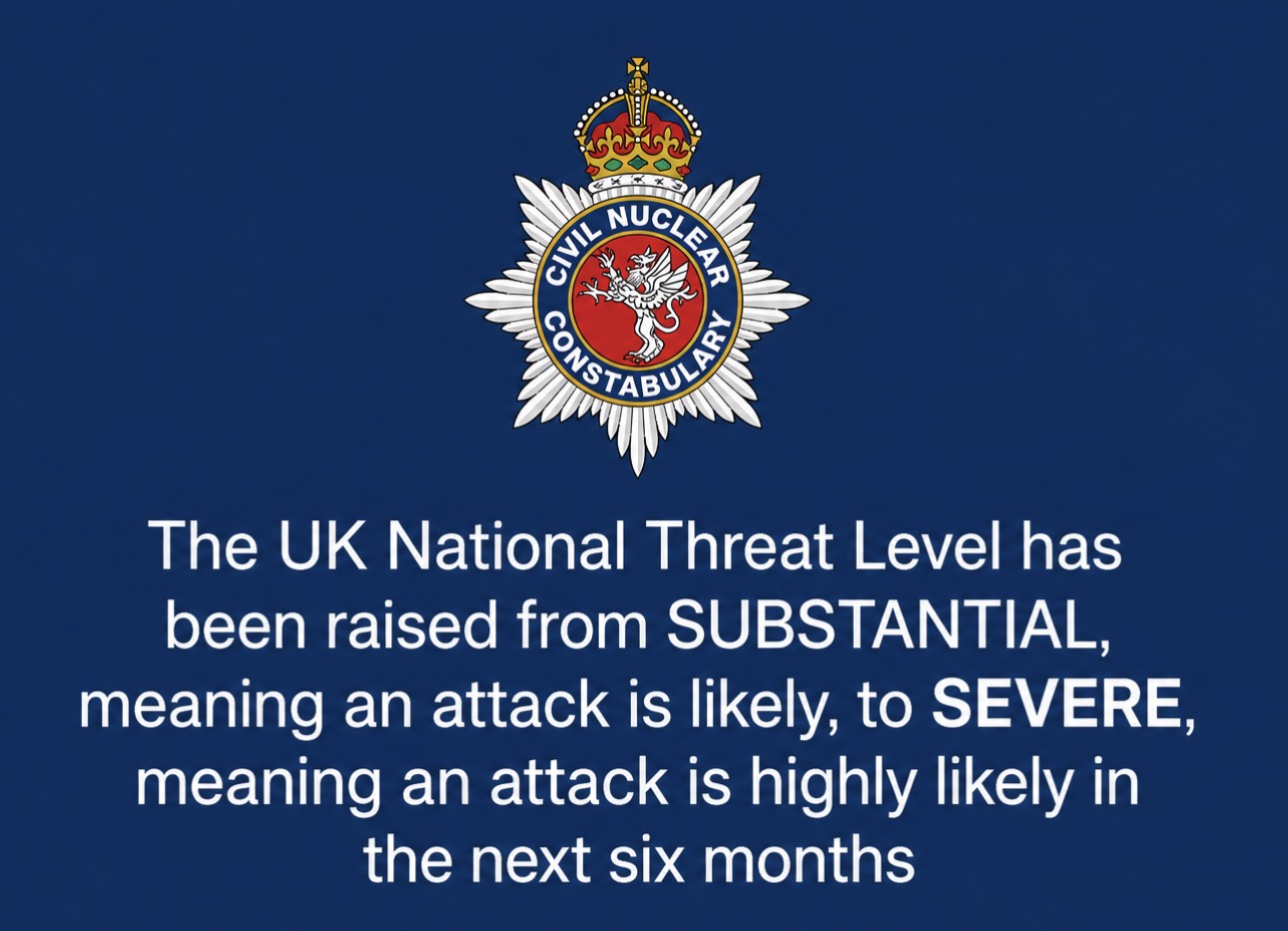
Raising the threat level to “severe” is an admission that something has gone badly wrong. But it is only a first step. Without a clear-eyed assessment of what is driving that threat, it risks becoming little more than a symbolic gesture.
The lesson of the past three years is stark. Violence against Jews has escalated not in a vacuum, but in a climate where certain ideologies have been allowed to fester, rationalised as political expression or excused as the by-product of distant conflicts.
That indulgence must end.
Protecting the British public — all of it — requires more than platitudes and balanced statements. It requires the political courage to identify the most immediate dangers and to act decisively against them.
Neutralising the real threat, rather than obscuring it, is not controversial. It is the basic duty of government, and that duty is not being fulfilled by Keir Starmer’s government.
Until that duty is met, the raising of the threat level will stand not as a sign of strength, but as a quiet admission of failure.