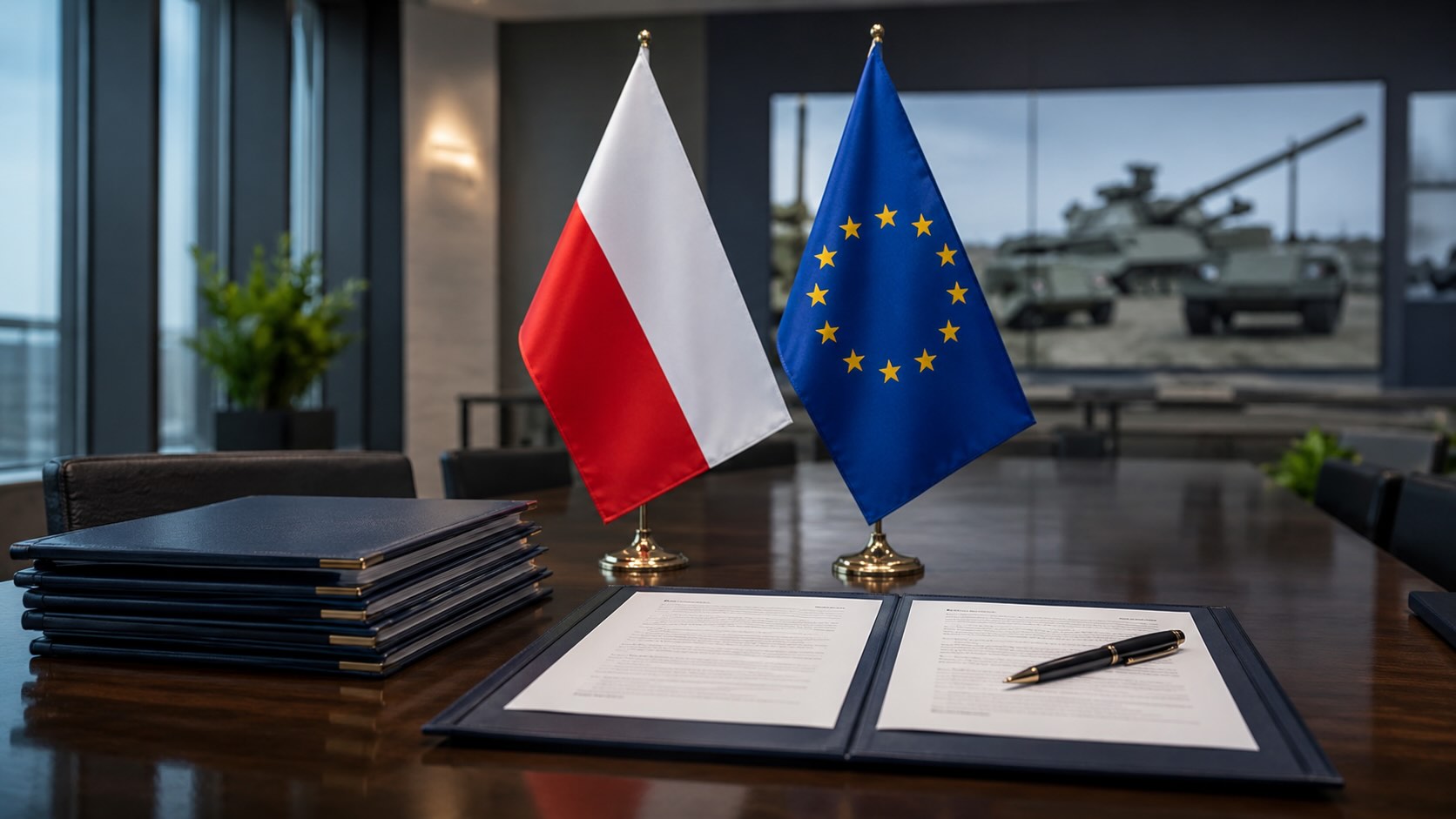
Poland has become the first European Union member state to sign a loan agreement under the bloc’s Security Action for Europe defence financing instrument, securing access to €43.7bn for military procurement and industrial investment.
The agreement, signed in Warsaw on Friday, places Poland at the front of the EU’s new defence-lending programme, designed to provide up to €150bn in long-maturity loans for urgent military investment by member states.
The European Commission describes SAFE as the first pillar of its wider ReArm Europe, or Readiness 2030, agenda. The instrument is intended to accelerate procurement, reduce fragmentation between national programmes, and support Europe’s defence industrial base through common purchasing and longer-term financing.
Poland is the largest single beneficiary of the scheme. According to the Commission’s published allocation table, Warsaw has been assigned €43,734,100,805, well ahead of the next largest recipients. Romania is listed at €16.68bn, France at €15.09bn and Italy at €14.9bn.
The signing is significant because it turns SAFE from an approved EU policy mechanism into an operational financing channel. Until now, the programme had been defined by allocations, national defence investment plans and institutional decisions. Poland’s agreement opens the way for pre-financing and subsequent procurement spending, subject to the agreed terms.
SAFE was adopted by the Council in May 2025 and is structured around EU borrowing, with funds passed on to member states as loans. The Commission says the model allows countries to benefit from the EU’s credit standing and to finance large-scale defence projects over longer periods than would normally be available through national budget cycles.
The programme covers a defined list of capability areas. These include ammunition and missiles, artillery systems, ground combat capabilities, small drones, counter-drone systems, critical infrastructure protection, cyber, military mobility, air and missile defence, maritime capabilities, electronic warfare, artificial intelligence, space assets and strategic enablers.
For Poland, the agreement comes at a time of sustained defence expansion. Warsaw has sharply increased military spending since Russia’s full-scale invasion of Ukraine and has pursued major procurement programmes involving tanks, artillery, air defence and other heavy equipment. Poland’s geography, bordering Ukraine, Belarus and Russia’s Kaliningrad exclave, gives the country a central role in NATO’s eastern flank planning.
The Commission’s rules state that SAFE projects should generally be based on common procurement involving at least one SAFE beneficiary and another member state, Ukraine or an EEA-EFTA country. The instrument also allows Ukrainian and EEA-EFTA defence industries to participate on equal terms in joint procurement, while other trusted partners may be included where agreements are in place.
At the same time, SAFE includes industrial-origin conditions. Across both main categories of procurement, no more than 35 per cent of component costs may originate from outside the EU, EEA-EFTA countries or Ukraine. For more complex systems, including air and missile defence, maritime systems, larger drones, electronic warfare and strategic enablers, contractors must also be able to modify equipment without restrictions imposed by non-EU actors.
That requirement is central to the political purpose of the scheme. SAFE is not only a borrowing mechanism; it is also an attempt to steer European defence spending towards European-controlled supply chains. For Poland, which has bought extensively from the United States and South Korea, the practical balance between urgent capability needs and European industrial conditions will be closely watched.
The agreement also has domestic political significance in Warsaw. Poland’s government had pushed ahead with the SAFE process despite a veto earlier this year by President Karol Nawrocki of legislation intended to facilitate the use of the funds. The government moved to proceed through alternative legal and budgetary routes, arguing that the loans were necessary for defence readiness.
For Brussels, Poland’s signature provides an early test case for whether the EU can move defence financing at the speed demanded by member states facing immediate security pressures. For Warsaw, the issue is more concrete: whether EU-backed borrowing can help accelerate the acquisition of air defence, anti-drone systems, artillery, military mobility assets and other capabilities without waiting for slower annual budget cycles.
The wider question is whether SAFE can support defence output at scale. Europe’s challenge is no longer limited to approving higher defence spending. It also concerns production capacity, procurement co-ordination, stockpile replenishment, and the ability of industry to deliver equipment within operationally useful timelines.